Lesson 04 · 90 minutes · 13 parts
Advertising
Advertising as a campaign: the objective, choosing a channel, creative (half of the effect), sponsorship and merchandising, tools and metrics. What works in B2B logistics and in sports, with Czech numbers from 2024 to 2026.
This lesson has no English narration yet. The Czech version is narrated.
What you will take away
- -Distinguish the campaign objective (brand, direct response, public interest) and choose a channel and a metric to match it.
- -Explain why creative decides roughly half of the effect and targeting only a tenth.
- -Describe the Czech advertising landscape in numbers: market size, the internet’s share, Seznam vs. Google, the limits on Czech Television (ČT).
- -Tell B2B advertising from B2C and apply the 95:5 rule.
- -Calculate CPM, CTR, CPC, CPA and ROAS on a specific budget.
- -Know the rules of the game: the Advertising Regulation Act, the RPR Code, labeling of influencer collaborations.
Lesson plan
- 5 minIntro: how many ads we see · How many ads have you seen today? Students guess, then the definition of advertising and the measured numbers.
- 5 minStudent presentation · Bring one ad that caught your attention this week. Say what its goal is, who it’s for, and how you would tell whether it works.
- 11 minObjective and campaign · Three types of objectives, SMART, AIDA(S), 60:40, the campaign as a plan of attack, IMC and a six-line brief.
- 14 minChannels and placement · Forms of media, push vs. pull, the Czech market in numbers, where you may and may not place ads.
- 12 minCreative, psychology, B2B vs. B2C · Five keys to effectiveness (NCS), the elements of creative, ELM and banner blindness, the 95:5 rule.
- 15 minExercise: a mini campaign brief · Pairs, 12 minutes: hiring 30 warehouse workers for Modletice, or a summer judo camp. A six-line brief: objective (number and deadline), audience, one idea, channels, budget, KPI. Three pairs read theirs aloud (3 minutes).
- 12 minSponsorship, merch and tools · Chance Liga, activation, merchandising, ad platforms and the Ad Library live.
- 12 minMetrics and rules · CPM to ROAS on the board, benchmarks, the law, the Code, influencers, ad blockers.
- 4 minSummary and quiz · Five sentences to remember and five questions.
Contents
- 1Advertising: the most visible part of marketing
- 2Objective: what the ad should do
- 3The campaign as a plan of attack
- 4Forms of media: where advertising lives
- 5Where to place it: the Czech media market in numbers
- 6Creative makes half the effect
- 7The psychology of persuasion: two routes
- 8B2B vs. B2C: logistics and sports
- 9Sponsorship and merchandising
- 10Tools and workflows: what to use for what
- 11Metrics: what you don’t measure, you don’t manage
- 12Rules of the game: the law, the Code, influencers, ad blockers
- 13Summary: five sentences to remember
1Advertising: the most visible part of marketing
Paid, non-personal, from an identified sponsor
- ·AMA: paid, non-personal presentation of ideas, goods and services by an identified sponsor
- ·Informs, persuades, reminds
- ·Commercial and institutional (government, nonprofits, campaigns for a good cause)
- ·Advertising is not marketing: it’s one part of the P for Promotion
- ·How many ads have you seen today? Guess a number
The American Marketing Association defines advertising as the paid, non-personal presentation and promotion of ideas, goods and services by an identified sponsor. Four words carry the whole field: paid (someone paid and wants a result), non-personal (it speaks to the masses, so it needs media), presentation (a product, a service, an idea, an event) and identified sponsor (someone is accountable for it). Advertising informs, persuades and reminds. It can be commercial (to sell) or institutional (the brand of a company or a country, a campaign for a good cause).
Students often confuse advertising with marketing. Advertising is just one tool in the communication mix, alongside PR, sales promotion, personal selling, direct marketing and events; it’s only the most visible one. Where there is infrastructure, there is advertising: print, radio, television, search engines, social networks and now AI; every technology brought a new format.
And how many ads do we see a day? The famous 5,000 a day comes from a 2005 book by J. Walker Smith, where he merely listed marketers’ growing estimates (500, 2,000, 5,000) to illustrate saturation; journalists turned it into a measurement. In 2024, Smith himself wrote that the ads that really break through number fewer than 100 a day. In 2014, Media Dynamics counted roughly 360 ad exposures a day for an adult American, of which they notice 150 to 155; the often-quoted 12 remembered is just an estimate from the SJ Insights blog. For comparison: 5,000 ads over 16 waking hours is one every 11 seconds; 360 exposures is roughly one in just under three minutes.
There’s a lot of money in it. According to WARC, global ad spend reached $1.19 trillion in 2025; the market had already crossed the trillion-dollar mark in 2024. In December 2024, GroupM expected only $1.1 trillion for 2025: that is a forecast made in advance set against a later estimate of the actual figure, and every agency calculates the market a little differently. According to the Association of Communication Agencies (AKA), the Czech market was worth CZK 150.2 billion in net investment in 2024, roughly CZK 13,800 for each of the 10.9 million inhabitants, infants included.
- 5,000+
- ads a day: an illustration from 2005, not a measurement
- ~360
- ad exposures a day, we notice 150 to 155
- $1.19 tn
- global ad spend 2025, estimate
- CZK 150.2 bn
- net ad investment in Czechia 2024
J. Walker Smith, MediaPost 2024
Media Dynamics 2014
WARC, December 2025
AKA, estimate May 2025

For discussion
How many ads have you seen today? And how many of them can you recall, brand included?
Rabbit holes
- J. Walker Smith: What Viral Numbers Get Right ↗ · The author of the 5,000 figure explains how it came about and why it isn’t a measurement.
- SJ Insights: Media Dynamics and daily ad exposures ↗ · Roughly 360 exposures and 150 to 155 noticed according to Media Dynamics; the figures 362, 153 and the further stages are the blog’s own model.
- AKA: The Czech advertising market 2024 ↗ · CZK 150.2 billion in net investment and an estimate of CZK 160 billion for 2025 (in Czech).
2Objective: what the ad should do
Objective first, then everything else
- ·Three types by objective: brand, direct response, public interest
- ·SMART, a sample objective: a club wants +30% Instagram engagement in 6 months
- ·AIDA(S) from the Marketing lesson: each stage has its own KPI
- ·Response: cognitive (I see), affective (I feel), conative (I click)
- ·60:40: six parts to brand, four to sales (Binet and Field)
Advertising without an objective is just a pretty picture. By objective, we distinguish three kinds. Brand advertising builds identity and memory (Adidas: Impossible is Nothing). Direct response advertising wants immediate action: buy, sign up, call (the countdown to Amazon Prime Day). Public interest advertising promotes a social cause (FIFA’s campaigns against racism). The objective should be SMART (specific, measurable, achievable, relevant, time-bound): the sample “the club will increase Instagram engagement by 30% in six months” is an objective; “we want to be more visible” is not.
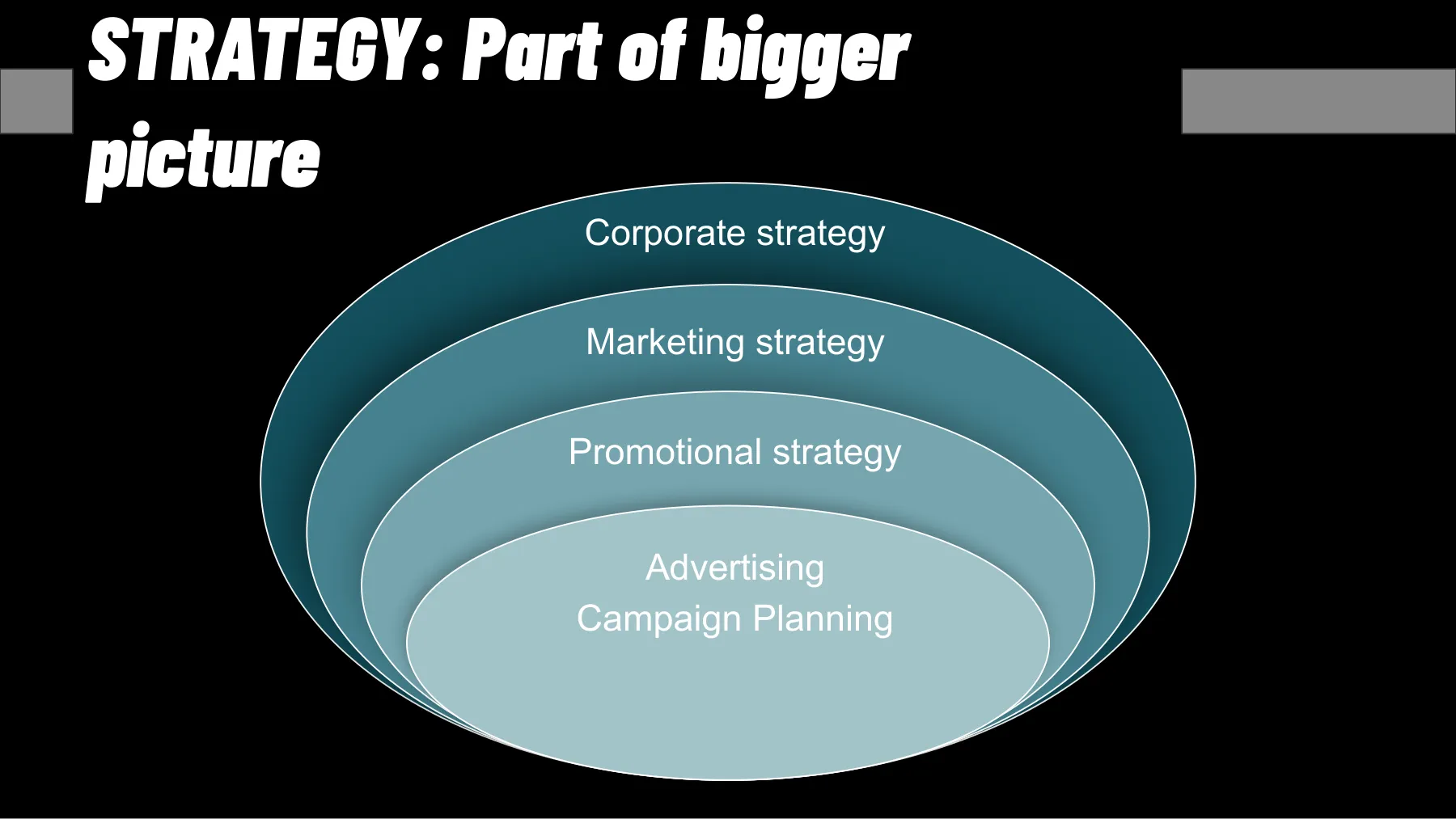
The objective doesn’t come out of nowhere. Strategy has layers: corporate strategy sets where the company is going, marketing strategy what it sells and to whom, communication strategy what it says about it, and only then do advertising and the campaign plan decide how it says it. When a logistics company wants more customers for its warehouses, the advertising objective is “50 inquiries from companies with more than 200 employees by the end of the quarter”, not “a LinkedIn campaign”. The campaign is a means.
The customer journey is described by the AIDA(S) model, which you know from the Marketing lesson. For advertising, the main takeaway is that each stage has its own key performance indicators, or KPIs: the numbers that tell you whether you’ve succeeded (see the list below). Psychology distinguishes three stages of response: cognitive (I see a billboard), affective (nostalgia in a Coca-Cola ad) and conative (I click “Buy”).
How do you split the money between brand and sales? The starting point is the 60:40 ratio from Les Binet and Peter Field: roughly 60% of the budget for long-term brand building, 40% for short-term sales activation (where the data came from and how it has shifted is covered in the Brand lesson). For campaign planning, the main lesson is this: don’t put everything into performance advertising just because it’s easy to measure.
- -Attention: impressions and awareness; the customer is looking for a solution to a problem.
- -Interest: website visits, newsletter signups; the customer discovers that a solution exists.
- -Desire: e-book downloads, clicks on a call to action (CTA); the customer reads and compares.
- -Action: purchases and closed deals.
- -Satisfaction: repeat purchases, referrals, reviews; without it, you pay for every customer all over again.
Rabbit holes
- IPA Effectiveness ↗ · The IPA’s hub on advertising effectiveness: the Effectiveness Awards, a database of 1,500 case studies since 1980 (EASE) and publications; Binet and Field drew on this databank.
- 60:40 summarized on one page ↗ · 996 campaigns, 60:40, emotion vs. arguments: the main findings without reading the whole book.
3The campaign as a plan of attack
Campaign: a series of messages with one idea
- ·Campaign: one idea and theme; IMC aligns all the tools and touchpoints
- ·Area fire, from the trenches, or targeted: three ways to shoot
- ·7 steps: objective, audience, channels, message, content plan, rollout, evaluation
- ·Flywheel: the UFC pays fighters, who draw viewers and sponsors
- ·A 6-line brief: objective, audience, idea, channels, budget, KPI
An advertising campaign is a series of advertising messages that share a single idea and theme. It is one part of integrated marketing communication (IMC): a planning approach that coordinates all the tools of the communication mix and all touchpoints so that the customer gets one consistent message. That is how the American Association of Advertising Agencies described it in 1989, and Don Schultz, Stanley Tannenbaum and Robert Lauterborn developed it in 1993. The emphasis is on the word integrated: the customer should get the same story in the same voice on LinkedIn, in email, at a trade fair and on the website; when the channels drift apart, the money is wasted twice.
In military terms, we can shoot in three ways. Area fire: television, radio, billboards; big reach, low precision, and you pay even for people who will never need you; it makes sense for a product for everyone (beer, a phone plan, elections). From the trenches: content, SEO, newsletter, community; positions that hold for years and are cheap per unit, but for the first few months you see nothing. Targeted: search by intent, retargeting (ads for people who have already been to your website), LinkedIn by job title; expensive per contact, but precise. Campaign strategy means choosing the mix of these three, not picking one.
Planning a communication strategy has seven steps: objectives, audience, channels, messages, content plan, implementation and monitoring, evaluation and adaptation; the loop closes back at the objectives. An alternative to the funnel is the flywheel: the UFC invests in fighters, they put on attractive fights, the fights draw viewers and the media, popularity brings in sponsors and broadcast rights, and the revenue goes back into new fighters. Advertising spins the wheel; it doesn’t fill the funnel just once.
- -A six-line brief: objective (number and deadline), audience, one idea, channels, budget, KPI.
- -One idea per campaign. If you need to say three things, run three phases.
- -Evaluate in advance: write down what number will count as success before you launch.

4Forms of media: where advertising lives
Every medium does something different
- ·TV = emotion, search = intent, social = interaction, OOH = unskippable
- ·Push vs. pull: we push the message to people, or people look for us themselves
- ·Internet in Czechia 2025: CZK 70.7 bn, +10.6% (SPIR)
- ·Video CZK 16.7 bn (+14.8%), 52% of display on mobile
- ·Super Bowl 2026: $8 million for 30 seconds on NBC
The basic split is push vs. pull. Push pushes the message to people who aren’t looking for it right now: a commercial, a billboard, a banner, a social media post. Pull waits until a person shows intent: search, comparison sites, directories. Push builds demand; pull captures the demand that already exists. If you only do pull, you’ll never grow beyond the size of existing demand; if you only do push, you pay for attention you have nowhere to capture.
Two numbers for scale. NBC sold 30-second spots in Super Bowl LX (February 2026) for an average of $8 million, with several slots going for over $10 million: more than a quarter of a million dollars per second, not counting production and talent fees. At the other end: a YouTube ad can be skipped after 5 seconds, the non-skippable bumper is 6 seconds long, and you pay per thousand impressions.
The internet is the biggest advertising medium in Czechia. According to SPIR, CZK 70.7 billion went into internet advertising in 2025, 10.6% more than the year before. Display (banners, content networks, video, native formats, social media) accounted for CZK 51.1 billion, search for CZK 18.2 billion, and directories and classifieds for CZK 1.3 billion. Within display, video grew fastest (CZK 16.7 billion, +14.8%); 52% of display is shown on mobile.
- -Print: credible, good for narrow groups (trade titles, luxury); reach is falling and it’s hard to measure.
- -Television: mass awareness, emotion, story; expensive, and attention is drifting to streaming.
- -Radio and podcasts: reach for little money, targeting by region and genre; host-read ads work best; without visuals, they’re harder to remember.
- -Outdoor advertising (OOH): can’t be switched off, local targeting; little space, and the effect is hard to track.
- -Direct marketing (email, SMS, mail): precise and measurable; annoying, low response, GDPR.
- -Search (PPC, pay per click): captures intent, you pay per click; popular keywords are expensive.
- -Content: doesn’t look like advertising, builds trust and SEO; slow payback, a lot of work.
- -Social media: targeting by interests and behavior, retargeting; attention of 1 to 2 seconds, ad fatigue.
- -Online video: the strongest storytelling on mobile, 6 to 15 seconds; people love to skip it.
- -Influencers and sponsorship: trust “from a friend”, access to communities; the wrong partner does damage, big names are expensive.
Internet advertising in Czechia, 2015 to 2025 (CZK bn)
unit: CZK bn
Almost fivefold in ten years. According to SPIR, the internet overtook television for the first time in 2021 (at rate-card prices) and has been the largest advertising medium ever since.
data table
| 2015 | CZK 15 bn | |
|---|---|---|
| 2016 | CZK 19.7 bn | |
| 2017 | CZK 23.3 bn | |
| 2018 | CZK 28.6 bn | |
| 2019 | CZK 34.4 bn | |
| 2020 | CZK 39.5 bn | |
| 2021 | CZK 48.3 bn | |
| 2022 | CZK 56.8 bn | |
| 2023 | CZK 59.5 bn | |
| 2024 | CZK 64 bn | |
| 2025 | CZK 70.7 bn |
For discussion
Which channel would you choose for hiring 30 warehouse workers for Modletice, and which for a summer judo camp for kids? Why do the answers differ?
Rabbit holes
- SPIR: internet ad spend 2025 ↗ · The full table since 2015, with display broken down into video, native, mobile and programmatic (in Czech).
- MediaGuru: the internet overtook television in 2021 ↗ · SPIR: the internet ahead of television for the first time; why the comparison uses rate-card prices (in Czech).
- TVLine: how much a Super Bowl LX ad costs ↗ · An average of $8 million for 30 seconds and several slots above $10 million, as confirmed by NBCUniversal (February 2026).
- Google Ads: video ad formats ↗ · Skippable, non-skippable, bumper, in-feed, Shorts, and what you pay for with each (in Czech).
5Where to place it: the Czech media market in numbers
Three to five exposures are enough, more is annoying
- ·Reach = how many people, frequency = how many times; both cost money
- ·Search in Czechia: Google 79%, Seznam 15%, Bing 5% (Statcounter, September 2026)
- ·Social: YouTube 88%, Facebook 84%, Instagram 67%, TikTok 37% (AMI 2025)
- ·ČT: ads only on ČT2 and ČT sport, 0.5% of daily airtime; none online since May 2025
- ·Billboards: banned within 250 m of highways and 50 m of first-class roads (since September 2017)
A media plan rests on three quantities. Reach: how many different people see the ad. Frequency: how many times the average person sees it. Multiplied together, they give GRP (gross rating points), the currency of television and radio. One ad won’t stick, ten are annoying; the usual compromise is three to five exposures. The third quantity is context and timing: sports nutrition during a match broadcast works differently than in the middle of a romantic movie, and recruiting temporary workers in September works differently than in January.
Czechia has its quirks. Seznam, the homegrown Czech search engine, holds roughly 15% of searches according to Statcounter (Google 79%, Bing 5%, September 2026), and more on tablets; a campaign in Google Ads alone leaves a sixth of the intent on the table. On social media, according to the AMI Digital Index 2025 (1,010 internet users aged 15+, STEM/MARK), YouTube leads with 88%, Facebook has 84%, Instagram 67%, TikTok 37%, LinkedIn 24%; the average Czech spends 143 minutes a day on them. Among Gen Z, Instagram reaches 96% and TikTok 77%; among millennials, Facebook reaches 94%.
Public television is almost closed to advertising. ČT (Czech Television) may air ads only on ČT2 and ČT sport, at most 0.5% of daily airtime, and since May 1, 2025, it may not sell commercial messages on its website either; program sponsorship is capped at 50 hours a year on ČT1 and 260 hours in total.
Outdoor advertising has its own law. Since September 1, 2017, billboards outside towns and villages may not stand within 250 meters of highways or within 50 meters of first-class roads; around 3,000 of an estimated 25,000 billboards were supposed to disappear. Gas stations and businesses within 200 meters of their own premises are exempt. For a company with a warehouse by the D1 highway, this means its advertising belongs on its own site and building, not by the highway.
How is TV advertising bought? Airtime is sold by the sales departments and sales houses of TV groups. Nova sells its own channels; Prima’s channels and several other stations are sold by Media Club; Atmedia represents about twenty thematic channels, such as AXN, Discovery, and Eurosport; and Czech Television sells the ads on ČT2 and ČT sport itself. You don’t pay for seconds but for rating points. The GRPs from the start of this section add up spot by spot: one point is 1% of the target group that saw the spot. When they are counted in the narrower group the campaign is aimed at, say men aged 25 to 40, they are called TRPs (target rating points). The price of one point is the CPP (cost per point), and the price of a spot is roughly the CPP times the rating of the break, adjusted by coefficients. Czech Television’s commercial policy shows this in practice: the base CPP for 2026 is CZK 31,900 in the 15+ target group, a 30-second spot costs half as much again as a 20-second one, and prices in September and October are multiplied by a seasonal coefficient of 1.75, in January by only 0.8. Each broadcaster also sells a different buying target group: Nova viewers aged 15 to 54, Prima 18 to 69, ČT everyone aged 15 and up. That’s why the CPPs of different broadcasters can’t be compared directly.
The rate card is only the starting point. Large advertisers often don’t buy specific spots but a volume of points in a target group over a given period: the broadcaster places and moves the spots so that it delivers the points ordered. Nova recommends such a guaranteed GRP volume because in months of high demand these campaigns go on air first. Discounts are negotiated: for 2027, Nova gives 10% off a binding order placed by December 1 and further discounts when the advertiser leaves the placement of spots to the broadcaster or pays part of the order in advance. But points are getting scarcer and the legal cap on advertising, 20% of airtime between 6 a.m. and midnight for commercial broadcasters, can’t be exceeded, so broadcasters keep raising prices: for 2026, Nova by 16%, Prima by 17.5 to 19.5%, and Atmedia by 10% on average, and for 2027, Nova by another 12%. Outside the ad breaks, broadcasters sell sponsorship and product placement. Under the broadcasting act, the sponsor must be identified at the beginning and during or at the end of the program, and a sponsorship message must not directly encourage a purchase. Product placement is not allowed in news, in political and consumer affairs programs, or in religious and children’s programs, and a program containing it must be labeled at the beginning, at the end, and after every ad break.
Online video is bought in a different currency: you pay not for rating points but per thousand impressions (CPM, called CPT in broadcasters’ rate cards). TV groups also sell video in their own apps, known as BVOD. For 2026, Media Club offers premium video on Prima+ with a non-skippable 30-second spot for between CZK 530 and CZK 730 per thousand impressions, and it adds online views to its GRP packages as so-called eGRPs. The two currencies meet on smart TVs (CTV, connected TV): according to data Google presented in 2023, about a third of YouTube impressions in Czechia are shown on them. Ads on smart TVs can also be bought programmatically. Reach is measured with two different yardsticks. TV viewing is measured by ATO, which since 2018 has also covered TV programs watched on computers, phones, and smart TVs; online advertising is counted by the ad platforms themselves. Under the MRC standard, a video impression counts as viewable when at least half of the ad is on screen for two consecutive seconds, so a thousand impressions online is not the same as a thousand viewers in front of a TV. The difference between linear TV, video on demand, and catch-up viewing is covered in the Media chapter.
- -GRP and TRP: the sum of the ratings of all spots in a campaign, in percent; GRPs usually in the broad buying group, TRPs in the campaign’s target group.
- -CPP (cost per point): the price of one rating point; it can only be compared within the same target group.
- -Guaranteed GRP volume: the broadcaster commits to delivering the ordered number of points and places the spots itself.
- -CPM and CPT: the price per thousand impressions, the currency of online video; TV groups call it CPT in their rate cards.
- 15%
- Seznam’s share of search in Czechia, September 2026
- 0.5%
- cap on ads on ČT2 and ČT sport, share of daily airtime
- CZK 31,900
- base price of a rating point (CPP) on ČT in 2026, viewers 15+
- +12%
- Nova’s TV ad price increase for 2027, after +16% for 2026
Statcounter
MediaGuru, August 2026
ČT commercial policy 2026
MediaGuru, October 2025 and 2026
Social media reach in Czechia 2025 (% of internet users 15+)
unit: %
YouTube and Facebook reach almost everyone, LinkedIn a quarter: few people for B2B, but the right ones.
data table
| YouTube | 88% | |
|---|---|---|
| 84% | ||
| 67% | ||
| 45% | ||
| TikTok | 37% | |
| Snapchat | 26% | |
| X | 25% | |
| 24% | ||
| Threads | 17% | tried it this year |
Rabbit holes
- MediaGuru: AMI Digital Index 2025 ↗ · Social media reach, time spent on social media and what changed compared to 2024 (in Czech).
- MediaGuru: Czech generations on social media ↗ · Social media reach by generation: Gen Z, millennials, Gen X, boomers (AMI Digital Index 2025, in Czech).
- MediaGuru: limits on advertising and sponsorship at ČT (2026) ↗ · 0.5% of daily airtime, the online ad ban since May 2025, sponsorship caps and what ČT wants to change (in Czech).
- ČT24: the billboard ban near highways ↗ · Distances, exemptions and how many billboards were supposed to disappear (in Czech).
6Creative makes half the effect
The idea makes half the effect, targeting a tenth
- ·Creative 49%, brand 21%, reach 14%, targeting 11%, recency 5% (NCS 2023)
- ·Marketers guess creative at 17% and targeting at 22%: exactly the other way around
- ·Headline under 6 words, one visual, one CTA, colors that fit the brand
- ·Effie 2025: Proud lager, “We reversed the current of Czech beer” (VCCP)
What can you rely on? NCSolutions (formerly Nielsen Catalina Solutions) linked campaigns for fast-moving consumer goods to actual household purchases. In 2017 (just under 500 campaigns), creative came out at 47% and context at 2%; the 2023 update (just under 450 campaigns) merged the two and works with five keys: creative 49%, brand strength 21% (15% in 2017), reach 14% (22%), targeting 11% (9%), recency 5%. When Advertiser Perceptions asked 305 brands and agencies in 2021 how they would split the effect, they gave targeting 22% and creative 17%. The market overestimates data and underestimates the idea. This holds for groceries and drugstore products; in other categories, the weights differ.
Creative has five elements. Headline: under six words, with a benefit or a question (“Forever Faster” from Puma, “Impossible is Nothing” from Adidas). Visual: authenticity (Messi in the locker room, not in a studio), movement, contrast, one focal point, a face showing emotion. Body copy: short sentences, a conversational tone, verbs in the imperative. Colors: red for energy, blue for trust, black for luxury, yellow for optimism; stick to the brand palette and leave negative space. Call to action (CTA): one, visible, with a strong verb.
Czech benchmarks for effectiveness come from the Effie awards, where the jury judges documented results against objectives. The 2025 Grand Prix went to Plzeňský Prazdroj, the brewer of Pilsner Urquell, and VCCP for Proud lager (“We reversed the current of Czech beer”; proud is Czech for current): the goal was to bring the young generation back to beer, and the result, in less than a year, was a sales share comparable to all foreign beers combined. The entries of Effie winners are the cheapest advertising course in Czechia.
- -One idea per ad. If it can’t be said in one sentence, it can’t be shot either.
- -The first 3 seconds of a video: brand, face or movement. Nobody will see a logo at the end.
- -Read the headline aloud to a colleague; if they ask “so what do you mean?”, rewrite it.
- -Formats: 16:9 for YouTube and TV, 9:16 for Reels, TikTok and Stories, 1:1 or 4:5 for the feed.
What advertising effectiveness is made of: five keys (NCS, 2023)
unit: %
- Creative49%
- Brand21%
- Reach14%
- Targeting11%
- Recency5%
Creative alone drives half of the sales effect; targeting, which marketers overestimate, roughly a tenth.
data table
| Creative | 49% | |
|---|---|---|
| Brand | 21% | |
| Reach | 14% | |
| Targeting | 11% | |
| Recency | 5% |

Rabbit holes
- NCSolutions: Five Keys to Advertising Effectiveness (2023) ↗ · The primary source for the chart: the 2017 vs. 2023 table and what strong creative means.
- Westwood One: Perception vs. Reality ↗ · Estimates from 305 brands and agencies against the NCS measurement: they guessed targeting at 22%, the measured figure was 9%.
- MediaGuru: Effie 2025 Grand Prix for Proud ↗ · What the jury recognized and what results the campaign documented (in Czech).
- Effie Czech Republic ↗ · Results of the 2021 to 2025 editions and the criteria for judging effectiveness (in Czech).
7The psychology of persuasion: two routes
We persuade with an argument or with a face: two routes (ELM)
- ·Central: arguments, comparisons, specs; B2B, tech, finance
- ·Peripheral: emotion, a face, music, a celebrity; lifestyle, sports, food
- ·The route is chosen by the recipient’s motivation and ability, not by the advertiser
- ·Hierarchy of effects: awareness → knowledge → preference → conviction → action
- ·Banner blindness: people ignore whatever looks like an ad (NN/g)
How does advertising persuade? In 1986, Richard Petty and John Cacioppo described the Elaboration Likelihood Model (ELM). The recipient processes a message along one of two routes. Central: they think, weigh the arguments, compare the specs; an attitude formed this way lasts longer and predicts behavior better. Peripheral: they decide based on surface cues, a pretty face, music, a well-known personality, the rule “experts are right”; the attitude forms quickly but is more fragile.
Which route the recipient takes depends on motivation (how much the topic interests them, how much the decision costs them) and ability (whether they have the time, the calm and the knowledge). That’s why B2B logistics, tech and finance speak centrally (Tesla shows range and software), while lifestyle, sports and food go peripheral (Red Bull shows a jump from a height, not what’s in the drink). Most consumer advertising takes the peripheral route: a sports brand shows an athlete in slow motion, not a table of shoe specs.
The second framework is the hierarchy of effects: awareness, knowledge, preference, conviction, action. A brand has to teach before it sells. Apple: the teaser creates awareness, the keynote knowledge, feature demos preference, reviews conviction, and people buy on day one. A “buy now” spot doesn’t work on someone in the awareness stage.
And the recipient’s defense. Nielsen Norman Group has documented banner blindness since 1997: people ignore the places where ads usually are (the top strip, the right column) and anything that looks like an ad; for one user tracked on a travel site, the right column got just 0.8% of fixations. On mobile, people skip even a large image in an article that isn’t an ad. The more an ad looks like content, the more people see it, and the more important it is to label it honestly. More in the Psychology lesson.
For discussion
Think of the last ad that got you to buy something. Did you take the central or the peripheral route? And did you know it at the time?
Rabbit holes
- Elaboration Likelihood Model ↗ · An overview of the model, Petty and Cacioppo’s original study and its criticism.
- NN/g: Banner Blindness Revisited ↗ · Eye tracking on desktop and mobile: where people don’t look and why.
8B2B vs. B2C: logistics and sports
The same advertising, a different world
- ·Sports: fans, emotion, social media, reach and engagement
- ·Logistics: buyers, ROI and USP, LinkedIn and trade fairs, cost per lead
- ·Market = all possible customers, audience = the ones we talk to
- ·95:5: only 5% of B2B buyers are in the market right now
- ·Firmographics: company size, industry, job title; LinkedIn targets by job title
Advertising in sports and in B2B logistics differs in everything except the principles. Audience: fans, athletes and sponsors versus supply chain managers, procurement teams and the C-suite. Message: emotional storytelling versus return on investment and a unique selling proposition (USP). Channels: social media, sponsorship, merch, TV and print versus trade media, LinkedIn, webinars, trade fairs and the company’s own website. Metrics: awareness and engagement versus cost per lead (an inquiry, the contact details of a prospect) and contract value. In B2B, there are fewer deals, they are bigger, more people decide, and it takes months; in B2C, there are many, they are small, and they happen in seconds. In between sits B2B2C: HOPI Logistics stores and transports goods for manufacturers and retail chains (the customers on hopilogistics.eu include Tesco, BILLA and Nestlé), but it’s the consumer who buys them, so a successful ad by a retail chain or a manufacturer indirectly helps logistics too.
Remember: the market is not the audience. The market is all potential customers; the audience is the people we talk to in a campaign. Confuse the two and you’ll either overpay or underdeliver. A B2B audience is described firmographically: company size, industry, region, job title. LinkedIn targets by job title, function and industry; it’s expensive per contact, but you won’t find logistics directors anywhere else.
The most important B2B number of recent years is 95:5. John Dawes (Ehrenberg-Bass) and the LinkedIn B2B Institute (Weinberg and Lombardo, 2021) showed that at any given moment only about 5% of business buyers are in the market; the other 95% will buy in months or years, and advertising won’t make them buy sooner. Companies change banks roughly once every five years, so in any one quarter about a twentieth are looking. The consequences: long-term objectives, creative that future buyers will remember, and broad reach across the whole category, not just companies showing intent signals. It’s a rule of thumb; the ratio depends on the purchase cycle, but the logic holds wherever people buy infrequently.
Rabbit holes
- Marketing Week: the 95:5 rule ↗ · The original article by Weinberg and Lombardo of the LinkedIn B2B Institute (September 2021).
- LinkedIn Ads ↗ · What LinkedIn can target: job title, function, industry and more than twenty other attributes.
9Sponsorship and merchandising
Sponsorship: you pay for association, not for space
- ·Chance Liga: CZK 260 m a year for 5 seasons, more than 3× what Fortuna paid
- ·Real Madrid 2024/25: €594 m in commercial revenue out of almost €1.2 bn
- ·Rights + activation: without activation, a logo is just a logo
- ·Ambush: around 25 unlicensed cases before the 2015 Ice Hockey Worlds in Prague
- ·Merch: Sparta’s airport fan shop has taken in over CZK 24 m since August 2024
Sponsorship is a paid association with an entity that has the kind of audience and emotions advertising can’t buy: a club, a league, an athlete, a festival. For your money, you get rights: the name of the competition, a logo on the jersey and the perimeter boards, content, tickets and hospitality (hosting guests at the event), exclusivity in your category. Advertising buys space; sponsorship buys a relationship. The most common mistake is to pay for the rights and do nothing with them. There is no fixed rule for how much to spend on activation (your own campaign, content, hospitality, employees): according to 2011 IEG research cited by McKinsey, companies spent $0.50 to $1.60 on activation for every $1 of rights, and many were skimping; in IEG’s December 2016 survey, the average was $2.20.
A Czech example: since the 2024/25 season, the title partner of the top football league has been the betting company Chance (part of the Tipsport group), which bid CZK 260 million a year for five seasons in the tender. According to media estimates, Fortuna paid just under CZK 80 million a year, and price was the tender’s only criterion. It makes sense for a betting company, because its customers are exactly the league’s viewers.
The top end is shown by the Deloitte Football Money League: Real Madrid had revenue of almost €1.2 billion in the 2024/25 season, of which €594 million was commercial, 23% more than the year before, mainly thanks to better merchandise sales and new partners. Sponsorship works in B2B too: DHL is the logistics partner of Formula 1, and every move of the paddock between continents is an advertisement for the service it sells.
Related disciplines live around sponsorship. Ambush marketing: a brand piggybacks on an event without paying for the rights (before the 2015 Ice Hockey World Championship in Prague and Ostrava, the organizing committee recorded around 25 cases, such as ticket giveaways by companies that weren’t partners). Guerrilla: a cheap, unconventional stunt with a big impact (stunts by OKTAGON, the Czech and Slovak MMA promotion). Experiential marketing: a fan zone, the Slavia Fest before a match.
Merchandising is advertising that the customer pays you for: a jersey or a scarf carries the club crest everywhere the fan goes. In Czechia, according to E15, Sparta Prague has taken in over CZK 24 million at its airport fan shop since August 2024, roughly a tenth of its merch turnover; in fall 2026, Slavia Prague is opening a fan shop on the corner of Národní and Perlová streets and starting to sell on Alza, the largest Czech online retailer. A small club or camp will start more modestly: print on demand with no inventory, or a small limited run; selling where the emotion is (a tournament, a camp, a match) and in an online store (Shoptet, a Czech e-commerce platform). With print on demand, the price per item is higher and the margin lower; work it out from the supplier’s price list before the first design.
- CZK 260 m
- a year from Chance for the league title partnership, 5 seasons
- €594 m
- Real Madrid’s commercial revenue 2024/25, +23%
- €12.4 bn
- revenue of the 20 richest football clubs 2024/25
- CZK 24 m
- sales at Sparta’s airport fan shop since August 2024
CzechCrunch, ČTK 2024
Deloitte Football Money League 2026
Deloitte Football Money League 2026
E15, July 2026
Rabbit holes
- CzechCrunch: Chance Liga for 260 million a year ↗ · The new name, logo, colors and the price of the five-year partnership (July 2024, in Czech).
- ČTK: Chance wins the league partnership tender ↗ · The result of the two-round tender and what Fortuna paid (April 2024, in Czech).
- Deloitte: Real Madrid tops Football Money League ↗ · The 29th edition, covering the 2024/25 season: club revenue by source.
10Tools and workflows: what to use for what
All platforms share the same skeleton: campaign, ad group, ad
- ·Google Ads and Sklik: search, content networks, YouTube, Zboží.cz
- ·Meta Ads Manager, LinkedIn Campaign Manager, TikTok Ads
- ·Programmatic: DSP → auction → SSP, already 75% of display in Czechia
- ·Legal spying: Meta Ad Library, Google Ads Transparency Center
- ·Workflow: brief → creative → setup → test → measurement → scaling
Ad platforms share the same skeleton: the campaign (objective and budget), the ad group (audience, placement, bid) and the ad (creative). Google Ads covers search, YouTube, the Display Network, Gmail, Maps and Discover. Sklik is the same thing from Seznam: search, Zboží.cz (Seznam’s shopping comparison site), a content network on more than 2,000 Czech websites, paid per click. Meta Ads Manager (Facebook, Instagram, WhatsApp), LinkedIn Campaign Manager and TikTok Ads follow the same logic. On top of that sits programmatic: the advertiser’s demand-side platform (DSP) bids in a real-time auction (RTB) for every impression offered by the publisher’s supply-side platform (SSP). In Czechia, 75% of display advertising is bought programmatically (CZK 38.4 billion, SPIR 2025).
A fast-growing family of ad platforms is retail media: advertising sold by a retailer on its e-shop, in its app, or in its newsletter, and targeted by what people buy there. A manufacturer pays for a top spot in search results or in a category, a so-called sponsored product, or for a banner; the offsite variant takes the retailer’s data to other websites too. The model is Amazon, which made more than $68 billion from advertising in 2025. In Europe, according to IAB Europe, €13.3 billion went into retail media in 2025, 16.7% more than the year before and, for the first time, more than a tenth of digital advertising. In Czechia, Alza has run its own self-service system, alzaAds, since June 2025; in the first month, more than 70 partners launched almost 500 campaigns in it. Rohlik sells advertising on its e-shop and, since September 2024, beyond it through Criteo; Notino has a platform built on Criteo’s technology; and Allegro sells sponsored listings. Why it’s growing: the retailer knows its logged-in customers and what they actually buy, its own first-party data, and because the ad and the checkout are in one system, it sees whether a person bought after seeing the ad (a closed loop). But the results are reported by whoever sells the ad: Alza cites an average return on ad spend (ROAS) of around 700%. Whether people would have bought anyway can only be shown by a test with a control group, just as with the automated campaigns in the box below.
Two tools that are free and legal: the Meta Ad Library shows all active ads of any page on Facebook and Instagram, and the Google Ads Transparency Center does the same for Google and YouTube. Watch how many variants your competitors test and how long their creatives live (an ad that runs for a long time usually works). For timing, use Google Trends; for the size of the competition, Similarweb.
Put 10 to 20% of the budget into testing and the rest into scaling the winner. The most common technical mistake is missing conversion tracking: without it, the system optimizes for clicks that bring nothing.
- -Creative and measurement: the brief from the exercise, 3 headlines × 2 visuals, a CTA, a landing page; conversion tracking tested before the first impression: UTM parameters in the link, a tracking pixel on the website, a consent banner from a certified consent management platform with Consent Mode v2 for Google, the Conversions API for Meta, and for leads, conversion import from the CRM; check it in Tag Assistant and Events Manager.
- -Setup: campaign → ad group → ad, exclusions (negative keywords, placements), a daily cap, frequency.
- -Test and scale: one week, one variable, a threshold set in advance (e.g., CPL under CZK 300); then the budget goes to the winner, with a weekly report on the three numbers from the brief.
- 75%
- of display advertising in Czechia is bought programmatically, 2025
- €13.3 bn
- retail media in Europe 2025, +16.7%
- $68+ bn
- Amazon’s advertising revenue in 2025
SPIR
IAB Europe AdEx Benchmark 2025
Marketing Dive
Rabbit holes
- Meta Ad Library ↗ · Type in the name of a page and you see all its running ads on Facebook and Instagram.
- Google Ads Transparency Center ↗ · A brand’s ads across Google and YouTube, including by region.
- Sklik (Seznam) ↗ · Advertising in Seznam search, on Zboží.cz and in the content network (in Czech).
- Google Ads: Performance Max ↗ · What you provide, what the AI does and what controls you have.
11Metrics: what you don’t measure, you don’t manage
Double the CTR and the ROAS doubles too
- ·CPM, CPC, CTR, CVR, CPA/CPL, ROAS, CAC, LTV: knowing the formulas is enough
- ·CZK 10,000 → 100,000 impressions → 1,000 clicks → 20 orders
- ·US search 2026: CTR 6.6%, CPC $5.42, CPL $67, CVR 8.2% (LocaliQ)
- ·Facebook 2025: a lead for $28, Google the same year $70 (WordStream)
- ·Attribution: last click lies, multi-touch lies less; A/B test one variable
Metrics are fractions made of a few numbers. CPM (cost per mille): the price per thousand impressions. CTR (click-through rate): clicks divided by impressions. CPC: cost per click. CVR (conversion rate): conversions divided by clicks. CPA / CPL: cost per action or per lead. ROAS (return on ad spend): revenue from advertising divided by its cost. CAC (customer acquisition cost): marketing and sales costs divided by the number of new customers. LTV (lifetime value): what a customer brings in over the whole relationship; as long as LTV is higher than CAC, you can pay more for acquisition than seems reasonable.
An example with CZK 10,000. At a CPM of CZK 100, you buy 100,000 impressions. At a CTR of 1%, that’s 1,000 clicks, a CPC of CZK 10. At a CVR of 2%, you have 20 orders, a CPA of CZK 500. With an average order of CZK 1,500, revenue is CZK 30,000 and ROAS is 3. Now move one variable: better creative raises CTR to 2%, and for the same money you get 2,000 clicks, 40 orders and a ROAS of 6. That’s why it pays to test headlines, not just raise bids.
Treat benchmarks as an order of magnitude, not a target. LocaliQ (formerly WordStream) reports an average CTR of 6.64%, CPC of $5.42, CPL of $66.69 and a conversion rate of 8.18% for US search in 2026. Compare data from the same year: according to WordStream, in 2025 a lead from Facebook (lead campaigns) cost an average of $27.66 and one from Google $70.11, so roughly a third as much; traffic campaigns on Facebook had a CTR of 1.71% at a CPC of $0.70. The only right benchmark is your own last month.
What did the advertising actually do? Analytics, surveys, A/B tests (two versions, one variable, enough data) and attribution models. “Last click” credits the purchase to the ad the person clicked last, which overestimates search and retargeting and underestimates the video and brand that prepared the purchase; multi-touch models share out the credit, but they only see what can be tracked. Measure brand advertising beyond the click too: searches for the brand name, direct visits, the question “how did you hear about us?”
- 6.64%
- average CTR in search, US 2026
- $5.42
- average cost per click in search, US 2026
- $66.69
- average cost per lead in search, US 2026
- $27.66
- cost per lead from Facebook 2025, from Google the same year $70.11
LocaliQ Search Benchmarks 2026
LocaliQ Search Benchmarks 2026
LocaliQ Search Benchmarks 2026
WordStream Facebook Ads Benchmarks 2025
Rabbit holes
- LocaliQ: Search Advertising Benchmarks 2026 ↗ · CTR, CPC, CVR and CPL across 23 industries, updated every year.
- WordStream: Facebook Ads Benchmarks 2025 ↗ · Traffic and lead campaigns separately, by industry, plus a comparison with Google.
12Rules of the game: the law, the Code, influencers, ad blockers
Advertising has rules
- ·Act No. 40/1995 Coll.: unfair practices, tobacco, alcohol, gambling, unsolicited ads
- ·Advertising Standards Council: Advertising Code, arbitration committee, recommendations, no fines
- ·Influencer: “ad” or “paid partnership” at the start of the post
- ·GDPR and cookies: consent before tracking; cookieless Umami needs no banner
- ·29.5% of internet users worldwide block ads (GWI, Q2 2025)
The basic legal norm is Act No. 40/1995 Coll., on the Regulation of Advertising. It divides responsibility among the advertiser, the producer and the disseminator. It prohibits advertising that is an unfair commercial practice (including hidden advertising), advertising for illegal goods and prohibited gambling, harassing unsolicited printed advertising, and advertising contrary to good morals; it has special rules for tobacco, alcohol (not aimed at under-18s), medicines and children. Supervision lies with the regional trade licensing offices, and for broadcasting with the RRTV (the Council for Radio and Television Broadcasting); the Consumer Protection Act and GDPR also apply alongside it.
Alongside the law, there is self-regulation. The Czech Advertising Standards Council (Rada pro reklamu, RPR), a member of the European EASA since 1995, issues the Advertising Code: the industry’s ethical rules that go beyond the law (decency, honesty, truthfulness, protection of children, a ban on hidden advertising). Anyone can file a complaint; the arbitration committee reviews it, and the outcome is a recommendation. The RPR doesn’t impose fines, but it can refer a case to the trade licensing office.
Influencer marketing in Czechia is a market worth billions of crowns; according to TrendIn, the number of accounts with more than 10,000 followers grew by almost a third between 2024 and 2025, to more than 16,000. A substantial share of collaborations remains unlabeled, and penalties tend to be symbolic. The rules are simple: anything an influencer received money, a product or a discount for (barter is payment) is advertising and should be labeled “ad”, “paid partnership” or “sponsored content” at the start of the post, in the language of the content; a hashtag among twenty others is not enough. Both the advertiser and the influencer are responsible. The Fair Influencer Code now adds labeling of political advertising and AI-generated content, archiving for 24 months and a ban on targeting people under 18.
The last rule wasn’t set by anyone: people don’t want ads. According to GWI, in Q2 2025, 29.5% of internet users worldwide used an ad blocker at least occasionally, most often because there are too many ads, because they get in the way, and for privacy. The only defense against being ignored is advertising that people want to see.
- 29.5%
- of internet users worldwide block ads, Q2 2025
- 16,000+
- Czech profiles with more than 10,000 followers, 2025
- 1995
- year of the Advertising Regulation Act and of RPR joining EASA
GWI via Backlinko
TrendIn via MediaGuru
zakonyprolidi.cz, rpr.cz
For discussion
An influencer gets shoes worth CZK 4,000 from a brand for free and makes a video about them without a label. Is that OK? Who is responsible?
Rabbit holes
- Act No. 40/1995 Coll., on the Regulation of Advertising ↗ · The current wording: definitions, prohibitions, responsibility, supervision (in Czech).
- Czech Advertising Standards Council (Rada pro reklamu) ↗ · The Advertising Code, how to file a complaint and decisions of the arbitration committee (in Czech).
- MediaGuru: influencers often don’t label ads ↗ · The state of Czech influencer marketing, supervision and the new Fair Influencer Code (February 2026, in Czech).
- Backlinko: Ad Blocker Usage Statistics ↗ · The share of ad blocker users by country and their reasons (GWI data).
13Summary: five sentences to remember
What to take away
- ·Advertising starts with an objective and ends with measurement; a campaign is a plan of attack, not an idea
- ·Creative is half the effect, targeting a tenth; every medium does something different
- ·B2B: 95% of buyers aren’t buying now, so build memory; B2C: emotion and the peripheral route
- ·Sponsorship without activation is an expensive logo; merch is advertising they pay you for
- ·Rules: the law, the Code, labeled collaborations; a third of people block ads
Advertising is paid, non-personal and has an identified sponsor; it is the most visible tool of communication, not the only one. A campaign is a series of messages with one idea and one part of integrated marketing communication (IMC), which aligns all the tools and touchpoints. It’s built in seven steps from objective to evaluation; the money is split roughly 60:40 between brand and activation. Effectiveness is decided half by creative, a fifth by brand strength and only a tenth by targeting. Every medium does something different; in Czechia, the biggest is the internet at CZK 70.7 billion, Seznam holds 15% of search, and ČT is almost closed to advertising.
In B2B, 95:5 applies: advertising should make sure the buyer remembers you when their moment comes; in B2C, emotion decides. Sponsorship is association, not space, and it doesn’t work without activation. Metrics are fractions made of a few numbers; calculate them on your own budget before launch. And the rules: the law, the RPR Code, labeled collaborations, consent before tracking. Next time, Brand: what stays in people’s heads when the ad is over.
For the exam
Terms
- -Kinds of advertising by objective: brand advertising builds identity and memory, direct response wants immediate action, and public interest advertising promotes a social cause.
- -GRP and CPP: TV is bought in rating points; one GRP is 1% of the target group, the CPP is the price of one point, and it can only be compared within the same target group.
- -Creative: the idea and execution of an ad (headline, visual, body copy, colors, CTA), which decide roughly half of the effect, while targeting decides only about a tenth.
- -The 95:5 rule: at any given moment only about 5% of business buyers are in the market, so B2B advertising mainly has to make sure the rest remember you when their time comes.
- -CPM, CTR, CPC, CPA, ROAS: price per thousand impressions, clicks divided by impressions, cost per click, cost per action, and ad revenue divided by ad cost.
- -Labeling collaborations: anything an influencer received money, a product, or a discount for is advertising and is labeled at the start of the post, in the language of the content.
Numbers
- -CZK 70.7 billion: internet advertising in Czechia in 2025, the largest advertising medium (SPIR)
- -15%: Seznam’s share of search in Czechia in September 2026; a campaign in Google Ads alone leaves a sixth of the intent on the table (Statcounter)
- -0.5%: the cap on advertising as a share of daily airtime on ČT2 and ČT sport (MediaGuru)
The final exam is online in the last lesson, in English: 30 questions with three options each from the whole course, and you need 80% to pass. It asks about the terms in the For the exam boxes and how to apply them, much like the quizzes at the end of each lesson.
Final quiz
1A club needs to sell 500 tickets for a match by the end of the month. Which kind of advertising and which metric do you choose?
- a)Direct response, measured by tickets sold
- b)Brand advertising, measured by club awareness
- c)Direct response, measured by impressions and reach
answer
a) Direct response, measured by tickets soldDirect response advertising wants immediate action, so you measure it by purchases from the Action stage, not by impressions, which belong to the Attention stage (section 2)2A yogurt maker is considering sponsored products on an e-shop. The seller of the ads reports a return on ad spend (ROAS) of around 700%. What should it check before believing it?
- a)Whether the ROAS is calculated with or without VAT
- b)Whether people would have bought anyway: a test with a control group shows it
- c)Whether e-shop ads are measured in rating points like TV
answer
b) Whether people would have bought anyway: a test with a control group shows itRetail media effect figures are reported by whoever sells the ads; only a test with a control group shows whether the ad actually caused the purchase (section 10)3For three months, a logistics company has been targeting LinkedIn ads at logistics directors. Inquiries are few, and management wants to stop. What follows from the 95:5 rule?
- a)Target only companies actively looking for a warehouse right now
- b)Put 5% of the budget into brand and the rest into performance ads
- c)Most companies aren’t buying now; the ads build future recall
answer
c) Most companies aren’t buying now; the ads build future recallAt any given moment only about 5% of business buyers are in the market, the rest will buy in months or years, and advertising should make sure they remember the company then (section 8)4Budget CZK 15,000, CPM CZK 150, CTR 2%, and conversion rate (CVR) 1.5%. What is the cost per action (CPA)?
- a)CZK 7.50
- b)CZK 10
- c)CZK 500
answer
c) CZK 500CZK 15,000 buys 100,000 impressions, 2% of them is 2,000 clicks, 1.5% of the clicks is 30 conversions, and CZK 15,000 / 30 = CZK 500 (section 11)5An athlete gets free shoes from a brand and makes a video about them. At the end of the caption, among twenty hashtags, is #ad. Is that OK?
- a)Yes; barter isn’t a paid partnership, so no label is needed
- b)No; the label belongs at the start, in the post’s language
- c)Yes; a hashtag in the caption is fine, only its wording matters
answer
b) No; the label belongs at the start, in the post’s languageBarter is payment, so it’s advertising that must be labeled at the start of the post in the language of the content; a hashtag among twenty others isn’t enough (section 12)
For next time
Student presentation at the start of lesson 05 Brand
Pick a brand you pay extra for and show three things that let you recognize it even without the logo.
5 minutes, one student or a pair, three slides at most or a phone on the projector
Sources worth clicking
- 1SPIR: internet ad spend survey (internet advertising in Czechia) ↗ · The only series of figures on Czech online advertising since 2015: CZK 70.7 billion for 2025, a breakdown by format, an estimate for the next year (in Czech).
- 2AKA: The Czech advertising market 2024 (Advertising Report) ↗ · CZK 150.2 billion in net investment, +3.3%, and where digital, TV and radio grew (in Czech).
- 3NCSolutions: Five Keys to Advertising Effectiveness (2023) ↗ · The primary source on advertising effectiveness: creative 49%, brand 21%, reach 14%, targeting 11%, recency 5%, compared with 2017, based on just under 450 campaigns.
- 4Marketing Week: The 95:5 rule is the new 60:40 rule ↗ · Weinberg and Lombardo of the LinkedIn B2B Institute on why 95% of B2B buyers aren’t buying right now and what to do about it.
- 5IPA Effectiveness: case study database and Awards ↗ · The IPA databank (1,500 case studies since 1980), from which Binet and Field derived 60:40 and the evidence that emotional campaigns earn more in the long run.
- 6LocaliQ: Search Advertising Benchmarks 2026 ↗ · Average CTR, CPC, conversion rate and cost per lead in search by industry (US, Google and Microsoft Ads).
- 7ČT24: The billboard ban near highways takes effect ↗ · 250 m from highways, 50 m from first-class roads, 3,000 of 25,000 billboards gone: OOH regulation in practice (in Czech).
- 8Act No. 40/1995 Coll., on the Regulation of Advertising ↗ · What counts as advertising under the law, what is prohibited and who is responsible: the advertiser, the producer, the disseminator (in Czech).
- 9Statcounter: search engines in Czechia ↗ · A live chart of Google’s and Seznam’s shares; it tells you whether to go into Sklik.
- 10MediaPost: What Viral Numbers Get Right (J. Walker Smith) ↗ · Where 5,000 ads a day came from and why fewer than a hundred break through.
Rabbit holes
- Meta Ad Library ↗ · All active ads of any page on Facebook and Instagram; the rules are explained by the Meta Transparency Center. Legal spying on the competition.
- Google Ads Transparency Center ↗ · The same for Google: search, YouTube, display. Type in a brand and see its creatives.
- NN/g: Banner Blindness Revisited ↗ · Why people ignore whatever looks like an ad, and how that plays out on mobile (2018).
- Elaboration Likelihood Model (Petty & Cacioppo) ↗ · The central and peripheral routes to persuasion: the theory behind most of the ads that have ever persuaded you.
- Ehrenberg-Bass Institute ↗ · Byron Sharp’s institute: How Brands Grow, mental availability and the 95:5 rule all come from here.
- Effie Czech Republic ↗ · The competition for the most effective Czech advertising since 1997; results by year and case studies (in Czech).
- Google Ads: YouTube video ad formats ↗ · Skippable after 5 s, non-skippable up to 60 s, bumper 6 s, Shorts: what you pay for and when (in Czech).
- Digiday: AI campaigns take a bigger share of budgets ↗ · Madison & Wall: Performance Max and Advantage+ from 2% of US budgets in 2023 to 12% in 2026.