Lesson 08 · 90 minutes · 13 parts
Artificial Intelligence
How language models work (tokens, probability, context), who makes them, what they cost, and how to use them in marketing every day: text, images, video, audio, and agents that work on their own.
This lesson has no English narration yet. The Czech version is narrated.
What you will take away
- -Explain in your own words what a model does when it writes: tokens, next-token probability, the context window, training vs. inference.
- -Find your way around the players and the layers: chips, data centers, APIs, frontier models vs. open-weights, chat vs. API.
- -Write a prompt that gives usable output on the first try, and know what to check in the model’s work.
- -Choose a tool for text, images, video, audio, and transcription, and estimate what it will cost.
- -Understand what an agent and MCP are, and see from the example of velín, my control-room dashboard, how AI sorts news for $0.25 a day.
- -Know the risks (deepfakes, hallucinations, privacy) and the obligations under the EU AI Act from August 2026.
Lesson plan
- 5 minIntroduction and a question for the class · When did you use AI today without noticing?
- 5 minStudent presentation · Show one AI tool you’ve used for school or work: what for, what worked, what it got wrong, and what it cost.
- 15 minWhy now, and the technology layer · From Turing to ChatGPT, four drivers of the boom, chips, data centers, energy, APIs.
- 13 minHow it works and who’s who · The tokenizer live, probability, training vs. inference, vocabulary, frontier vs. open-weights.
- 6 minText and prompting · Five classes of use, a short vs. a full prompt live, what I check in the PR package.
- 10 minExercise: a prompt for recruiting kids into judo · Everyone writes their own prompt for the same brief (the template is in the AI in practice box), swaps the output with a neighbor, and fixes the prompt. Three iterations in ten minutes.
- 11 minImages, video, audio, and transcription · The bestiary and a consistent style, 30 seconds of Hell Grind, transcription and quotes from a recording.
- 11 minAgents, velín, and pricing · Agents, MCP, Claude Code, multi-agent workflows, velín as a filter, tokens and caching.
- 9 minRisks, regulation, and AI in marketing · Deepfakes, hallucinations, the EU AI Act, what will be rare, a checklist by field.
- 5 minSummary and quiz · Five questions, three sentences to take away.
Contents
- 1From Turing to ChatGPT: 72 years in the making
- 2Why the boom came only now
- 3The technology layer: chips, data centers, cloud, APIs
- 4How it works: tokens and probability
- 5Who’s who: frontier models and open-weights
- 6Text to text and prompting in practice
- 7Images: from prompt to visual
- 8Video, audio, and transcription
- 9Agents, MCP, and Claude Code
- 10Velín: AI as a news filter
- 11What it costs: tokens, caching, batches
- 12Risks, regulation, and what will be rare
- 13AI in marketing: where to start tomorrow
1From Turing to ChatGPT: 72 years in the making
AI is not an idea from 2022
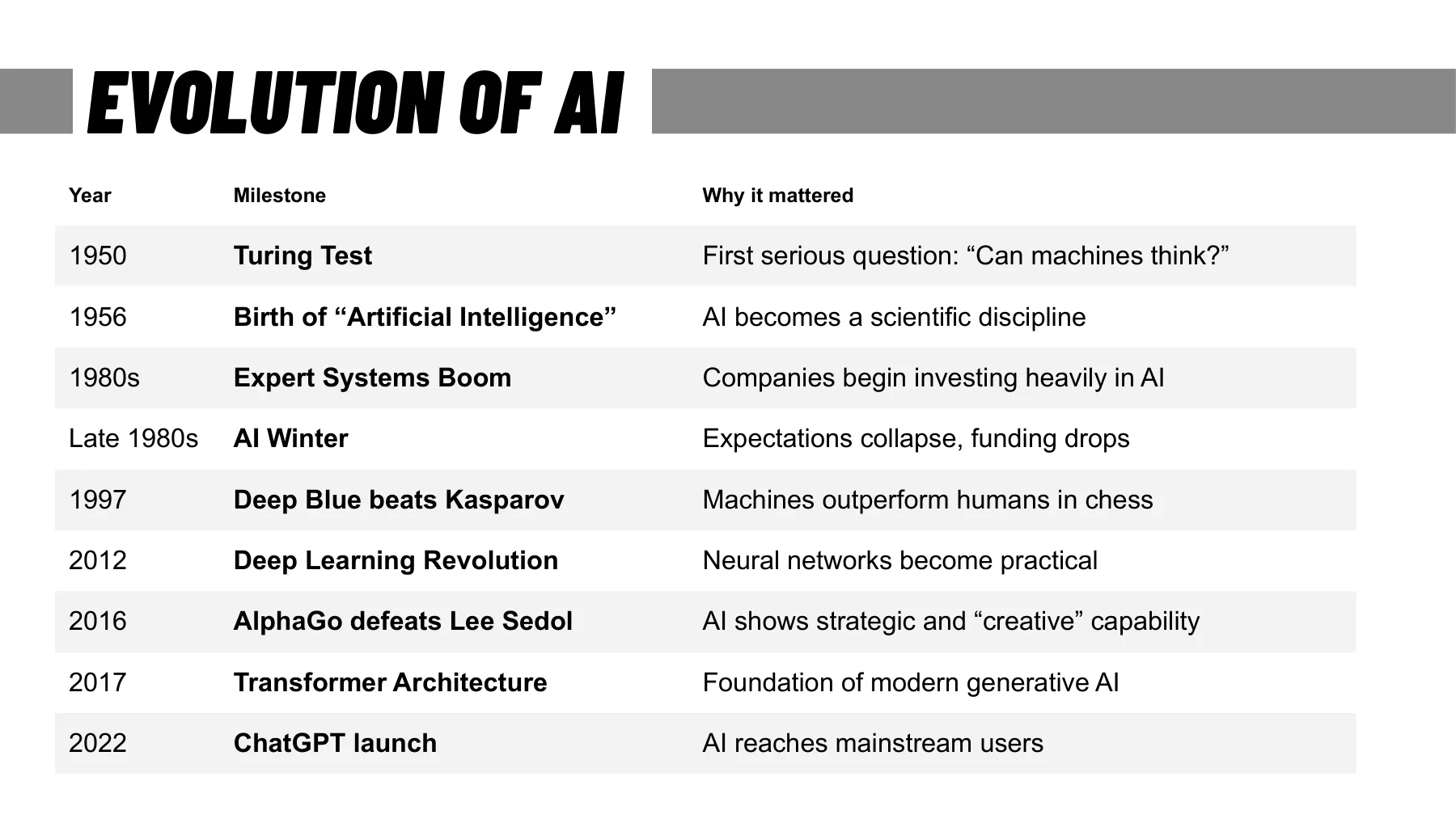
- ·1950 Turing: “Can machines think?” · 1956 Dartmouth: the term AI
- ·1997 Deep Blue · 2012 deep learning · 2016 AlphaGo · 2017 Transformer
- ·November 30, 2022 ChatGPT: AI has a mass audience for the first time
- ·Waves: hype, winter, hype. A marketer has to recognize where we are right now
The field is older than most of your parents. In 1950, in his paper Computing Machinery and Intelligence, Alan Turing asked whether machines can think, and instead of a definition he proposed a game: if you can’t tell whether you are chatting with a human or a machine, the argument about “thinking” is pointless. Today we call it the Turing test. In 1956, at Dartmouth, the field got the name artificial intelligence.
Then came the waves. In the 1980s, companies invested in expert systems (hand-written rules); at the end of the decade came the “AI winter”: both the money and the interest disappeared. In 1997, IBM’s Deep Blue beat Kasparov at chess; in 2012, graphics cards turned neural networks into a usable tool (deep learning); and in 2016, AlphaGo beat Lee Sedol at Go, a game machines were supposed to master only “decades from now.”
Two key years for what you have in your phone today: 2017, when Google published the Transformer architecture (Attention Is All You Need), which GPT, Claude, and Gemini are built on, and November 30, 2022, when OpenAI launched ChatGPT. The technology existed before, but only the chat window put it in the hands of hundreds of millions of people, no manual needed.
Part of what you hear today is a bubble, part of it is infrastructure for the next twenty years, like the internet around 2000. Pop culture prepared you for a killer robot, not for an assistant that transcribes your meeting; that’s the expectation you work with in communication.
For discussion
Which film or TV series was the first to show you artificial intelligence? And how does it differ from what you have in your phone today?
Rabbit holes
- Turing: Computing Machinery and Intelligence (1950), PDF ↗ · The original paper from the journal Mind (doi 10.1093/mind/LIX.236.433) as a free copy from a McGill course. Still a good read today.
- IBM: Deep Blue ↗ · What the machine that beat Kasparov in 1997 looked like.
- AlphaGo: The Movie ↗ · DeepMind’s documentary about the match with Lee Sedol, 90 minutes of suspense.
2Why the boom came only now
Four drivers, none of them enough on its own
- ·Computing power: GPUs and specialized chips
- ·Internet data: text, images, code in trillions of tokens
- ·Transformer (2017): handles context and can be parallelized
- ·Cloud and APIs: you don’t need a data center, a key is enough
Why now and not in 2010? Four things came together, and none of them would have been enough on its own. Power: graphics cards (GPUs, mainly from Nvidia) multiply matrices in parallel, and that is exactly what training a model is. Data: the internet provided trillions of words, images, and code from which a model learns patterns. Transformer: the 2017 architecture with its attention mechanism weighs connections across a long text and trains in parallel, so it uses GPUs to the full. Cloud and APIs: the model runs at the maker’s end, and you pay for usage.
The speed of adoption is unprecedented. ChatGPT had a million users in 5 days and, according to an estimate by the bank UBS, 100 million in 2 months. In February 2026, OpenAI reported 900 million weekly active users and 50 million paying ones. Stanford’s AI Index 2026 calculated that generative AI reached 53% of the population within three years, faster than the personal computer or the internet (for a comparison of media, see the Media chapter).
The Czech context is more sober. According to ČSÚ, the Czech Statistical Office, 18% of companies with 10 or more employees used AI in 2025 (11% the year before, EU average 20%); most often generative AI for text and code (13%, 9% in the EU). People are ahead of companies: according to ČSÚ, 32% of Czechs aged 16 and over use generative AI, and 78% of those aged 16 to 24. In Microsoft’s global comparison (first quarter of 2026), the Czech Republic, at 30% of people aged 15 to 64, is above the 18% average but far behind the UAE (70%) and Singapore (63%). So in this classroom you are probably ahead of most of the companies you will go on to work for.
- 100 million
- ChatGPT users within 2 months of launch (estimate)
- 900 million
- weekly active ChatGPT users, February 2026
- 53%
- of the population using generative AI within 3 years of launch
- 18%
- of Czech companies with 10+ employees used AI in 2025
UBS / Reuters, February 2023
OpenAI via TechCrunch
Stanford AI Index 2026
ČSÚ

Rabbit holes
- Attention Is All You Need (2017) ↗ · The paper GPT, Claude, and Gemini are built on. Read at least the abstract and Figure 1.
- TechCrunch: ChatGPT reaches 900 million weekly users ↗ · Figures from February 2026, including 50 million paying users.
- ČSÚ: V používání AI dohání podniky v Česku průměr EU ↗ · Official Czech figures for 2025 (in Czech): 18% of companies with 10+ employees, EU 20%; generative AI 13%.
- Microsoft: Global AI Diffusion, Q1 2026 (PDF) ↗ · How many people aged 15 to 64 use AI in each country. The ranking comes out every quarter.
3The technology layer: chips, data centers, cloud, APIs
Chat is just the tip: a token’s price pays for chips, buildings, and electricity
- ·Chips (Nvidia GPUs, Google TPUs) → data centers → cloud and APIs → applications
- ·Nvidia: the first company worth $5 trillion (October 2025)
- ·Data centers: 415 TWh in 2024, 945 TWh in 2030 (IEA)
- ·One query: about 0.24 Wh, a microwave running for one second
Under the chat window there are four layers. At the bottom, chips: Nvidia GPUs and specialized chips such as Google’s TPUs. Above them, data centers: halls with tens of thousands of chips, cooling, and a power supply; they are built by Microsoft, Google, Amazon, Meta, and OpenAI with partners (Stargate). Above that, cloud and APIs: Anthropic, OpenAI, or Google run the model and you call it. At the top, applications: ChatGPT, Claude, Gemini, or your website that calls the API. A marketer works in the top layer, but the price of a token pays for all four.
On October 29, 2025, Nvidia became the first company with a market value of $5 trillion; it had crossed $4 trillion less than four months earlier. The four largest data center operators invested roughly $410 billion in 2025, and according to their outlooks they are heading toward an estimated $700 billion in 2026, mostly in AI infrastructure.
The second cost is electricity. According to the IEA, data centers consumed 415 TWh in 2024, about 1.5% of the world’s electricity, and since 2017 they have grown 12% a year, four times faster than total consumption. By 2030, the IEA expects that to double to 945 TWh, more than all of Japan consumes today. A single query, meanwhile, is a trifle: Google measured the median text prompt in Gemini at 0.24 Wh (a microwave running for one second, five drops of water), and Sam Altman gives 0.34 Wh for ChatGPT. The problem is billions of queries, and training. Through an API you buy a service, not a technology, just like with a payment gateway (see the Internet chapter).
- $5 tn
- Nvidia’s market value, the first company in the world to reach it (October 29, 2025)
- ~$700 bn
- estimated 2026 investment by Amazon, Microsoft, Alphabet, and Meta
- 0.24 Wh
- median energy use of one text prompt in Gemini
AP, October 2025
Yahoo Finance, May 2026
Google / MIT Technology Review
Electricity consumption of data centers worldwide (TWh)
unit: TWh
In 2024 it was 1.5% of the world’s electricity; in 2030 it will be more than Japan consumes today. The years 2030 and 2035 are the IEA’s base case scenario.
data table
| 2024 | 415 TWh | |
|---|---|---|
| 2030 | 945 TWh | projection |
| 2035 | 1,200 TWh | projection |
4How it works: tokens and probability
The model guesses the next token. Over and over
- ·Text → tokens (about 3.5 characters in English), each one has a number
- ·The model computes the probability of the next token, picks one, adds it, repeats
- ·Training happens once and is expensive; inference happens every time you ask
- ·Context window = working memory: today up to 1 million tokens
- ·Hallucination: it optimizes for plausibility, not truth
A large language model (LLM) is a statistical model of language. First, the text is chopped into tokens: pieces of words, about 3.5 characters per token in English, and in Czech, with its diacritics and inflection, more pieces per word. Every token has a number. For every token in its vocabulary, the model computes the probability that it comes next, picks one, adds it to the end, and repeats. Nothing more. That an article, code, or a little poem comes out of it is the result of billions of parameters that encode patterns from the trillions of words the model learned from.
Tell training and inference apart. Training happens once: pretraining on an enormous corpus with a single task, predicting the next word; then fine-tuning and reinforcement learning from human feedback (RLHF), so the model answers like an assistant, not like a random page from the internet. It takes months on thousands of GPUs. Inference is every one of your queries: cheap per call, expensive at mass scale. And above all: after training, the model is frozen; it learns nothing from your conversation unless the app has a separately built memory.
The context window is working memory: how many tokens the model “sees” at once, meaning the prompt, attached documents, and its own answer. Claude and Gemini both offer a window of 1 million tokens. A million tokens is roughly 2,000 pages of text (an estimate). Whatever doesn’t fit into the window, the model doesn’t know.
Temperature controls how random the choice is: zero gives the most probable and most boring text, a higher value gives more surprising but less reliable text. This leads to the most important property for a marketer: hallucination. The model optimizes for plausibility, not truthfulness; a made-up study or a wrong number looks just as confident as a correct answer. That’s why you check every name, number, and link yourself. And Czech pays extra: more tokens per word, a higher price, less text in the window. The vocabulary is below.
- -LLM: large language model, the core of generative AI. It predicts the next token.
- -Prompt: instructions for the model. The system prompt sets the role and the rules, the user prompt gives the task.
- -Token: a piece of text, the unit you pay for.
- -Context window: how many tokens the model sees at once.
- -Temperature: how random the choice of token is. Zero = predictable, higher = more creative and more error-prone.
- -Hallucination: a confident but false answer. It looks like the truth.
- -Fine-tuning: further training of a model on your own data. Expensive, rarely needed in marketing.
- -RAG: before answering, search the documents for what’s relevant and put it into the prompt. The basis of company chatbots.
- -Multimodality: the model processes and creates text, images, audio, video.
- -Agent: a model with a loop and tools. It plans, calls tools, executes, evaluates.
- -MCP: a standard for connecting a model to data and tools. “USB-C for AI.”
- -Open-weights: a model with published weights that you run yourself.
- ~3.5 chars
- one token of English text in older Claude models
- 1 million
- tokens in the context window of Claude and Gemini
Anthropic, glossary
Anthropic, Google

For discussion
Why would a model rather make up a citation than write “I don’t know”? And what does that mean for every text you take from it?
Rabbit holes
- Anthropic: glossary ↗ · Token, context window, temperature, RAG, RLHF on a single page.
- 3Blue1Brown: But what is a GPT? ↗ · A visual explanation that even a humanities major will understand.
- OpenAI Tokenizer ↗ · A playground for tokens. Try Czech.
5Who’s who: frontier models and open-weights
Four labs, two camps, three ways in
- ·Frontier: Anthropic (Claude), OpenAI (GPT), Google (Gemini), xAI (Grok)
- ·Open-weights: Meta Llama, Mistral, DeepSeek, Qwen, gpt-oss
- ·Chat ($20/month) · API (per token) · self-hosting (open-weights)
- ·US $285.9 bn of investment vs. China $12.4 bn, a 2.7% performance gap
At the frontier there is a handful of labs: Anthropic (Claude), OpenAI (GPT), Google DeepMind (Gemini), and xAI (Grok). You can get their models only through an app or the API; the weights (the learned parameters) are secret. The second camp is open-weights models: Meta (Llama), the French Mistral, the Chinese DeepSeek, Qwen, or Kimi, and more recently gpt-oss from OpenAI. You download the weights and run them yourself. Be careful with the term “open source”: what’s open are the weights, not the training data or the method.
Three ways in. Chat apps (Claude, ChatGPT, Gemini) are for people: Claude’s Pro plan costs $20 a month, or $17 a month with annual billing, and Max starts at $100 (claude.com/pricing, October 2026). The API is for automation: you pay for tokens, and the model becomes part of your website or script. Self-hosting an open-weights model gives you control over your data, but you pay for the servers and the people. For a marketing team: apps for people, the API for processes, self-hosting only with a good reason.
Models differ in character more than in leaderboard numbers; the leaderboards change every month, so it’s better to have two or three models at hand and choose by task. Stanford’s AI Index 2026 reports that in March 2026 the gap between the best American and Chinese models was only 2.7%, even though private investment in AI reached $285.9 billion in the US in 2025 and $12.4 billion in China (not counting state money). Europe has Mistral, and regulation.
- $285.9 bn
- private investment in AI in the US in 2025
- $12.4 bn
- private investment in AI in China in 2025, excluding state funding
- 2.7%
- performance gap between the best US and Chinese models, March 2026
- $20/month
- Claude Pro plan, $17 a month with annual billing
Stanford AI Index 2026
Stanford AI Index 2026
Stanford AI Index 2026
claude.com/pricing, October 2026
Rabbit holes
- Arena (formerly LMArena): a leaderboard based on human votes ↗ · People compare two anonymous answers. The most honest leaderboard there is.
- Artificial Analysis ↗ · Performance, speed, and price of models in a single chart. Good for choosing by task.
- Hugging Face: open-weights models ↗ · Where open models get downloaded. Look at how many there are.
6Text to text and prompting in practice
A good prompt has seven parts
- ·Five classes: text→text, text→image, text→video, text→audio, speech→text
- ·Role and context · task · input material · output format
- ·Examples · constraints (length, tone, what not to do) · “if you don’t know, say so”
- ·Iterate: the first output is a draft, not the result
- ·Facts, names, and numbers get checked by a human. Always
Text to text is the most widespread use: emails and summaries, meeting notes, brainstorming names, rewriting a specialist text for a different target group, a campaign strategy, analyzing a pasted spreadsheet, or code. What makes the difference between usable and generic output is the prompt.
A good prompt has a structure. Role and context: who the model is and who it works for (“you are the club’s copywriter, writing to parents of kids aged 6 to 10”). Task: one clear sentence. Input material: facts, data, previous texts; the model doesn’t have your know-how until you give it. Output format: length, bullet points, three variants. Examples of what you like (few-shot). Constraints: tone, banned words, what not to make up. And a safeguard: “if you’re missing information, ask.” For more complex tasks, let the model ask you questions first.
The process is always the same: the model writes a draft, you correct the facts and the tone, and you ask for a second iteration. Save recurring context (brand manual, tone of voice, target groups) in a project in Claude or in a custom GPT. The iron rule: no text you haven’t read goes out. More in Anthropic’s guide, which applies to other models too.
- -Prompt check: Does it have a role and an audience? Does it have one clear task? Did the model get the facts it needs?
- -Does it have a format and a length? An example of what you want? Constraints (tone, banned words, what not to make up)?
- -Does it have the safeguard “if you don’t know, ask”? Did you check the output against the source before sending it?
For discussion
What’s the difference between “write me a post” and a good prompt? List what the model would need to know to write the post for you.
7Images: from prompt to visual
Text → image: a moodboard in a minute, a campaign in an hour
- ·Midjourney (aesthetics, styles) · GPT Image · Nano Banana · Flux · Firefly
- ·Prompt: subject, style, composition, light, aspect ratio, reference
- ·Brand consistency: the same style suffix at the end of every prompt
- ·Not for truthful product photos. Label deepfakes in the EU (from August 2026)
Instead of stock photos or hours of a designer’s time, you get ten variants in a minute. Midjourney has the best aesthetics and thousands of styles, GPT Image from OpenAI handles text in images and precise edits, Nano Banana from Google keeps a character consistent, Flux is open-weights, Adobe Firefly is trained on licensed data for cases when a lawyer wants certainty, and Higgsfield puts several models under one roof, including video.
An image prompt has a different grammar: the subject (who or what, doing what), the style (photography, illustration, 3D), composition and lens (close-up, wide-angle, from above), light (golden hour, studio, neon), the aspect ratio for the channel, and optionally a reference image. A generic prompt gives a generic image, like a million others on social media; a precise prompt gives a visual from your campaign. For a brand, consistency is key: one fixed style string at the end of every prompt, so the images look like the work of one hand.
Where AI images don’t belong: in truthful product photos (food packaging at HOPI has to match reality), on people without their consent, and on anything that passes itself off as a document. Licensing: paid plans allow commercial use; read the terms. From August 2, 2026, you must clearly label deepfakes in the EU, meaning realistic-looking images of people, places, or events that aren’t real; the machine-readable watermark is embedded in the output by the generator itself. You do the finishing in ordinary tools: Photopea for edits, remove.bg for backgrounds, Squoosh for compression to WebP, Adobe Express for templates. More in the Production chapter.
Rabbit holes
- mjpro.ai: styles for Midjourney ↗ · Ready-made styles and prompts. Pick one and stick with it.
- Midjourney: documentation ↗ · Parameters, aspect ratios, image references, plans.
- Higgsfield ↗ · Images, video, and audio from several models in one interface.
- Adobe Firefly ↗ · A commercially safe generator trained on licensed data.
8Video, audio, and transcription
Video, voice, music, and transcription: the youngest and fastest-moving area
- ·Text → video: Veo, Kling, Seedance, Runway. Seconds, not films
- ·Text → audio: ElevenLabs (voice), Suno and Udio (music), NotebookLM (podcast)
- ·Speech → text: Whisper and transcripts in Teams. The least flashy, the most useful
- ·Video is no longer limited by technology but by imagination and the budget for iterations
Text to video is the youngest field and changes month by month: OpenAI’s Sora app, launched at the end of September 2025, announced its shutdown in March 2026. Veo (Google), Kling, Seedance (ByteDance), Runway, or Pika generate clips from a few seconds to tens of seconds long; they handle camera movement, character consistency, and ever better physics. Clips get assembled into ads, reels, and even whole series; Higgsfield has its own series, generated from start to finish. Video is ceasing to be limited by technology and starting to be limited by imagination. And by the budget for iterations, because the first generation rarely gets it right.
Text to audio: ElevenLabs does realistic voices, voice cloning, and dubbing into dozens of languages; Suno and Udio compose a track including vocals; Google’s NotebookLM turns any document into a podcast with two hosts. In marketing: a voiceover without a studio, localizing a video in a single voice, a podcast from an article, a jingle without licensing fees.
The least flashy and the most useful is speech to text: Whisper from OpenAI (open-weights, runs even on a laptop), transcripts in Teams, automatic subtitles. A transcript of an interview gives you quotes, a transcript of a meeting gives you tasks, a transcript of a podcast gives you an article. Transcription plus a language model is the biggest time saver AI has brought to media work so far. How this meets streaming is in the Streaming chapter.
Rabbit holes
- Higgsfield: the Hell Grind series ↗ · What generated video can do today across a whole episode.
- ElevenLabs ↗ · Voice, cloning, dubbing. Try your own voice for free.
- NotebookLM ↗ · Upload a document and have it turned into a podcast.
- Suno ↗ · Music including vocals from a single prompt.
9Agents, MCP, and Claude Code
From chat to delegation
- ·Agent = model + tools + loop: it plans, calls, evaluates, continues
- ·MCP (November 2024): “USB-C for AI,” 10,000+ servers, 97 million downloads a month
- ·Claude Code (2025): the agent reads a project, writes code, proposes a change
- ·Multi-agent workflow: orchestrator, specialists, critic
- ·Agents on a computer: OSWorld from 12% to 66% in a year (AI Index 2026)
A chat waits for a prompt and answers. An agent gets a goal and goes to work: the model runs in a loop, plans the steps, calls a tool (reads a file, runs a command, searches the web, calls an API), looks at the result, and decides what to do next, until the task is done. You set the goal and the boundaries, not the steps: from conversation to delegation. How fast this is moving shows in the AI Index 2026: on the OSWorld test (tasks on an ordinary computer), agents’ success rate rose in a single year from about 12% to 66%, and on SWE-bench Verified (fixing bugs in real code) from 60% to nearly 100%.
An agent needs tools. MCP (Model Context Protocol) is an open standard that Anthropic introduced on November 25, 2024: a unified way to connect a model to data and tools, from Google Drive and Gmail to Trello and a company database. Like USB-C: one connector, many devices. In December 2025, Anthropic handed MCP over to the Agentic AI Foundation under the Linux Foundation (together with OpenAI and Block); at that point there were over 10,000 public MCP servers, and ChatGPT, Gemini, and Microsoft Copilot all supported it. For a marketer: you can connect a model to your Trello, spreadsheets, or email without a programmer.
Claude Code (in preview from February 2025, fully launched in May 2025) is an agent in the terminal or a desktop app: it reads an entire project (repository), writes code, runs tests, fixes bugs, and opens a pull request, a proposed change that a human approves or sends back. Codex from OpenAI does the same. n8n and Make are no-code automation tools where the model is one step (an email arrives → the model sorts it → a Trello card is created). The next level up is a multi-agent workflow: an orchestrator divides the work among specialists, and a critic reads the results and sends them back. That’s also how this garden was made: thirteen agents wrote the chapters in parallel and two critics read them, one for facts, the other for clarity.
- Nov 25, 2024
- Anthropic introduced MCP; on December 9, 2025, it handed it over to the Linux Foundation
- 10,000+
- public MCP servers, December 2025
- 97 million
- MCP library downloads per month, December 2025
- 66%
- agent success rate on OSWorld, ~12% a year earlier
Anthropic
Anthropic
Anthropic
Stanford AI Index 2026
For discussion
What in your work would you delegate to an agent right away, what only after a year, and what never? Why?
Rabbit holes
- Model Context Protocol: introduction ↗ · What a server, a client, and a tool are. Twenty minutes of reading.
- Claude Code: documentation ↗ · How the agent in the terminal works and what it can do.
- n8n ↗ · No-code automation with a model as one of the steps.
10Velín: AI as a news filter
68 emails in 26 days, one useful every three weeks
- ·Problem: the monitoring sent everything. Goal: 2–3 items in a quiet week
- ·Haiku throws out the noise, Sonnet decides: right away, the weekly digest, or out
- ·Rules written in plain language, calibrated on 226 labeled mentions, thumbs up/down
- ·Cost: from $0.89 to $0.25 a day (−72%) thanks to caching and a cheaper model
Velín (Czech for “control room”) is my personal dashboard at jecminek.co/dashboard: news, mentions of HOPI, of judo, and of me, things to read, the weather, the markets, the status of my websites. The most interesting part is the one where AI writes nothing and only sorts. Before, my media monitoring sent me an email about every mention: 68 emails in 26 days, one useful every two to three weeks. I wanted discreet delivery: two or three items in a quiet week, better nothing than noise.
Haiku, the cheapest class of Claude models, acts as the filter: it throws out obvious noise (recipes, contests, namesakes). Sonnet decides according to a rubric: 2 = alert right away (a Grand Slam medal, a HOPI truck accident, the company’s owner in politics), 1 = weekly digest (an independent product test), −1 = noise (regional judo, a PR article about a recipe). I didn’t write the rubric from behind a desk: first I labeled 226 mentions and 134 headlines by hand (117 of them noise), and the labels turned into rules with examples. Every item that gets delivered has a thumbs up and a thumbs down. Haiku isn’t good enough for the decisions (false alarms), so it only does the filtering.
Cost was the second problem. The first version cost $0.89 a day, and 81% of that went to the expensive Opus, which got the full rules again with every query, without caching. Three changes: the rules and the evaluations as two blocks with a one-hour cache, decisions on Sonnet instead of Opus (a local test on my labels came out the same), and a night pause, when from 10 p.m. to 6 a.m. items are only collected and at 6:07 a.m. the night gets sorted. The result: $0.25 a day, 72% less, at the same quality. The daily cap is $1.50, in case something breaks.
- 68
- emails in 26 days from the original monitoring, one useful every 2–3 weeks
- $0.25/day
- running AI in velín after the changes, $0.89 before
- −72%
- savings from the one-hour cache, Sonnet instead of Opus, and the night pause
- 226
- hand-labeled mentions the sorting rules were built from
velín
velín, spending breakdown
velín, spending breakdown
velín, calibration
Velín’s spending on models ($ per day)
unit: $/day
Same sorting quality, 72% of the cost gone: a one-hour cache for the rules, Sonnet instead of Opus, no sorting at night.
data table
| before (Opus, no cache) | $0.9/day | |
|---|---|---|
| after (Haiku + Sonnet, 1h cache) | $0.3/day |
11What it costs: tokens, caching, batches
You pay for tokens. Output costs 5× more than input
- ·A 100× range: $0.10 (Haiku 5.5) to $10 (Fable 5.1) per 1 million input tokens
- ·Cache: a repeated prompt beginning at 2.5 to 10% of the price
- ·Batches within 24 h: −50%
- ·Example: 1,000 queries a day = $11 on Sonnet, $0.55 on Haiku
The API is billed by tokens, separately for input (what you send) and output (what the model writes); output is five times more expensive because it’s generated token by token. The price range is a hundredfold. At Anthropic, a million input tokens costs $0.10 on Haiku 5.5, $2 on Sonnet 5.5, $4 on Opus 5.5, and $10 on Fable 5.1; output costs $0.50 to $50. OpenAI’s current lineup is almost a mirror image: gpt-6-luna $0.10, gpt-6.1-sol $2, gpt-6-astra $10; older “pro” models cost as much as $30 (gpt-5.5-pro). Google charges $0.30 to $0.75 for Gemini Flash and $2 for Gemini 4 Argon (from December 1, 2026, already $4, and Flash 3.6 and 3.8 double from January 2027). Prices are as of October 2026 and change every few months; the ratios between the classes stay.
Besides choosing the model, there are two ways to pay less. Prompt caching: a repeated beginning of the prompt (rules, brand manual) is stored in a cache, and on the next call it costs 2.5 to 10% of the input price, depending on the model; writing it costs 1.25× for five minutes or 2× for an hour, and it pays off from the second call. Batches: whatever isn’t urgent, you send all at once and get back within 24 hours at half price. Long context: Anthropic charges the whole 1-million-token window at the same rate (except Haiku 5.5 above 100,000), while Google, for its Pro models above 200,000, and OpenAI, above 272,000 tokens, charge double.
An example for the board: 1,000 queries a day, each with 3,000 input tokens and 500 output tokens. On Sonnet 5.5: 3 million × $2 = $6 for input, 0.5 million × $10 = $5 for output, $11 a day. If 2,500 of the 3,000 input tokens are a fixed prefix in the cache ($0.10 per million), the total drops to roughly $6.25. On Haiku 5.5, the same thing costs $0.30 + $0.25 = $0.55 a day. A twentyfold difference, which is why the checklist below starts with the cheapest model. For an individual, the $20-a-month plan is enough; the API is for when something has to run without a human.
- 100×
- range of input token prices in the current Anthropic and OpenAI lineups
- 5%
- price of a cache hit relative to the input price on Sonnet and Opus 5.5
- −50%
- discount for batch processing within 24 hours
Anthropic and OpenAI price lists, October 2026
Anthropic, pricing
Anthropic, pricing
Price per million input tokens, Anthropic models (October 2026)
unit: $
Haiku 5.5 is a hundred times cheaper than Fable 5.1; for all four, output costs five times more than input.
data table
| Haiku 5.5 | $0.1 | output $0.50 |
|---|---|---|
| Sonnet 5.5 | $2 | output $10 |
| Opus 5.5 | $4 | output $20 |
| Fable 5.1 | $10 | output $50 |
12Risks, regulation, and what will be rare
The risks aren’t sci-fi: one video call cost $25 million
- ·Arup 2024: a fake CFO on video, 15 transfers
- ·AI Act from August 2026: label deepfakes, a chatbot admits it’s a bot
- ·WEF by 2030: 92 million jobs will disappear, 170 million will be created
- ·What will be rare: trust, authenticity, judgment
The risks aren’t sci-fi. Deepfakes: in early 2024, a finance employee at the firm Arup in Hong Kong joined a video call with the “CFO” and colleagues, all of them generated, and sent 200 million Hong Kong dollars (about $25 million) in 15 transfers. Two things for a marketer: a brand can be misused for fraud (a fake executive, a fake contest), and every viral video needs to be verified (a reverse image search in TinEye, the original source) before you share it.
Information overload: generating is almost free, the amount of average content grows, and attention shrinks. Hallucinations: confident errors in numbers and names; the AI Index 2026 counted 362 documented AI incidents in a year, up by half from the year before. Privacy: what you type into a public chat may be used for training; customer data, contracts, and internal prices belong only in company accounts with training turned off, or nowhere. Jobs: the World Economic Forum estimates that by 2030, 170 million jobs will be created and 92 million will disappear; 41% of employers plan to reduce their workforce because of AI, and routine cognitive work is first in line. Addiction and attention are covered in the Social Media chapter.
Regulation: the EU AI Act has been in force since August 1, 2024, and is phasing in step by step. From February 2, 2025: bans (manipulative techniques, social scoring, emotion recognition at school and at work) and an AI literacy obligation for companies. From August 2, 2025: obligations for providers of large models (GPAI). From August 2, 2026: transparency; a chatbot must make it clear that you are not talking to a human, and anyone who publishes a deepfake must clearly label it. The Digital Omnibus (in effect since July 27, 2026) postponed machine-readable marking of outputs for generators already on the market to December 2, 2026, and the rules for high-risk systems (recruitment, loans) to December 2, 2027. For marketing: label generated content, don’t manipulate emotions, keep a record of where you use AI.
What will remain for people? When anyone can produce text, images, and video in a minute, the value isn’t in the production but in who stands behind the content. What will be rare: trust, authenticity, character, creativity drawn from experience, the courage to make an unpopular decision, leadership, and the ability to decide under uncertainty. For your career, that’s a more important question than when general AI will arrive.
- $25 million
- Arup’s loss after a deepfake video call, 15 transfers (2024)
- Aug 2, 2026
- the date from which deepfakes must be labeled and chatbots must admit they’re bots
- 92 million
- jobs will disappear by 2030, 170 million will be created
- 362
- documented AI incidents in a year, 233 the year before
CNN
European Commission, AI Act
WEF Future of Jobs 2025
Stanford AI Index 2026

For discussion
Which of your skills will be rarer in five years than it is today? And which one will AI take from you first?
Rabbit holes
- European Commission: AI Act, timeline ↗ · The official overview of what applies from when, including the 2026 postponement.
- CNN (via ABC17 News): Arup and the $25 million deepfake ↗ · How the scam unfolded, step by step.
- WEF: Future of Jobs Report 2025 ↗ · Which jobs are growing and which are disappearing, according to 1,000 companies from 55 economies.
- Stanford AI Index 2026: incidents and safety ↗ · The chapter on responsible AI, with incident counts.
13AI in marketing: where to start tomorrow
AI cuts across every lesson of this course
- ·Copy, graphics, PPC, social, PR, data, production, web: a different tool everywhere
- ·A human approves, checks the facts, guards the brand
- ·Start with one process, measure the time, then the next one
- ·Three sentences to take away: tokens, prompt, delegation
AI isn’t just one chapter out of fourteen; it’s a layer over all thirteen others. In each of them, a different tool does a different job; an overview by field is in the list below.
Three rules for every field. A human approves: the model prepares, a human sends. A human checks the facts: names, numbers, quotes, links. A human guards the brand: tone, values, and what isn’t said are not in the prompt unless you write them there. Roll out one process at a time, and measure the time before and after.
Three sentences to take away. The model guesses the next token: brilliant with language, unreliable with facts. A good prompt is a brief like one for a temp: role, task, material, format, constraints. And the biggest change is still to come: from writing prompts to delegating goals to agents that work while you sleep. Whoever can do that will be rare in marketing. Today’s AI is still narrow (ANI), though; when general AI (AGI) will arrive is a debate measured in years, or decades.
- -Copywriting and the brand: drafts, tone variants, translations; you guard the facts, the brand voice, and the identity.
- -Graphics and production: moodboards, concepts, backgrounds, video; product photos stay truthful.
- -PPC and advertising: text and creative variants for A/B tests, analysis of data exports.
- -Social and PR in the media: content plan, transcripts, quotes, press releases; relationships and community are yours.
- -Data and marketing: paste in a spreadsheet, have the model describe what’s in it, suggest segments and what to measure.
- -Streaming, events, web: subtitles, voice, scripts, code; dramaturgy and architecture are your decisions.

For the exam
Terms
- -Token and context window: the model repeatedly predicts the most probable next token and sees only as many tokens as fit into the context window.
- -Training vs. inference: training happens once and is expensive, inference is every query, and after training the model is frozen, so it learns nothing from your conversation.
- -Frontier vs. open-weights: you get frontier models (Claude, GPT, Gemini) only through an app or the API, while you download open-weights models and run them yourself.
- -Hallucination: a confident but false answer, because the model optimizes for plausibility, not truth, so you check names, numbers, and links yourself.
- -Agent and MCP: an agent is a model running in a loop with tools that gets a goal and works on its own, and MCP is the open standard for connecting it to data and tools.
Numbers
- -August 2, 2026: from this date, deepfakes in the EU must be clearly labeled and chatbots must make it clear that you aren’t talking to a human (AI Act, European Commission)
- -5×: how much more an output token costs than an input token, because output is generated token by token (Anthropic pricing)
- -−50%: the discount for batch processing with results within 24 hours (Anthropic pricing)
The final exam is online in the last lesson, in English: 30 questions with three options each from the whole course, and you need 80% to pass. It asks about the terms in the For the exam boxes and how to apply them, much like the quizzes at the end of each lesson.
Final quiz
1In a chat, a coach corrects a model’s mistake in an athlete’s name. The next day, in a new window, the model repeats the mistake. Why?
- a)The temperature was high, so it randomly picked the old version
- b)The model is frozen after training and can’t learn from chats
- c)The model learns from the fix, but it takes a few weeks to show
answer
b) The model is frozen after training and can’t learn from chatsAfter training, the model is frozen and learns nothing from your conversation unless the app has a separately built memory (section 4).2A colleague asks a model to “Write a post about recruiting for the volleyball club” and gets a generic text that would fit any club. What was missing most from the prompt?
- a)A higher temperature to make the text more creative
- b)A bigger context window so the model can take in more
- c)Role, audience, and the facts the model needs
answer
c) Role, audience, and the facts the model needsThe model doesn’t have your know-how until you give it, and without a role, an audience, and input facts it returns a generic text (section 6).3A club wants a model to sort 1,000 messages a day. Each query has 2,000 input tokens and 200 output tokens. The model costs $1 per million input tokens and $5 per million output tokens. How much will the club pay per day?
- a)$2 a day
- b)$3 a day
- c)$11 a day
answer
b) $3 a dayInput is 2 million tokens × $1 = $2 and output is 0.2 million × $5 = $1, $3 in total, because output is billed separately and at a higher rate (section 11).4The task: “Find out which media wrote about our club in the past month and prepare a spreadsheet.” How does an agent differ from a chat here?
- a)A chat suggests the steps; an agent carries them out with tools
- b)An agent is a chat with a bigger context window and a pricier model
- c)An agent answers faster because it draws on its own answer database
answer
a) A chat suggests the steps; an agent carries them out with toolsAn agent is a model running in a loop with tools that gets a goal, plans the steps, calls tools, and checks the result until the task is done, while a chat only answers (section 9).5In September 2026, an agency wants to publish an ad in the EU with a realistic, AI-generated video of a packed stadium that doesn’t exist. What must it do?
- a)Nothing; the machine-readable watermark the generator adds is enough
- b)Nothing; such obligations apply only to high-risk systems
- c)Clearly label the video as a deepfake under the AI Act
answer
c) Clearly label the video as a deepfake under the AI ActFrom August 2, 2026, anyone who publishes a deepfake in the EU, meaning a realistic-looking image of people, places, or events that aren’t real, must clearly label it (section 12).
For next time
Student presentation at the start of lesson 09 Streaming
Find a live stream of a smaller sport or event and describe what you could see: how many cameras, graphics, commentary, how many viewers.
5 minutes, one student or a pair, three slides at most or a phone on the projector
Sources worth clicking
- 1Attention Is All You Need (Vaswani et al., 2017) ↗ · The paper that introduced the Transformer. The abstract and the architecture figure are enough; the rest is for the brave.
- 23Blue1Brown: But what is a GPT? ↗ · The best visual explanation of tokens, embeddings, and attention, 27 minutes.
- 3Andrej Karpathy: Intro to Large Language Models ↗ · An hour-long lecture on what an LLM is, how it’s trained, and where it’s heading. No math.
- 4Stanford HAI: AI Index Report 2026 ↗ · An annual summary of the numbers: adoption, investment, model performance, incidents. The primary source for most of the statistics in this chapter.
- 5IEA: Energy and AI ↗ · How much electricity data centers use today and will use in 2030. A one-page summary.
- 6Anthropic: Pricing ↗ · Prices per million tokens, caching, batches, long context. A model of how AI gets billed.
- 7Anthropic: Prompt engineering overview ↗ · The official guide to prompts: clarity, examples, roles, breaking a task down. Applies to other models too.
- 8Model Context Protocol ↗ · Documentation for the standard that connects models to data and tools. Read at least the introduction.
- 9European Commission: AI Act ↗ · The official page with the timeline: bans, GPAI, transparency from August 2026, high risk from December 2027.
- 10MIT Technology Review: how much energy a Gemini prompt uses ↗ · The first public numbers from Google: 0.24 Wh, 0.26 ml of water, 0.03 g of CO2 per median prompt.
Rabbit holes
- OpenAI Tokenizer ↗ · Paste in your name and a sentence in Czech and in English, and see how many tokens that is.
- mjpro.ai: styles for Midjourney ↗ · Thousands of tested styles and prompts. This is where I get the consistent style for the atlases.
- Higgsfield: the Hell Grind series ↗ · A whole series generated by AI. A look at where video stands in 2026.
- CNN (via ABC17 News): a deepfake cost Arup $25 million ↗ · A video call with a fake CFO and 15 transfers. A case for every company meeting.
- Anthropic: MCP donated to the Linux Foundation ↗ · How an internal standard became a joint project of Anthropic, OpenAI, and Block.
- Sam Altman: The Gentle Singularity ↗ · An essay by the head of OpenAI on where this is heading, including the figure of 0.34 Wh per query.
- Wikipedia: ChatGPT ↗ · An overview of the history and the numbers, with links to primary sources.