Lesson 07 · 90 minutes · 14 parts
Social Media
How social networks work, how they differ, how they make money and why they keep us hooked: algorithms, tribes, virality, influencers, maps as a social network and digital health.
This lesson has no English narration yet. The Czech version is narrated.
What you will take away
- -Tell a social network (people and ties) from social media (algorithm and ads) and know what that means for reach.
- -Choose a platform by audience: who in Czechia is on YouTube, Facebook, Instagram, TikTok and LinkedIn, and how much time they spend there.
- -Explain the dopamine loop and dark patterns, and answer them with the 5Cs framework.
- -Use STEPPS to judge why something spreads, and plan events as content factories.
- -Pick the type of influencer for the campaign goal and know how partnerships are labeled in Czechia.
- -Work out who makes money on social media: platforms, creators, advertisers and you as the “product.”
Lesson plan
- 5 minIntro and a question for the class · Activity 1: how many minutes a day does a Czech spend on social media? Guesses first, then phones out and the real number.
- 5 minStudent presentation · Pick one post by an athlete or a sports brand with a big reach and explain why you think it spread.
- 15 minNetwork, medium, history and platforms · Five eras in three minutes, the algorithm and pay-to-play, from goal to network. Activity 2: three products, three networks.
- 10 minMaps and tribes · A business profile as a social network; a tribe is reached from the inside. A quick round of tribes, the full exercise as homework.
- 15 minBehind the scenes and the 5Cs · The dopamine loop, dark patterns. Activity 3: the 5Cs on your own phone, 3 minutes in silence, then in pairs.
- 15 minVirality and events · Activity 4: STEPPS on a real post. The event as a content factory, a PR package within half an hour of a medal.
- 20 minInfluencers, sponsorship, monetization, social selling · Four sizes, the transfer of trust to the sponsor, the code, who earns and how much, your network as net worth.
- 5 minWrap-up and quiz · A checklist for a brand on social media, five questions.
Contents
- 1What a social network is and why we joined
- 2History: five eras and Web 1.0 → 2.0 → 3.0
- 3From social network to social media: the algorithm and pay-to-play
- 4Platform overview: who’s where
- 5Maps as a social network: business profiles and reviews
- 6Tribes: sociology gives marketing scale
- 7Behind the scenes: the dopamine loop and dark patterns
- 8The 5Cs of digital health: what to do about it
- 9Virality: STEPPS
- 10Events as content factories
- 11Influencers and sponsorship
- 12Monetization: who makes money on social media
- 13Social selling and network = net worth
- 14Wrap-up: a brand on social media in ten points
1What a social network is and why we joined
Social network = people + ties
- ·Social: behaviors and relationships between people, groups, institutions
- ·Network: nodes and ties through which information and influence flow
- ·5.66 billion user identities worldwide, 8.08 million in Czechia
- ·How many minutes a day does a Czech spend on social media? Take a guess
- ·Why we joined: connection, identity, network effect, accessibility, validation
Social refers to behaviors, interactions and relationships between people, groups and institutions. A network is a structure of nodes and ties through which information, resources and influence flow. So Silicon Valley didn’t invent the social network: a judo club, a pub or the ultras’ end at Slavia Prague are all social networks. The internet added speed, global reach and measurability. For the first time, every node and every tie can be counted, and therefore monetized.
The scale: according to Kepios and DataReportal Digital 2026, there were 5.66 billion user identities on social media worldwide in October 2025, 68.7% of the planet’s population (identities are not unique people). The average adult uses 6.75 platforms a month. In Czechia, according to DataReportal Czechia, it’s 8.08 million identities, 76.4% of the population, with 9.96 million internet users.
Time is the second currency. The AMI Digital Index 2025 (Stem/Mark, 1,010 internet users over 15) measured 143 minutes a day on social media for Czechs, and 220 minutes for Gen Z. That’s one feature film every day. And the number isn’t growing: it has dropped by four minutes since 2023. The attention market is saturated; the platforms are just fighting over it.
Why did we join? The five motivations of the initial adoption still hold: connection, identity expression (the profile as your digital self), network effect (“all my friends are there, so I must join”), accessibility and social proof and validation (the like as instant feedback). The Czech index puts numbers on the motivations: keeping in touch with friends 81%, entertainment 80%, information 76%, inspiration 65%. People don’t go on social media for brands. The brand is a guest there.
- 5.66 billion
- user identities on social media, 68.7% of humanity (October 2025)
- 8.08 million
- identities in Czechia, 76.4% of the population
- 143 min
- a day on social media for the average Czech, Gen Z 220 min
- 6.75
- platforms the average adult uses every month
DataReportal Digital 2026
DataReportal Czechia 2026
AMI Digital Index 2025
GWI / DataReportal
For discussion
How many minutes have you already spent on social media today? Take a guess, then check your phone settings (Screen Time / Digital Wellbeing). Who got within ten minutes?
Rabbit holes
- DataReportal: Digital 2026 Global Overview ↗ · The annual Kepios roundup: the most-cited numbers on the internet and social media, hundreds of charts for free.
- DataReportal: Digital 2026 Czechia ↗ · The same, just for Czechia: ad reach on every platform, age groups, penetration.
2History: five eras and Web 1.0 → 2.0 → 3.0
Each era changed who decides what you see
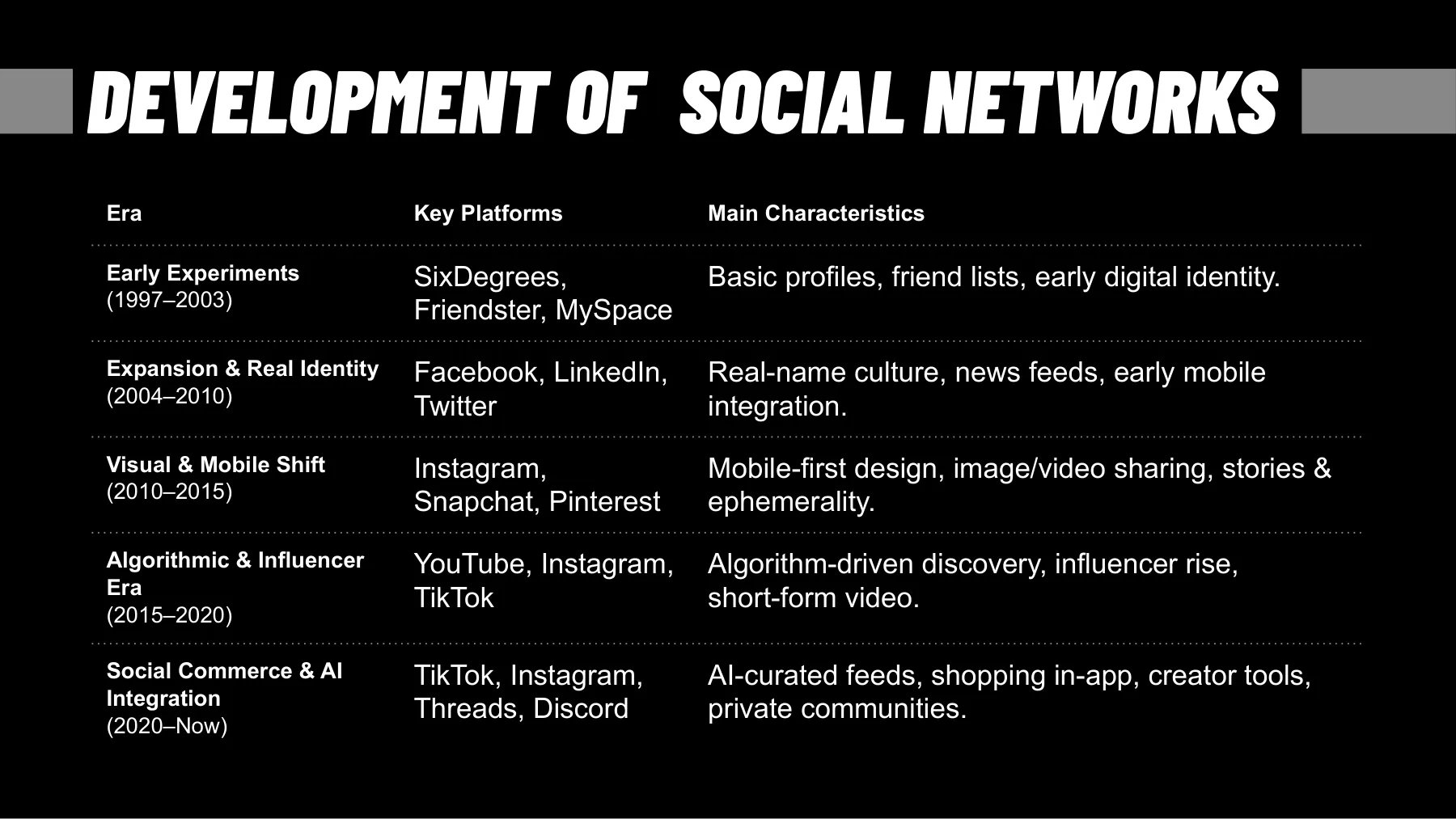
- ·1997–2003 experiments: SixDegrees, Friendster, MySpace
- ·2004–2010 real identity: Facebook, LinkedIn, Twitter
- ·2010–2015 mobile and visual: Instagram, Snapchat, Pinterest
- ·2015–2020 algorithm and influencers: YouTube, Instagram, TikTok
- ·2020–now AI feeds and in-app shopping: TikTok, Threads, Discord
Five eras. Early experiments (1997–2003): SixDegrees.com as the first site with a profile and a friend list, then Friendster and MySpace. Real identity (2004–2010): Facebook with real names, LinkedIn, Twitter with real-time updates; the feed was chronological. Visual and mobile shift (2010–2015): Instagram, Snapchat and Pinterest; the photo beat the text. Algorithm and influencers (2015–2020): the feed shows what keeps you there, not what you follow. Social commerce and AI (2020–now): in-app shopping, AI feeds, private communities (Discord, Telegram), Threads.
According to a comparison by Visual Capitalist, Facebook needed 4.5 years to reach 100 million users, Instagram 2.5 years, TikTok 9 months, ChatGPT 2 months and Threads 5 days (July 2023). Threads didn’t do it with a better product, but with login through an Instagram account: the network of ties was simply copied over. And a warning: 100 million sign-ups isn’t 100 million active people; Threads only reached 400 million monthly active users in August 2025.
Web 1.0 (roughly 1991–2004) was for reading: the company publishes, the visitor reads. Web 2.0, as Tim O'Reilly described it in 2005 in his essay What Is Web 2.0, is for reading and writing: users create the content, the platform is the intermediary. Web 3.0 promises ownership of data and identity; in practice, AI is winning so far, and it doesn’t just sort the feed, it generates it. For a marketer: in 1.0 you paid for hosting, in 2.0 for reach, in 3.0 for the model to find you. More in the Internet and Artificial Intelligence chapters.
How long it took to reach 100 million users
unit: months
Each new era cuts adoption time by an order of magnitude: Threads did it in 5 days thanks to Instagram login.
data table
| Facebook (2004) | 54 months | 4.5 years |
|---|---|---|
| Instagram (2010) | 30 months | 2.5 years |
| TikTok (2017) | 9 months | 9 months |
| ChatGPT (2022) | 2 months | 2 months |
| Threads (2023) | 0.2 months | 5 days |
Rabbit holes
- Tim O'Reilly: What Is Web 2.0 (2005) ↗ · The essay that named the web as a platform and users as creators of value. It reads as surprisingly current.
- Visual Capitalist: time to 100 million users ↗ · An infographic comparing everything from the telephone to Threads; data from PwC, Yahoo and company announcements.
3From social network to social media: the algorithm and pay-to-play
“If they follow me, they see me” no longer holds
- ·Chronological feed → algorithmic feed (2015+)
- ·Facebook: average engagement rate of 0.15% per post
- ·The platform doesn’t have to make content; you make it (UGC)
- ·Meta 2025: +12% ad impressions, +9% price per ad
- ·Organic reach can’t be planned; paid reach can
Around 2015, feeds switched from chronological order to algorithmic recommendation. It used to be “if they follow me, they see me”; now a model decides, predicting what will keep you in the app. Great for virality: a good post from a nobody can reach millions. A problem for brands: reach among their own followers stopped being a sure thing. That gave rise to pay-to-play: if you want even your own followers to see your content, pay for promotion.
The numbers are sobering. According to the Socialinsider benchmark (data from January 2024 to December 2025, retrieved October 2026; 25 million posts, 130,683 pages), the average engagement rate on Facebook is 0.15% per post: out of a thousand followers, one and a half people react. That’s why brands publish less, 39 posts a month, 22% fewer than a year earlier. Status updates work best (0.20%), links worst (0.05%): the algorithm doesn’t like letting people leave the app.
The key advantage over traditional media: television has to produce its content and pay for it. Meta gets it for free from users (user-generated content, UGC) and sells ads alongside it. For 2025, Meta reports 12% more ad impressions and a 9% higher average price per ad: advertiser demand is growing faster than people’s attention. More on metrics (CPM, CPC, ROAS) in the Advertising chapter.
Three rules. Followers are potential, not reach. Plan organic content for engagement (comments, shares, saves); that’s what the algorithm rewards. And the only place nobody can take from you is your own website and email list: social networks are rented land, so bring people home (the Internet chapter).
- 0.15%
- average engagement rate on Facebook, 2024–2025 data
- 39
- posts a month from the average brand, 22% fewer
- +9%
- rise in Meta’s average ad price in 2025, impressions +12%
Socialinsider, 25 million posts
Socialinsider
Meta, Q4 2025 results
For discussion
Quick math: a page has 10,000 followers and an engagement rate of 0.15%. How many people react to a post? And how many followers would it need for a hundred people to react?
4Platform overview: who’s where
Don’t be everywhere. Be where your audience is
- ·Czechia: YouTube 88%, Facebook 84%, Instagram 67%, TikTok 37%, LinkedIn 24%
- ·World: Instagram and WhatsApp 3 billion, YouTube 2.5 billion, TikTok 1.5+ billion
- ·Each network = a different format, a different age, a different reason to visit
- ·Facebook is aging, TikTok grew fastest, X is declining for the first time
No network is “the right one”: each has a different demographic, format and reason to visit. The most common mistake is being everywhere in the same way, which means nowhere properly. Watch the units: platforms report monthly active users (MAU), sometimes daily active users (DAU), LinkedIn reports registered members and DataReportal ad reach. They’re not interchangeable.
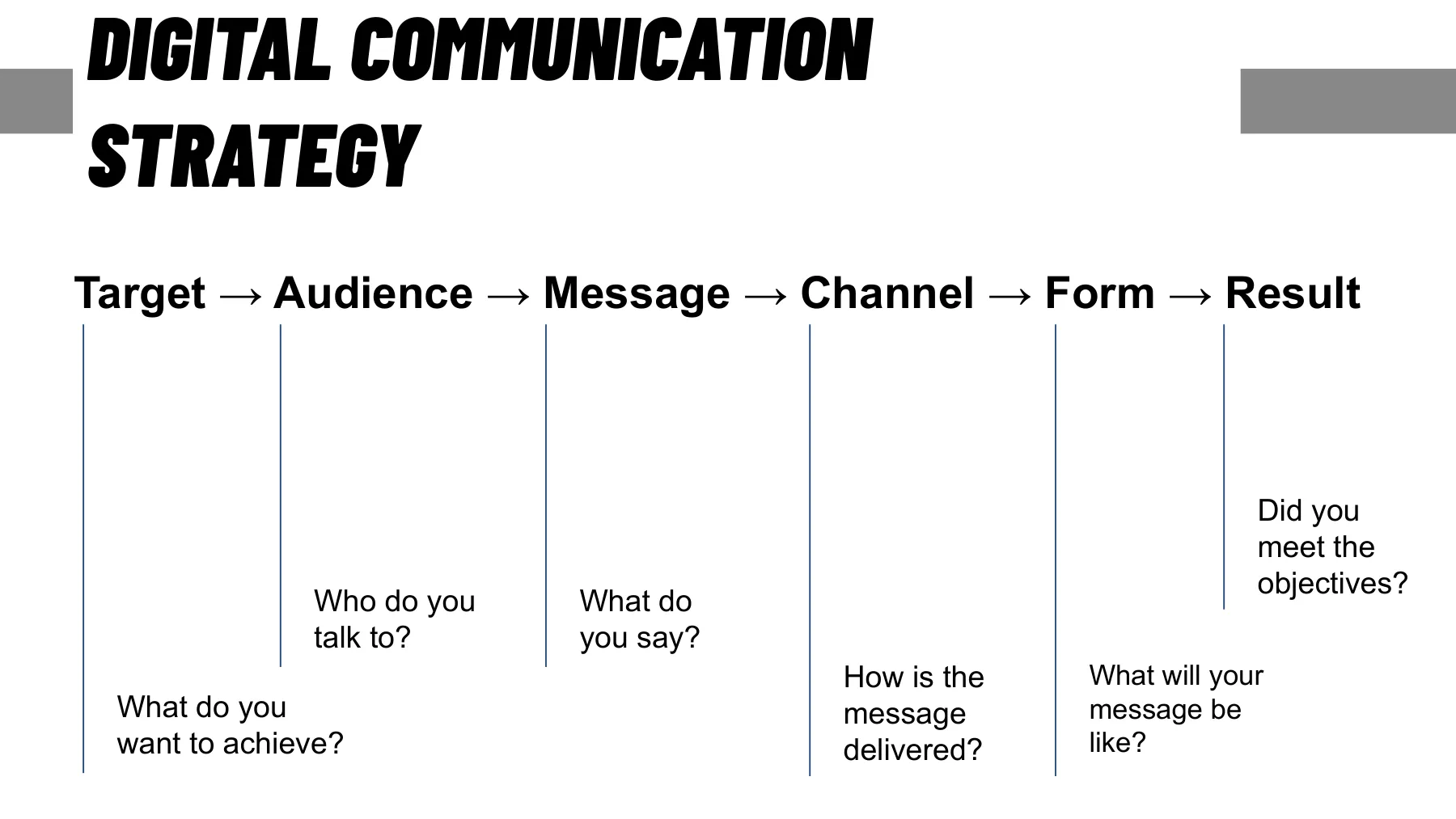
Before you choose a network, go through the digital strategy framework: target (what it should change) → audience → message → channel → form → result (what you measure and how). The network is only step four; if you start with “should we be on TikTok?”, you’re starting in the middle. And every path should lead to the website, the only place you control. The framework is laid out in the Internet chapter.
- -Facebook (2004, Meta): roughly 3 billion MAU; since 2024 Meta hasn’t reported it separately and gives 3.58 billion people a day across its apps. The strongest ad targeting, groups, Marketplace. The most universal network in Czechia (84%), declining among young people: American teens went from 71% (2014) to 32% (2024, Pew).
- -Instagram (2010, Meta since 2012): 3 billion MAU (September 2025). Visual branding, Reels, influencers, in-app shopping; growth comes from direct messages, Reels and recommendations, not from friends’ photos. In Czechia 67%, among millennials 75% (AMI, August 2025).
- -TikTok (2017, in China as Douyin since 2016; ByteDance): officially 1 billion MAU (2021), estimates for 2025 over 1.5 billion; the company doesn’t publish figures. The strongest organic reach, short vertical video, trends. In Czechia 37%.
- -YouTube (2005, Google since 2006): roughly 2.5 billion MAU (Statista and eMarketer estimates). Long content lifespan, Shorts, the best monetization for creators. The most visited network in Czechia (88%).
- -WhatsApp (2009, Meta since 2014): over 3 billion MAU (Q1 2025). Private messaging, encryption, WhatsApp Business. In Czechia 74% use it regularly, Messenger 57%.
- -LinkedIn (2003, Microsoft since 2016): over a billion registered members (2023), not active ones. B2B, recruiting, personal brand. In Czechia 24%.
- -X (2006, Musk since 2022): ad reach of 586 million (January 2025, DataReportal); the company doesn’t officially publish MAU, and Musk claimed 600 million in May 2024. Real-time news, politics, journalists. In Czechia 25% and declining for the first time; Snapchat (26%) has overtaken it.
- -Snapchat (2011): 946 million MAU, 474 million DAU (Q4 2025). Stories, AR filters, Gen Z. In Czechia 26%.
- -Pinterest (2010): 619 million MAU (Q4 2025, a record). A visual search engine with purchase intent, mostly women. In Czechia a surprising 45%: an underrated channel for online stores selling home, fashion and food.
- -Reddit (2005): 121.4 million daily active users (Q4 2025). Niche communities, anonymous discussions, AMA sessions (Ask Me Anything); since 2024 highly visible in Google and in the answers of AI models.
- -Threads (2023, Meta): over 400 million MAU (August 2025), a text-based network linked to Instagram. In Czechia 17% have tried it.
- -Discord, Telegram, Signal: private communities with no algorithm; for brands, they’re the place when you want a few hundred passionate people, not millions of random ones.
How many Czechs visit each network (internet users 15+, 2025)
unit: %
YouTube and Facebook are almost universal in Czechia; TikTok reaches a third, but dominates among Gen Z.
data table
| YouTube | 88% | |
|---|---|---|
| 84% | ||
| 67% | ||
| 45% | ||
| TikTok | 37% | |
| Snapchat | 26% | |
| X | 25% | |
| 24% | ||
| Threads | 17% | have tried it |
For discussion
Three products: a home-brewed beer for people in their thirties, a summer judo camp for kids aged 9–15 (the parents decide) and logistics services for procurement directors. Which network will each of them go to and why? Just one for each.
Rabbit holes
- Meta: Q4 2025 results (PDF) ↗ · What Meta tells investors about users and advertising. Two pages of numbers without the marketing fluff.
- Pinterest: Q4 2025 results ↗ · 619 million users and 14% revenue growth: the network Czech marketers overlook.
- MediaGuru: Czech generations on social media (AMI 2025) ↗ · Gen Z, millennials and older people: who’s where and how many minutes a day. Millennials 152 minutes, Instagram 75% (in Czech).
- Reddit: Q4 2025 results ↗ · 121 million people a day and data licensing for AI: how a forum became a source of truth for models.
5Maps as a social network: business profiles and reviews
A business profile on a map is a social network; it just doesn’t look like one
- ·Google Maps: over 2 billion users a month, Mapy.com: ~5 million in the app
- ·Profile = posts, photos, reviews, replies, messages
- ·Reviews are UGC that decides purchases more than your website does
- ·AI assistants read reviews and sum them up: 4.2 stars is the new brand
We usually don’t count maps as social networks, and that’s a mistake. A business profile on Google Maps (Google Business Profile) or Mapy.com (the Firmy.cz listing) has everything a network has: posts, photos, reviews, messages and “followers” who have saved the business. The difference is intent: people go to Instagram to be entertained, and to a map when they want to buy, visit or call. It’s the bottom and most profitable part of the funnel (the Marketing chapter), and the content there is created by strangers.
Scale: according to Sundar Pichai (Alphabet’s Q3 2024 results), more than 2 billion people use Google Maps every month. The Czech Mapy.com (Mapy.cz until March 2025), run by Seznam.cz, the Czech search engine and web portal, has roughly 5 million monthly active app users, a third of them from abroad (2024), and a goal of 12 million within five years. For a Czech business, that means two profiles: Google for tourists and younger people, Mapy.com for Czechs, drivers and older people.
Reviews are UGC in its rawest form: you don’t decide what anyone writes, only how you reply, and every future customer reads the reply, while the author reads it only once. Reply within 24 hours, to criticism factually and without getting defensive, to praise briefly. A negative review with no reply is the worst outcome: the customer sees a problem and silence.
- -Profile checklist: name, category, address, opening hours including holidays, phone, website with a UTM parameter (a tag in the URL that tells your analytics where the visit came from).
- -Photos: at least 10 of your own, refreshed every quarter; don’t delete customers’ photos, they’re more credible.
- -Posts once a week. Google dropped the questions section at the end of 2025: put answers to frequent questions in the description, where the AI in Maps reads them.
- -Reviews: ask for them after a good experience (a QR code at the checkout, a link in an email), reply to all of them, never buy fake ones.
- 2 billion+
- people use Google Maps every month
- 5 million
- monthly active Mapy.com app users, a third from abroad
- 12 million
- Mapy.com’s goal within five years, three quarters from abroad
Alphabet, Q3 2024 results
Seznam / CzechCrunch 2026
David Finger, Seznam
6Tribes: sociology gives marketing scale
A tribe is reached from the inside, not with ads from the outside
- ·Marketing is psychology in motion, but sociology gives it scale
- ·Demographics: age, income → psychographics: values → tribe: rituals
- ·A tribe has its own language, aesthetics, heroes and rules of belonging
- ·Judokas, runners, ultras, sneakerheads, vanlifers, K-pop: thousands of tribes
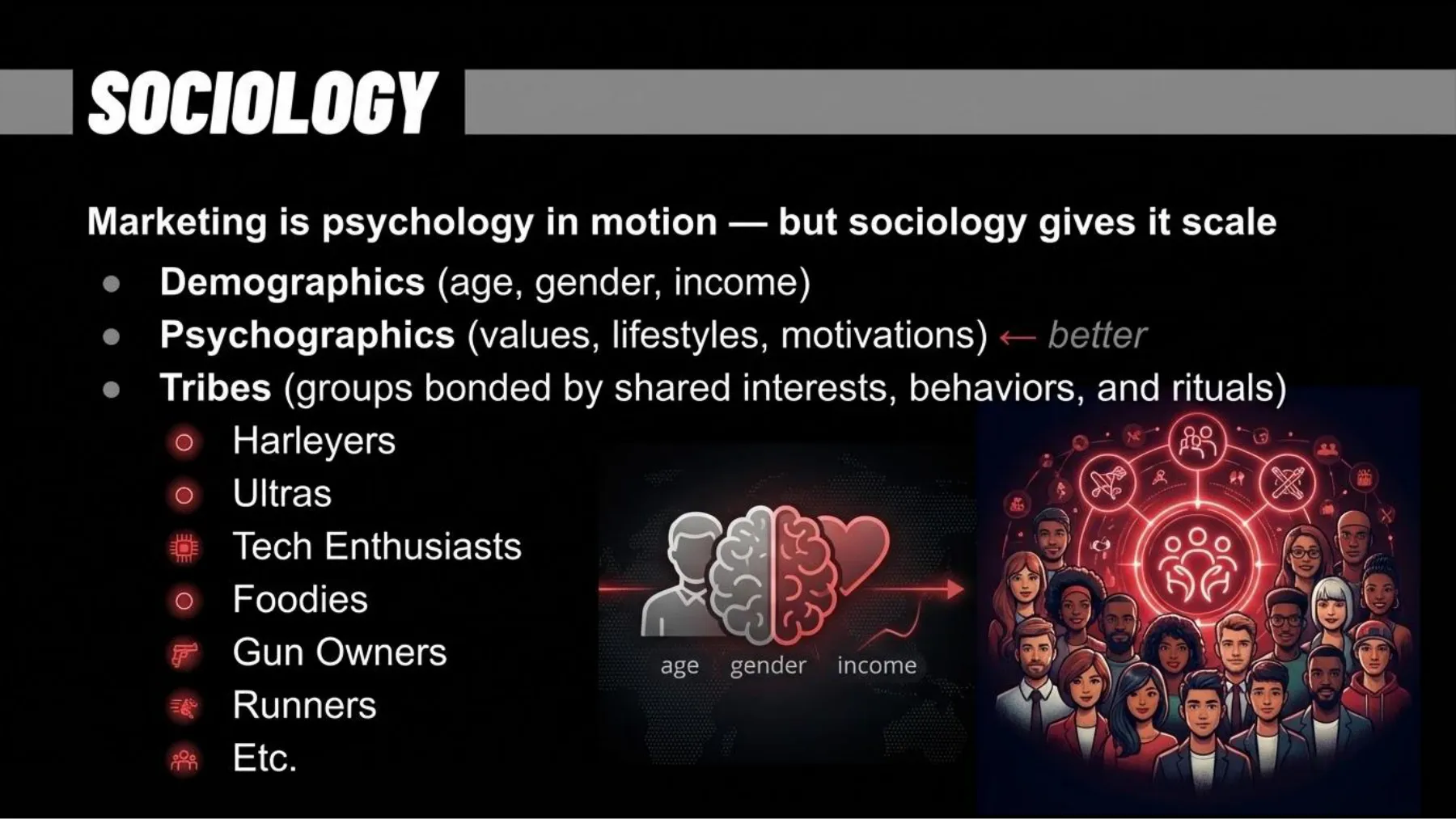
Marketing is psychology in motion, but sociology gives it scale. Demographic segmentation (age, gender, income) is a good foundation and a bad target: two men, 35, Prague, CZK 60,000 net a month, can be a judoka and a League of Legends player with nothing in common. Psychographics (values, lifestyle, motivations) is more precise. The strongest layer for social media is segmentation by tribes: groups bonded by interest, rituals and identity. More in the Marketing and Psychology chapters.
There are dozens of examples: Harley riders, ultras, foodies, runners, cosplayers, hackers, punks, hipsters, bikers, preppers, skaters, metalheads, ravers, otaku, gamers, vanlifers, sneakerheads, K-pop fandom. Members influence each other more strongly than advertising does, and social networks (a hashtag, a group, a subreddit, a Discord server) have turned local tribes into global ones.
Three rules. A tribe can’t be bought from the outside, only reached from the inside, with a language and people it respects (that’s why nano and micro influencers work). A tribe spots a tourist instantly: badly used slang does more damage than silence. And the most valuable tribes link identity with a regular ritual and a purchase: runners (races, shoes), judokas (tournaments, judogis), club fans (matches, merch). The ritual is a reason to come back, and therefore a reason to publish.
For discussion
Homework: which three tribes do you belong to? Pick one and describe its language (three words outsiders don’t know), a ritual and a hero. Then say which brand reached you there the right way and which one embarrassed itself.
7Behind the scenes: the dopamine loop and dark patterns
Social media isn’t designed for connection but for engagement
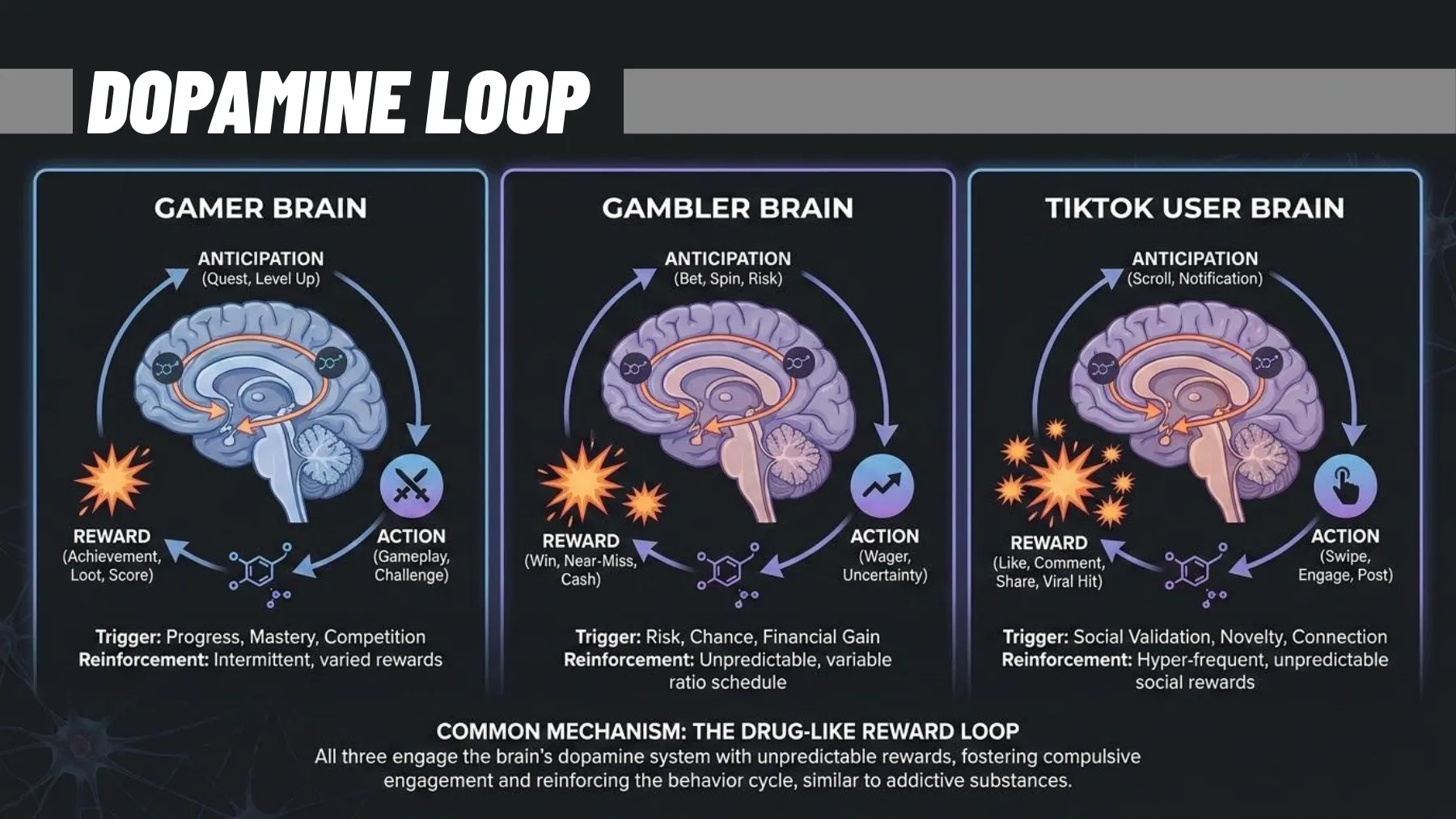
- ·Dopamine loop: trigger → action → variable reward → investment
- ·A slot machine in your pocket: infinite scroll, pull-to-refresh, autoplay, streaks
- ·American teens: 4.8 h a day on social media, half online “almost constantly”
- ·Facebook Files 2021: “We make body image issues worse for 1 in 3 teen girls”
- ·Australia since December 2025: social media from 16, 4.7 million accounts removed or restricted
Social networks aren’t optimized for connection, but for engagement, because engagement sells. At the core is the dopamine loop: the variable reward described by B. F. Skinner, which every slot machine uses. When you don’t know whether something great will appear after you refresh the feed, you keep refreshing. Nir Eyal broke it down in his book Hooked (2014) into four steps: trigger (a notification), action (opening the app), variable reward (the feed) and investment (a post, a follow), which kicks off the next round.
The loop goes hand in hand with dark patterns, Harry Brignull’s term from 2010, with a catalog at deceptive.design: interfaces designed to make you do what you wouldn’t do if you were thinking clearly. On social media: infinite scroll (no “done” signal), pull-to-refresh (a slot-machine gesture), autoplay, red badges, “X is typing…”, Snapchat streaks (runs of consecutive days you don’t want to break). These features stay because they extend time in the app. More in the Psychology chapter.
The second mechanism is the comparison trap: you compare your life with the edited highlights of other people’s lives. In September 2021, the Wall Street Journal published Facebook’s internal research (the Facebook Files): 32% of teenage girls who felt bad about their bodies said Instagram made it worse; an internal slide read: “We make body image issues worse for one in three teen girls.” Facebook objected that the sample was small and that 22% of girls said the opposite. A Congressional hearing followed; four years later came the first ban. Since December 10, 2025, Australia has banned accounts for children under 16 on ten platforms, from Facebook to Kick and Twitch (WhatsApp, Messenger and Discord are excluded), with fines of up to AUD 49.5 million; in the first month, the platforms deactivated, removed or restricted 4.7 million accounts.
Time: according to Gallup (2023, 1,591 teens in the US), the average teenager spends 4.8 hours a day on social media, and 51% spend more than 4 hours; YouTube 1.9 h, TikTok 1.5 h, Instagram 0.9 h. Pew Research (2024): almost half of American teens are online “almost constantly,” up from a quarter ten years ago. For marketers: know the mechanism, use it ethically (no campaigns built on fear of missing out) and look after your own hygiene.
- 4.8 h
- a day on social media for the average American teen, 51% over 4 hours
- 32%
- of girls with negative body image: Instagram makes it worse
- 4.7 million
- accounts of under-16s removed or restricted by platforms in Australia in a month
Gallup 2023
Facebook Files, WSJ 2021
eSafety Australia
Rabbit holes
- Deceptive Design: a catalog of dark patterns ↗ · A typology with examples, a hall of shame and an overview of the laws that ban dark patterns.
- Nir Eyal: Hooked ↗ · The trigger, action, variable reward, investment model. A textbook for designers, a warning for users.
- eSafety: Australia’s age limit ↗ · How the first social media ban for children works, which platforms are covered and how age is verified.
8The 5Cs of digital health: what to do about it
Don’t ask how many hours, ask what it does: the 5Cs
- ·Child: who I am and what stage I’m at (child, student, parent, pro)
- ·Content: what I consume, not how much
- ·Calm: do I use the screen to calm down? Do I have another tool?
- ·Crowding out: what the screen pushes out (sleep, exercise, people)
- ·Communication: do we talk about it at home, on the team, in class?
The American Academy of Pediatrics (AAP) created the 5 Cs of Media Use framework for doctors and parents. The main idea: don’t ask “how many hours,” ask “what does it do.” It works for an adult marketer just as well as for a child.
- -Child: what stage and situation you’re in. A child, a student before an exam, a new parent, a professional who manages social media. The same app affects each of them differently.
- -Content: what you consume, not how much. An hour of Figma tutorials and an hour of Reels are different hours; the quality of content shapes your relationship with media more than time does. The test: after closing the app, recall three things you saw. If you can’t, it was noise.
- -Calm: do you use the screen to calm down when you’re bored, anxious, before sleep? If your phone is the only tool you have for a strong emotion, have at least one other (a walk, music, a call).
- -Crowding out: what the screen pushes out: sleep, exercise, meals with people, learning, the boredom that ideas come from. According to the AAP, people are more likely to cut back when they see what they’ll get back. 143 minutes a day is 870 hours a year, or 36 full days.
- -Communication: do you talk about it at home, on your team, in class? It’s the only way to build digital literacy and to notice in time that someone isn’t coping. Teams that run social media should have rules for their own hygiene, just as they have for the brand’s tone.
- 7 → 11%
- of European kids aged 11–15 with problematic social media use, 2018 → 2022
- 5 → 8%
- the same in Czechia (15,000 pupils from 250 schools); girls more often than boys
- 13% / 9%
- girls / boys with problematic use in Europe
WHO Europe, HBSC 2024
HBSC Czechia, UPOL 2023
WHO Europe 2024
For discussion
Go through the five Cs on your own phone: which C is your weakest? And what would you get back if you scrolled an hour less tomorrow? Tell your neighbor, not me.
Rabbit holes
- AAP: 5 Cs Resource Hub ↗ · Posters, videos and handouts by age. Print one and put it up in the kitchen.
- WHO Europe: Teens, screens and mental health ↗ · A summary of HBSC 2024: 44 countries, 280,000 children, problematic social media use and gaming by gender.
- UPOL (Palacký University Olomouc): HBSC Czechia 2022 ↗ · Czech data from the same study: 8.3% problematic users, gaming among boys, a comparison with the rest of the world.
9Virality: STEPPS
Virality can’t be planned, but you can raise the odds: STEPPS
- ·Social currency: I share what makes me look good
- ·Triggers: what reminds me of the content in daily life (Fridays → “Friday”)
- ·Emotion: awe, anger and joy spread; contentment doesn’t
- ·Public and Practical value: what’s visible and what’s useful
- ·Stories: I retell a story, I forget a fact
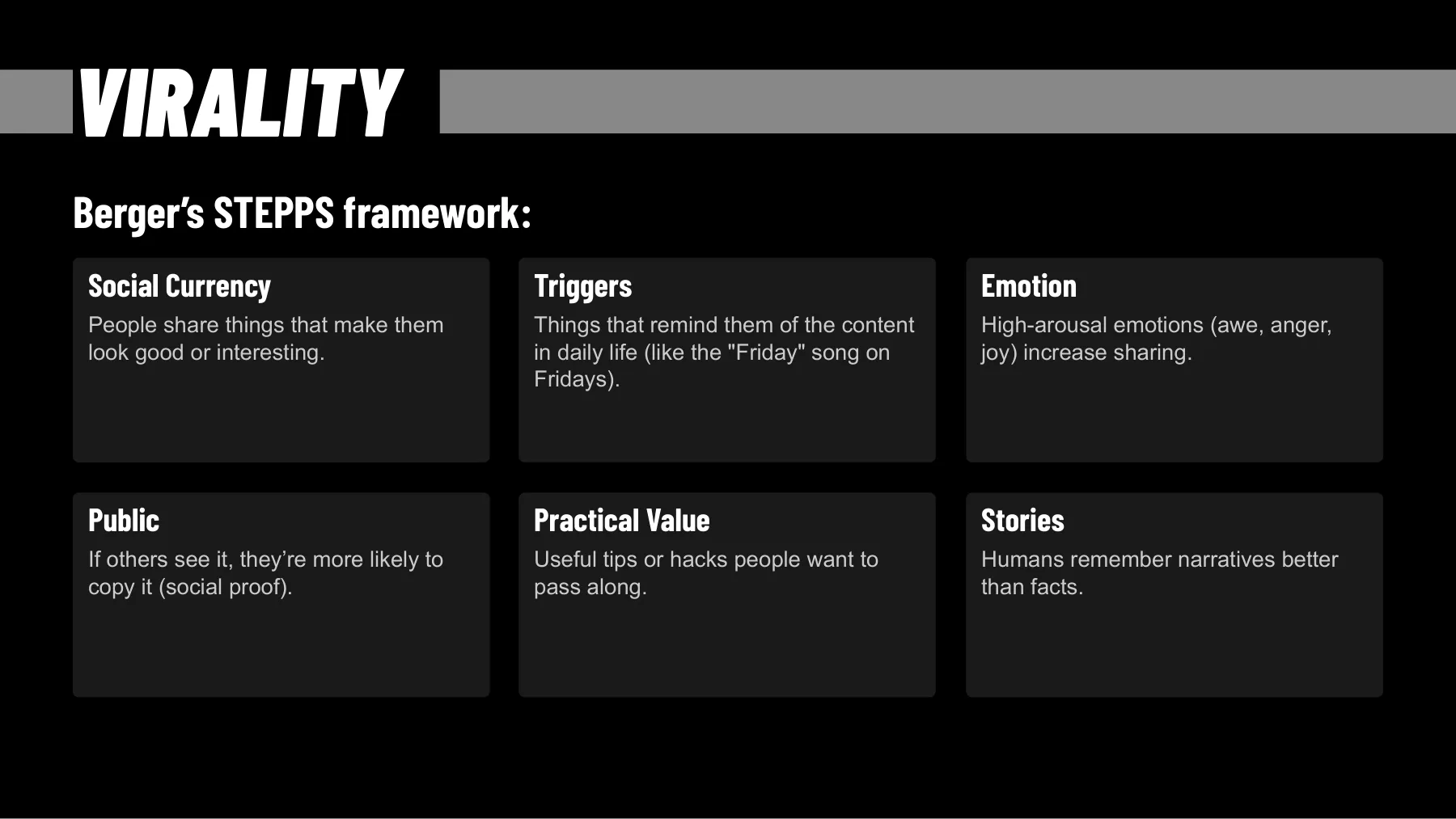
Why does one post spread and another doesn’t? Jonah Berger, a marketing professor at Wharton, summed up his research in the book Contagious: Why Things Catch On (2013) as six principles, STEPPS. It’s not a recipe for virality (virality can’t be planned), but a checklist: the more principles the content meets, the better its chances.
The textbook example is the Ice Bucket Challenge from the summer of 2014: pour ice water over yourself, film it, challenge three others and donate to ALS research. According to Facebook, between June 1 and September 1, 2014, more than 17 million videos were shared, and more than 440 million people watched them over 10 billion times.
- -Social currency: people share what makes them look good: being in the know, being funny, having taste. They don’t share your content for you, but for themselves. The question: how will the person who shares this look?
- -Triggers: what reminds people of the content in everyday life. Rebecca Black’s song “Friday” peaks in plays every Friday. A trigger in the environment beats one-off creative.
- -Emotion: strong, activating emotions spread: awe, anger, joy, anxiety. Sadness and contentment don’t spread; they calm people down.
- -Public: what’s visible gets imitated. The iPod’s white earbuds, Livestrong wristbands. Make private behavior visible and give it a brand.
- -Practical value: we pass useful things along (a how-to, a discount, a tip). The simplest and most often neglected principle: brand content is often about the brand, not about being useful.
- -Stories: we forget facts, but we retell stories. The brand has to be part of the story in a way that makes it impossible to tell the story without it.
- $115 million
- raised by the ALS Association in the summer of 2014 from the Ice Bucket Challenge
- 17 million
- challenge videos on Facebook (June–September 2014), 10 billion views
ALS Association
Facebook Newsroom, September 2014
For discussion
Take the latest post from an account you follow: FTVS, ČT sport (Czech Television’s sports channel) or your club. Give each STEPPS principle 0–3 points. What’s the total, which principle is missing and how would you add it?
Rabbit holes
- Facebook Newsroom: Ice Bucket Challenge (2014) ↗ · Primary numbers from the platform: 17 million videos, 10 billion views, 440 million people in three months.
10Events as content factories
One event = a month of content
- ·Plan content in the event brief, not after the event
- ·Before: shot list, people, access. During: one person with a phone is enough
- ·After: one 30-minute interview → Reels, quote, story, article, newsletter
- ·Press conference and medal: PR package within half an hour, while it’s news
Events, press conferences, tournaments and conferences aren’t just about being there: they are content factories. A well-planned event produces content for weeks ahead: the people, the venue and the technology are already paid for. Most companies’ mistake is planning content only after the event (“send me the photos”). Content belongs in the brief from the start. More in the Events and Streaming chapters.
Three phases. Before the event: a shot list: arrivals, the hall from above, a close-up of hands, audience reactions, the speaker from the front and from the side, the partner’s logo; people for interviews with three questions, and a slot in the program for filming: five minutes after a block, not during it. During the event: a content team, even if it’s one person with a phone and a brief; the photographer shoots for the archive, the phone films vertical video with sound for social media. After the event: slice it up. A 30-minute interview becomes a Reels clip, a quote for LinkedIn, a story, an article for the website and a paragraph for the newsletter.
A press conference is worth a few hours: a journalist wants facts, a quote and a credited photo before deadline. In sports, a result is news for an hour, then it’s a statistic.
- -Shot list.
- -Who films and who takes photos, where and when.
- -Three questions for each speaker.
- -Press release template.
- -Media list.
- -Folder for photos with photographer credits.
- -14-day publishing plan.
- -Filming consent (GDPR) on the invitation.
11Influencers and sponsorship
Trust from a person, not from a brand
- ·Influencer marketing: $32.55 billion (2025), up from $1.4 billion in 2014
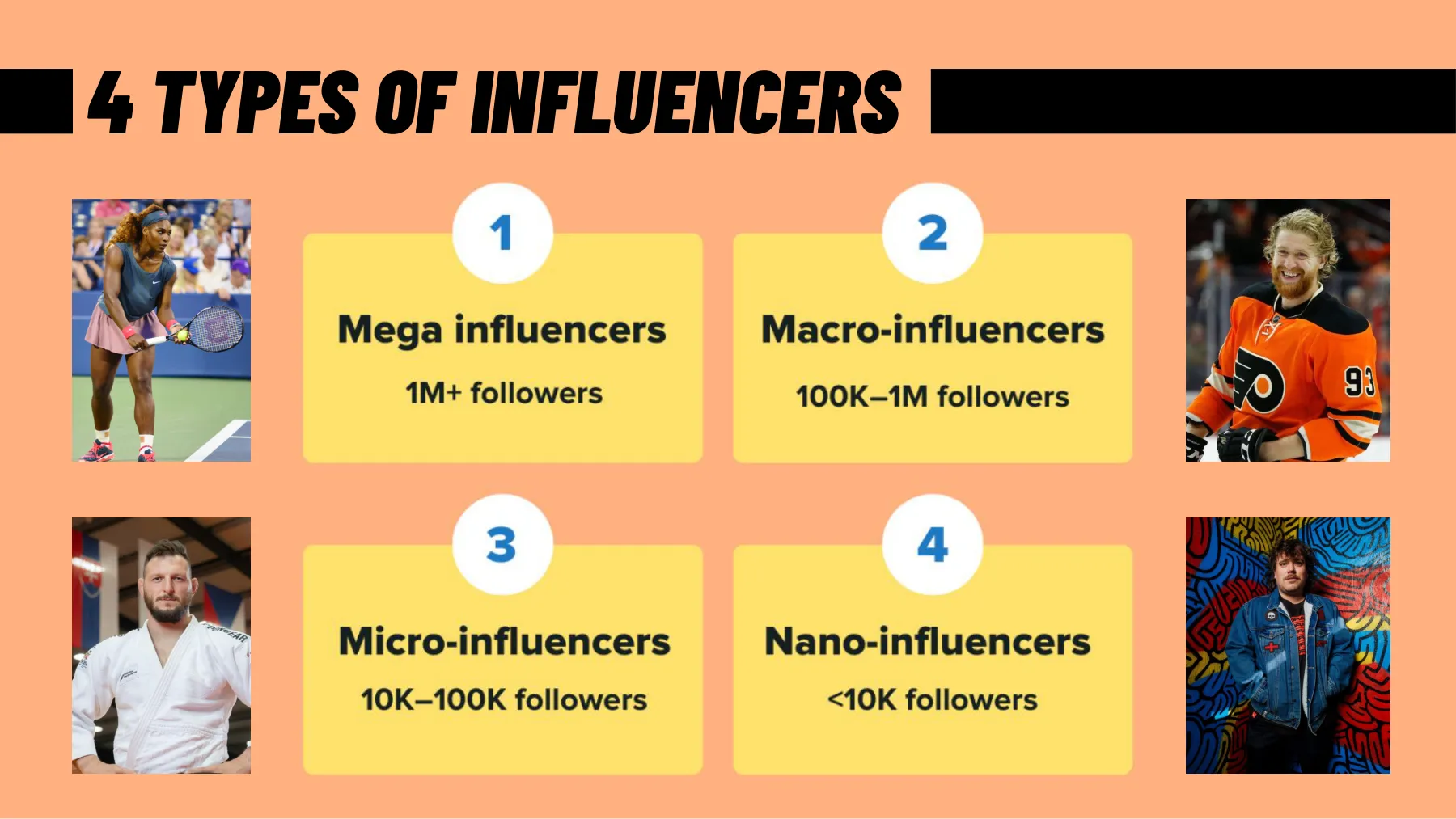
- ·Mega 1M+ · Macro 100K–1M · Micro 10K–100K · Nano under 10K
- ·Mega and macro = awareness. Micro and nano = engagement, community, trust
- ·Sponsorship = the same transfer of trust: club, event, athlete (DHL and F1)
- ·Czechia: “ad” or “paid partnership” at the very start, Férový influencer code
Influencer marketing rests on peer-to-peer trust: a recommendation from someone you follow feels natural. According to Influencer Marketing Hub (Benchmark Report 2025), the industry grew from $1.4 billion in 2014 to an estimated $32.55 billion in 2025. In Czechia, according to Lupa, spending is “in the single-digit billions of crowns a year”; TrendIn counted over 16,000 profiles with more than 10,000 followers in Czechia and Slovakia, 29% more year on year. Three quarters of Gen Z follow influencers, and half of regular followers trust their reviews (NMS 2024).
The risks: the wrong partner (values, scandals, fake followers), rising prices without rising impact, and the time spent on contracts and checking deliverables. The rule is bigger → more expensive → less effective: as size grows, reach goes up while engagement and authenticity go down, which is why each of the four sizes has a different job.
You have to label a collaboration. In the Czech Republic, the self-regulatory code Férový influencer (SPIR and Platforma profesionální komunikace) applies: a paid post carries the word “reklama” (advertisement) or “placené partnerství” (paid partnership) right at the start. A gift or a free product is payment too, so such a post gets labeled as well. The general advertising rules are in the Advertising chapter.
Sponsorship rests on the same transfer of trust, except the partner isn’t a person with an account but a club, an event or an athlete. A partner that makes sense works best: since 2004, DHL has been the official logistics partner of Formula 1, moving cars, fuel and team equipment between races. Here, logistics is visible as part of the show. Bigger → more expensive applies here too: a local club often delivers more trust per crown. The sports sponsorship numbers are in the Sponsorship chapter.
- -Mega (1M+): mass reach, viral potential, celebrity. The lowest engagement, the highest price; the audience reads the partnership as an ad. Use: awareness, a nationwide product launch.
- -Macro (100K–1M): reach within a niche, perceived expertise, a balance of reach and engagement. Still expensive, less personal connection. Use: awareness within a segment (fitness, tech, food).
- -Micro (10K–100K): higher engagement, more authentic content, good value; limited reach, so you need more of them. Use: conversion, community, local markets.
- -Nano (under 10K): the highest engagement, a recommendation from a “friend,” often paid in product; small reach, needs vetting and management. Use: local and niche campaigns, long-term ambassadors, sports and clubs.
- $32.55 bn
- estimated global influencer marketing market, 2025
- 2.19%
- engagement rate of nano creators on Instagram, the highest of all tiers
- 76%
- of creators on Instagram are nano (1K–10K), on TikTok 87%
- 16,000+
- profiles with over 10K followers in Czechia and Slovakia, +29% in a year
Influencer Marketing Hub
HypeAuditor, 2024 data
HypeAuditor 2025
TrendIn / Lupa 2026
For discussion
If there’s time left: you have CZK 200,000 to launch an isotonic drink for runners in Prague. One macro influencer with 300,000 followers and 1% engagement, or twenty nano runners with 5,000 followers each and 5% engagement? How many reactions does each option bring, and what are you buying with the remaining reach?
Rabbit holes
- Férový influencer (“Fair Influencer”): the code and member list ↗ · What exactly “label it right at the start” means, why a gift counts as payment and where to send a complaint (in Czech).
- Lupa: the new 2026 version of the code ↗ · Politics, AI content, health and finance: what’s been added, and how many CZ/SK profiles have over 10,000 followers (in Czech).
- HypeAuditor: State of Influencer Marketing 2025 ↗ · Data from millions of accounts: tier shares, engagement, fake followers, prices by platform.
12Monetization: who makes money on social media
If something is free, you’re the product
- ·Meta 2025: revenue $200.97 billion, 41% margin, 3.58 billion people a day
- ·How much does it make per person a year? $200.97 billion / 3.58 billion
- ·YouTube: over $100 billion to creators in 4 years, a 55% share
- ·Czechia: online advertising CZK 70.7 billion (2025); Herohero 400,000 paying
- ·Four creator income streams: ads, partnerships, subscriptions, own product
The platform provides the service for free, collects attention and data, and sells ads alongside them. Meta had revenue of $200.97 billion in 2025 (+22%), an operating margin of 41%, and in December 3.58 billion people a day across its apps. Simple division gives roughly $56 a year per daily active person. Almost all of it is advertising. Meta plans to put $115–135 billion into AI infrastructure in 2026: the battle for attention is turning into a battle over who will generate the feed.
The second layer is the creators. In September 2025, YouTube announced it had paid out more than $100 billion to creators, artists and media companies over four years; the standard creator share is 55%. A creator has four income streams: a share of ad revenue, paid partnerships, fan subscriptions (Patreon, or Herohero and Forendors here in Czechia) and their own product (merch, a course, a book, an event). A healthy creator has at least two, because the platform can change the rules at any time.
Czech numbers. According to SPIR, the Czech internet industry association, a record CZK 70.7 billion went into online advertising in Czechia in 2025 (+10.6%), of which display including social media was CZK 51.1 billion and search CZK 18.2 billion; SPIR doesn’t publish a separate figure for social media. Herohero had roughly 1.6 million registered users in September 2025, almost 400,000 paying ones and around 7,000 creators. An extreme case: in the summer of 2024, the YouTuber Mikýř was collecting over CZK 6 million gross a month from almost 30,000 subscribers paying 7–10 euros each.
Not everyone gets a share of ad revenue, though. A channel can join the YouTube Partner Program today with 1,000 subscribers and either 4,000 watch hours in the past 12 months or 10 million Shorts views in 90 days. The 55% applies to ads in videos; on Shorts, the creator gets 45% of a shared pool based on their share of views, and 70% of channel memberships, Super Chat and Super Thanks. A lower tier of the program, also available in Czechia, starts at 500 subscribers and unlocks memberships and fan donations, but not ad revenue. And the bar is rising: in August 2026, YouTube announced that starting February 1, 2027, a new channel will need 8,000 watch hours a year or 20 million Shorts views in 90 days, and only channels with at least 10 million Shorts views in 90 days will get money from Shorts. TikTok pays for views through its Creator Rewards program: you have to be 18 or older and have 10,000 followers and 100,000 views in the past 30 days, and it pays only for original videos longer than a minute. But the program is open in only eight countries: the United States, the United Kingdom, Germany, France, Japan, South Korea, Mexico and Brazil. So a Czech TikToker gets nothing from TikTok for views.
From fan subscriptions, the platform takes a much smaller cut than YouTube does from ads: Herohero takes 10% plus VAT, Forendors 15% of subscriptions and 20% of one-time payments, both including VAT and the payment gateway, and Patreon 10% for new creators, plus payment processing and currency conversion fees. In 2025, Forendors paid creators CZK 85 million; the average subscription was CZK 177 a month, and a subscriber stayed for 396 days on average. Since its launch, it has paid out over CZK 200 million, and more than 1,700 creators publish on it. But brand deals still bring in the most. In a NeoReach and Influencer Marketing Hub survey of more than 3,000 creators, 49% earn most of their income from brand deals, and most creators make less than $15,000 a year. On Czech Instagram, a study by the Lafluence agency and the Trendin.io platform estimated the value of tagged content over one year at CZK 3.5 billion, of which purely paid partnerships made up over CZK 1 billion; up to 70% of brand tags may have been free for the brands. The vocabulary people use when they talk about creators’ money:
- -Ad revenue share: the platform splits ad revenue with the creator; YouTube gives them 55% on videos and 45% on Shorts.
- -RPM (revenue per mille): how much the creator actually gets per 1,000 views after YouTube’s cut. It also counts views without ads, so it’s lower than the CPM the advertiser pays, and brand deals aren’t included.
- -Fan funding: channel memberships, Super Chat, Super Thanks and gifts during live streams on YouTube; the fan sends the money, and the platform takes a cut.
- -Creator subscription: fans pay monthly for extra content through Herohero, Forendors or Patreon; the platform takes 10–20% of it.
- -Paid partnership (brand deal): a brand pays the creator for an agreed post, story or video; the payment can also be a product (barter), and it still has to be labeled.
- -Affiliate marketing: the creator earns a commission on purchases made through their link or discount code, and the brand pays only for actual sales.
The third layer is you as the advertiser: you buy attention from the platform (ads), trust from a creator (partnerships), or build your own (content, community, newsletter). The first is the fastest and the most expensive; the third is the slowest and the only one that stays yours. More in the Advertising and Internet chapters.
- $56
- roughly what Meta makes a year per daily active person (calculation)
- $100 bn+
- paid out by YouTube to creators, artists and media in 4 years
- 49%
- of creators earn most of their income from brand deals
- 400,000
- paying subscribers on Herohero, ~7,000 creators
Meta, 2025 results
YouTube, September 2025
NeoReach / Influencer Marketing Hub
CzechCrunch, September 2025
Meta annual revenue ($ bn)
unit: $ bn
Almost three times as much in six years, with the same number of hours humanity has in a day. What’s rising is the price of attention, not the amount of it.
data table
| 2019 | $70.7 bn | |
|---|---|---|
| 2020 | $86 bn | |
| 2021 | $117.9 bn | |
| 2022 | $116.6 bn | |
| 2023 | $134.9 bn | |
| 2024 | $164.5 bn | |
| 2025 | $201 bn |
For discussion
Meta makes roughly $56 a year on the average user. How much would you want for selling it 143 minutes of your day? And why is nobody offering that?
Rabbit holes
- YouTube: partner earnings overview ↗ · The official creator shares: 55% of ads on videos, 45% on Shorts, 70% of memberships and Super Chat.
- YouTube: Partner Program changes from February 2027 ↗ · A higher entry bar for new channels, and 10 million Shorts views in 90 days as the condition for money from Shorts.
- Influencer Marketing Hub: Creator Earnings Report ↗ · A survey of more than 3,000 creators: where their money comes from and how much they make.
13Social selling and network = net worth
You’re planting seeds with content, not harvesting leads
- ·Social selling: relationship before offer, value before sale
- ·LinkedIn: case study, insight, know-how. Not “contact us”
- ·Results in months, not days; measured in replies, not likes
- ·Network = net worth: your network is access to ideas, opportunities, trust
Social selling is selling that starts with a relationship, not an offer. Instead of cold emails, you share what you know: a case study, an industry insight, a how-to. People file you away as “the one who understands this,” and when they need a solution, they get in touch themselves. It’s a long game: you’re planting seeds with content, not harvesting leads right away. It’s measured by how many conversations start with “I read your post,” not by likes.
On LinkedIn, in practice: a profile that says who you help, two or three posts a week with an insight from work, and comments under posts by people in your field (a comment is cheaper and often more visible than a post). LinkedIn measures its own Social Selling Index (0–100) from four components: professional brand, finding the right people, engaging with insights, building relationships.
A broader frame to finish: network = net worth. Who you’re connected to determines what you learn, what you have access to and what you become. Your network is access to ideas, opportunities, trust, support and even status. A student’s best investment isn’t followers, but ten people in the field who know what that student can do.
- -1. A profile for the customer, not for HR.
- -2. Follow 50 of the right people and read what they’re dealing with.
- -3. Comment before you publish.
- -4. Publish insights from work, with numbers.
- -5. Message only with a reason, never with a template.
For discussion
Homework: open your LinkedIn (or create it today). What would someone who wants to hire you for a summer internship take away from your profile? Write one sentence you’ll add there and one post about what you’re studying.
Rabbit holes
- LinkedIn: Social Selling Index ↗ · Measure your own score, 0–100, across four components. Free, after you log in.
14Wrap-up: a brand on social media in ten points
Social media is rented land; home is your website and email
- ·A network connects people, a medium sells attention: count on pay-to-play
- ·Be where your tribe is, and speak its language
- ·Know the loop: use it ethically, protect yourself with the 5Cs
- ·STEPPS before publishing, events as factories, small influencers for trust
- ·Target → audience → message → channel → form → result
This class had one through line: the social network is as old as humanity; social media is a twenty-year-old attention business. The platform earns from time, the creator from trust, the advertiser buys both and in the end is left with only its own content and its own people. A checklist for your first job:
- -1. Goal before channel: awareness, engagement, conversion or recruiting? Each goal has a different network and a different metric.
- -2. Audience before content: where your tribe is in Czechia (YouTube 88%, Facebook 84%, Instagram 67%, TikTok 37%, LinkedIn 24%) and what language it speaks.
- -3. Two or three channels done properly, not eight done badly. A business profile on maps is a channel too.
- -4. Organic content for engagement, paid for reach. Outbound links go in the comments, not in the text.
- -5. Run every post through STEPPS; at least three principles, otherwise it’s an announcement, not content.
- -6. Event = factory: shot list, a person with a phone, five formats, a PR package within half an hour.
- -7. Influencers by goal: mega and macro for awareness, micro and nano for trust. Audit the account before signing; “paid partnership” or “ad” at the start of the post (the rules are in the Advertising chapter).
- -8. AI for analysis and slicing, humans for decisions; label generated content with #AIobsah.
- -9. Always bring people home: website, newsletter, email. Social networks can change the rules tomorrow.
- -10. Your own hygiene: the 5Cs once a month, for yourself too. If you sell attention, you should know what it costs.
For discussion
Pick one of the ten points that you’ll do before the next class for your own profile or project. Say it out loud, so I can check on you next time.
For the exam
Terms
- -Social network vs. social media: a network connects people and ties, while a medium sells their attention through an algorithm and ads, which is why pay-to-play applies.
- -Dopamine loop: trigger, action, variable reward, and investment, the same mechanism a slot machine uses.
- -5Cs: the American Academy of Pediatrics framework (Child, Content, Calm, Crowding out, Communication) that asks not how many hours, but what it does.
- -STEPPS: Berger’s six principles of sharing (social currency, triggers, emotion, public, practical value, stories), a checklist, not a recipe.
- -Labeling a partnership: “ad” or “paid partnership” at the very start of the post under the Férový influencer code, even when the payment is a gift.
- -Creator income streams: a share of ad revenue (YouTube 55% on videos, 45% on Shorts), brand deals, fan subscriptions (Herohero, Forendors, Patreon) and their own product; a healthy creator has at least two, because the platform can change the rules at any time.
Numbers
- -143 min: what the average Czech spends on social media a day; Gen Z 220 min (AMI Digital Index 2025)
- -88%: of Czech internet users visit YouTube, the most of any network; Facebook 84%, Instagram 67% (AMI Digital Index 2025)
- -0.15%: average engagement rate per Facebook post (Socialinsider)
The final exam is online in the last lesson, in English: 30 questions with three options each from the whole course, and you need 80% to pass. It asks about the terms in the For the exam boxes and how to apply them, much like the quizzes at the end of each lesson.
Final quiz
1A sports club’s Facebook page has 20,000 followers and an average engagement rate of 0.15%. Roughly how many people will react to a typical post?
- a)About 3,000
- b)About 300
- c)About 30
answer
c) About 300.15% of 20,000 is 30 reactions, because followers are potential, not reach, which is why pay-to-play applies (section 3).2A running store in Brno wants sales and a local community, not nationwide awareness. Which influencers should it choose?
- a)One mega influencer with more than a million followers
- b)Several micro and nano runners with engaged audiences
- c)A macro fitness influencer for reach across the segment
answer
b) Several micro and nano runners with engaged audiencesMicro and nano creators have the highest engagement and trust and suit conversion, community, and local markets, while mega and macro are for awareness (section 11).3A club mostly posts announcements about itself: a new jersey, results, thanks to partners. Hardly anyone shares them. Which STEPPS principle is easiest to add, and how?
- a)Practical value: add a useful tip for fans
- b)Emotion: write more calmly, since contentment spreads best
- c)Public: post more often so the club is more visible
answer
a) Practical value: add a useful tip for fansAccording to Berger, practical value is the simplest and most often neglected principle, because brand content tends to be about the brand, not about being useful (section 9).4A student notices that because of late-night scrolling she has stopped going running and sleeps an hour less. Which of the 5Cs has she run into?
- a)Content: what matters is what exactly she watches
- b)Calm: she uses her phone to calm down before bed
- c)Crowding out: screens push out sleep and exercise
answer
c) Crowding out: screens push out sleep and exerciseCrowding out asks what the screen pushes out, such as sleep, exercise, or time with people (section 8).5A Czech TikToker with 50,000 followers and millions of views is waiting for the first per-view payout from TikTok. What do you tell them?
- a)It won’t come: Creator Rewards isn’t available in Czechia, so the money is in brand deals, subscriptions or affiliate
- b)They’ll get 55% of the ad revenue on their videos, just like on YouTube
- c)It will come once they add a business ID and bank account to the program
answer
a) It won’t come: Creator Rewards isn’t available in Czechia, so the money is in brand deals, subscriptions or affiliateCreator Rewards is open only in eight countries, not including Czechia, so a Czech creator lives mainly on brand deals and fan payments (section 12).
For next time
Student presentation at the start of lesson 08 Artificial Intelligence
Show one AI tool you’ve used for school or work: what for, what worked, what it got wrong, and what it cost.
5 minutes, one student or a pair, three slides at most or a phone on the projector
Sources worth clicking
- 1DataReportal: Digital 2026 Global Overview Report ↗ · The most-cited numbers on social media worldwide, new every year and free. The basis of every presentation on digital.
- 2DataReportal: Digital 2026 Czechia ↗ · The Czech slice: ad reach on every platform, penetration, age. When you need a number for Czechia, start here.
- 3AMI Digital Index 2025 (MediaGuru) ↗ · The only long-term Czech study of behavior on social media: who goes where, how much time they spend and why (in Czech).
- 4Jonah Berger: Contagious ↗ · The book STEPPS comes from. A Wharton professor with data, not impressions, on why things spread.
- 5AAP: 5 Cs of Media Use ↗ · The American Academy of Pediatrics framework: Child, Content, Calm, Crowding out, Communication. Works for adults too.
- 6WHO Europe: Teens, screens and mental health (HBSC 2024) ↗ · 280,000 children from 44 countries, Czechia included: problematic social media use rose from 7% to 11%.
- 7Influencer Marketing Hub: Benchmark Report 2025 ↗ · The 2025 edition: a market estimate of $32.55 billion, growth from $1.4 billion (2014) and a survey of 315 marketers. The URL without a number now leads to the 2026 edition.
- 8Meta: Q4 and full-year 2025 results ↗ · The primary source: revenue of $200.97 billion, 3.58 billion people a day, ad prices. Read what the platform tells investors, not marketers.
- 9Férový influencer: the code ↗ · The Czech self-regulatory code (SPIR and Platforma profesionální komunikace): how to label paid partnerships and gifts, a list of members, a complaint form. The 2026 version added AI content, see Lupa (in Czech).
- 10Nir Eyal: Hooked ↗ · A guide to building a habit-forming product (trigger, action, variable reward, investment). Read it as a user, not as a designer.
Rabbit holes
- Deceptive Design (Harry Brignull) ↗ · A catalog of dark patterns with examples and a hall of shame. By the author of the term dark patterns (2010).
- eSafety Australia: the age limit of 16 ↗ · What the first social media ban for children looks like in practice: which platforms, 4.7 million removed or restricted accounts, fines.
- Wikipedia: Ice Bucket Challenge ↗ · A timeline of the most famous viral campaign with links to sources: from the first videos to $115 million for ALS in the summer of 2014.
- CzechCrunch: Mapy.com goes global for the second time ↗ · An interview with David Finger: 5 million monthly app users, a third from abroad, a goal of 12 million (in Czech).
- CzechCrunch: Herohero has 1.6 million people ↗ · The Czech subscription platform: 400,000 paying users, 7,000 creators, and new competition from Komunita (in Czech).
- Lupa: the new version of the influencer code of ethics (2026) ↗ · What’s been added: political partnerships, #AIobsah, health and finance. Plus 16,000 profiles with over 10,000 followers in CZ and SK (in Czech).
- Pew Research: Teens, Social Media and Technology 2024 ↗ · American teens: almost half are online “almost constantly,” and Facebook fell from 71% to 32%.
- Tim O'Reilly: What Is Web 2.0 ↗ · The 2005 essay that named the web as a platform and users as a source of value.