Lesson 01 · 90 minutes · 13 parts
Marketing
What marketing is and why it matters to everyone: the 4Ps and 7Ps, market vs. audience, segmentation, targeting and positioning, SWOT and PEST, innovation, AIDA(S), and who does what in marketing.
What you will take away
- -Explain in your own words what marketing is and how it differs from advertising and sales.
- -Use the 4Ps and 7Ps as a checklist for any product or service.
- -Tell a market from an audience, and do segmentation, targeting, and positioning in that order.
- -Build a SWOT and a PEST with evidence for every item, and recognize disruptive innovation.
- -Describe the customer journey with the AIDA(S) model and match tools and metrics to each stage.
- -Know what marketing departments and professions look like, and where you fit in.
Lesson plan
- 5 minIntroduction · Who I am, why I teach this, the ground rules: from the second lesson on, each one starts with five minutes from one student, and the brief is at the end of the lesson. The syllabus in one sentence; the list of lessons comes at the end.
- 10 minWhy marketing, and questions for the class · What do you think marketing is? How many ads have you seen today? Let them guess, then three definitions, market figures, 60:40.
- 8 min4Ps and 7Ps, the promotion mix · The mix for Slavia and for HOPI; just list the six promotion tools.
- 23 minMarket and STP · Market vs. audience, players and types of markets, segmentation, targeting, positioning (Volvo, Tesla).
- 10 minExercise: segmentation in pairs · A 3 × 3 table for Judo Heroes Camp or for FTVS applicants; three pairs read theirs out.
- 13 minSWOT, PEST, innovation, departments · Christensen, Blockbuster vs. Netflix, in-house vs. agency, budgets and rates.
- 13 minProfessions, industries, AIDA(S) · Who does what in marketing, FMCG vs. B2B vs. sports, the funnel.
- 8 minSummary and quiz · Five sentences for the wall, homework for next time, the quiz at the end of the chapter.
Contents
- 1Who I am and why I teach this
- 2Marketing, but why?
- 3The 4Ps, the 7Ps, and the promotion mix
- 4A market is not an audience
- 5Segmentation: divide the market into tribes
- 6Targeting: who’s in, who’s out
- 7Positioning: a place in the mind
- 8SWOT, PEST, and innovation
- 9What a marketing department looks like
- 10Marketing professions: who does what
- 11Different industry, different marketing
- 12AIDA(S): from attention to action
- 1314 lessons ahead of us
1Who I am and why I teach this
0:00 / 2:49AI clone of Jan Ječmínek’s voice
Jan Ječmínek: practice over theory
- ·20 years in marketing, sports, and media; former judoka, FTVS graduate
- ·HOPI Holding: campaigns, videos, production, websites, events, studio
- ·Czech Judo Federation: Media Commission; Judo Heroes; website and velín
- ·Rules: ask me anything, attendance over 80%, final exam
My name is Jan Ječmínek, and I’ve been working in marketing, sports, and media for 20 years. I’m a former judoka, and I studied physical education right here at FTVS. At HOPI Holding, I’m in charge of campaigns, videos and production, websites, events, and the studio; the group has 4,500 people and does business in logistics and food in eight countries of Central and Eastern Europe; HOPI Logistics alone has some 3,000 people, 16 distribution centers, and more than 500 vehicles. At the Czech Judo Federation, I head the Media Commission and handle the media: the content plan, photographers and production at events, and PR packages for journalists. At Judo Heroes Camp, I’m in charge of organization and promotion. I also work for USK Praha, and I’m building my own website, jecminek.co, and the velín (Czech for “control room”), an app that keeps an eye on websites, news, and judokas’ results for me.
One rule applies to these lessons: practice over theory. Wherever I can, I’ll show a model on an example from my own work: the marketing mix of a logistics company, a PR package for journalists after a medal, websites, a streaming studio. When something doesn’t work, I’ll say that too.
This digital garden is the study material for each of the 14 lessons: slides, text, figures with sources, From practice and AI in practice boxes, links for going deeper, and a quiz. The slides in class are in English; this garden is in English and Czech. The quiz at the end of each chapter shows you what you remember from the lesson.
- -Practice over theory. I show models on real projects, including what went wrong.
- -Ask me anything: about tools, prices, mistakes, careers.
- -Attendance at more than 80% of lessons, and a final exam.
- -The garden at jecminek.co is available anytime; the quiz at the end of each chapter is a quick check of what you remember.
2Marketing, but why?
0:00 / 3:06AI clone of Jan Ječmínek’s voice
Marketing is about value, not advertising
- ·Question: what do you think marketing is? One sentence
- ·AMA: creating, communicating, delivering, and exchanging value
- ·Drucker: the aim of marketing is to make selling superfluous
- ·Not an exact science: 60:40 is the best ratio we know
- ·Everyone sells something: an idea, a product, work, themselves
In class, you write first: one sentence on what marketing is. The usual answers: “advertising,” “selling,” “manipulation.” Only then come three definitions side by side. AMA (American Marketing Association; the definition was last reviewed by a panel of five academics in 2017): marketing is the activity, set of institutions, and processes for creating, communicating, delivering, and exchanging offerings that have value for customers, clients, partners, and society at large. Philip Kotler: the science and art of exploring, creating, and delivering value to satisfy the needs of a target market at a profit. Peter Drucker (Management, 1973): the aim of marketing is to know the customer so well that the product sells itself and selling becomes superfluous. Notice the word value: none of the definitions says “advertising.”
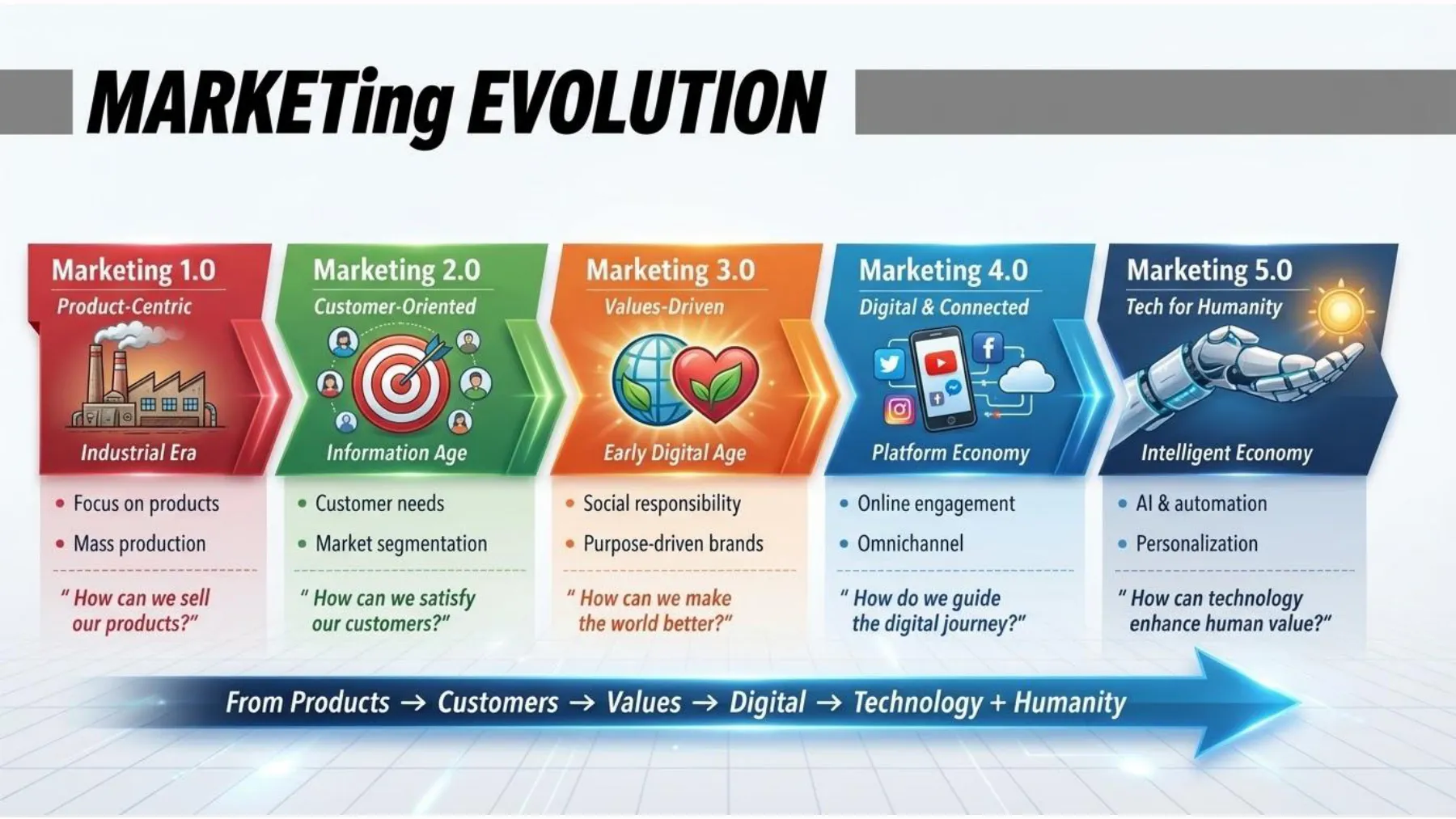
The word itself gives you a hint: market + ing, working with the market. The market provides data and structure; marketing adds meaning and direction. Kotler and his colleagues describe how the field evolved from Marketing 1.0 (the product) to 5.0 (technology for humanity, in the book Marketing 5.0, Wiley 2021); the image below the text carries it. The goal stays the same: connecting supply with demand.
Why teach this at FTVS? Because everyone sells something: a coach sells their method, a club sells tickets and partnerships, an athlete sells their story, a graduate sells themselves at a job interview. And there’s a lot of money in it. According to WARC, global advertising spend reached $1.19 trillion in 2025; according to an estimate by AKA, the Czech association of communication agencies, the Czech advertising market saw CZK 150.2 billion in net investment in 2024, roughly CZK 13,800 for every resident of the Czech Republic per year. How much of that flows through marketing departments, and what agencies charge for their work, comes in the section on departments.
Now the uncomfortable part: marketing is not an exact science; it’s more like alchemy with measurement. The merchant John Wanamaker is credited with saying that half the money he spends on advertising is wasted; the trouble is he doesn’t know which half. The best we have are long data series: Les Binet and Peter Field went through almost a thousand campaigns from the IPA database and found that brands grow fastest when roughly 60% of the budget goes into brand building and 40% into sales activation (we’ll dig into this in the Brand lesson). It isn’t a law; it’s the best ratio we know. The same goes for the question of how many ads you see a day: the figure of 5,000 comes from J. Walker Smith of the Yankelovich agency (a book from 2005; the New York Times made it famous in 2007), and nobody has ever measured it; we’ll look at where it came from in the Advertising lesson. If it were true, that would be one ad roughly every 11 seconds you’re awake.
- $1.19 tn
- global advertising spend in 2025
- CZK 150.2 bn
- Czech advertising market 2024, net investment
- CZK 13,800
- roughly per Czech resident per year (CZK 150.2 bn / 10.9 million)
- 60:40
- brand vs. activation, the best budget split we know
WARC, December 2025
AKA, estimate, May 2025
calculated from AKA and ČSÚ data
Binet & Field, IPA 2013
For discussion
What do you think marketing is? Write one sentence. And how many ads have you already seen today: 50, 500, or 5,000?
Rabbit holes
- AMA: What Is Marketing? (definition) ↗ · The official definition and the 2017 academic panel on one page.
- IPA: The next chapter for The Long and the Short of It ↗ · Where 60:40 came from and why it shifted to 62:38.
- Kotler, Kartajaya, Setiawan: Marketing 5.0 ↗ · The publisher’s page for the book on Marketing 1.0 to 5.0.
3The 4Ps, the 7Ps, and the promotion mix
0:00 / 3:55AI clone of Jan Ječmínek’s voice
The 4Ps are a checklist; services need 7Ps
- ·Product, Price, Place, Promotion (McCarthy, 1960)
- ·Services add People, Process, Physical evidence (1981)
- ·Promotion mix: advertising, PR, sales promotion, personal selling, direct, events
- ·Slavia: the match, the ticket, Eden for 19,370 people, the campaign
The marketing mix is the field’s oldest checklist. In 1960, E. Jerome McCarthy narrowed it down to four Ps: Product (what we offer), Price (for how much), Place (where and how it reaches the customer), and Promotion (how we let people know). With sports, you can explain it in a minute. The product of Slavia Prague isn’t football; it’s the match plus the experience around it: 90 minutes, chants, beer, friends. The price is the ticket, the season ticket, merch, and the TV rights. The place is the Eden stadium with a capacity of 19,370 spectators, plus the broadcast and the stream for those who don’t come. Promotion is everything from a billboard to an Instagram post. In the 2024/25 season, an average of 18,306 people came to league matches at Eden, roughly 95% of capacity (LFA statistics): product, price, and place were in tune.
Sports, logistics, and education are services, and for services, four Ps aren’t enough. In 1981, Bernard Booms and Mary Jo Bitner added People (the people who deliver the service: stewards, coaches, dispatchers), Process (how the service runs: getting into the stadium, registering for a camp, ordering transport), and Physical evidence (tangible proof: the stadium, the jersey, a clean warehouse, the website). When a parent loses their child in the registration line, that’s a failure in the P for process, and no advertising will fix it.
The fourth P, promotion, has its own mix of six tools. They aren’t planned one by one: integrated marketing communication (IMC) coordinates them together with all the customer’s touchpoints so that the customer gets one message, whether they meet an ad, a salesperson or the website (more in the Advertising lesson). Most of the tools get their own lesson in this course: Advertising, Media (PR), Events.
- -Advertising: paid, non-personal, builds awareness. TV, outdoor, online.
- -PR (public relations): media relations, press releases, reputation. You don’t pay for the space; you pay for the work.
- -Sales promotion: short-term incentives: a discount, a coupon, a contest, a sample.
- -Personal selling: person to person. In B2B, it’s decisive.
- -Direct marketing: email, SMS, push, direct mail. Measurable response.
- -Events and sponsorship: an experience where the brand meets people in person.

Rabbit holes
- Wikipedia: Marketing mix ↗ · The history of the 4Ps (McCarthy 1960) and the 7Ps (Booms & Bitner 1981), with links to the original works.
- Livesport: Chance Liga 2024/25 měla třetí nejvyšší návštěvnost v historii ↗ · LFA statistics: Slavia had 18,306 spectators per home match and 95% occupancy; the league averaged 6,177 (in Czech).
4A market is not an audience
0:00 / 2:20AI clone of Jan Ječmínek’s voice
Market ≠ audience
- ·Market = everyone who could buy. Audience = the people we talk to
- ·Players: buyers, sellers, regulators, opinion shapers, intermediaries
- ·B2B, B2C, B2B2C, B2G, C2C, C2B: who sells to whom
- ·Need › category › product: performance › sports nutrition › protein bar
A market is the environment where goods and services are exchanged: everyone who could buy. An audience is the people we actually talk to. The difference is crucial: nobody has the budget for everyone, so you pick segments from the market and talk to them. The Czech Republic has 10.9 million inhabitants (ČSÚ, the Czech Statistical Office, as of January 1, 2026); 81% of people over 16 are online every day, and 68% bought something online at least once in the second quarter of 2025 (ČSÚ). That’s the market. The audience for a judo camp is parents of children who do judo: a fraction of the market.
Five types of players act in a market: buyers (consumers, companies, institutions), sellers (manufacturers, retailers, service providers), regulators (the state, the Czech Trade Inspection Authority, GDPR, the Czech Advertising Standards Council), opinion shapers (media, experts, influencers, communities), and intermediaries (platforms, distributors, agencies). A marketer has to know which of them they’re persuading at any given moment.
A useful trick: think about the market in layers: need › category › product. A protein bar (the product) belongs to sports nutrition (the category) and satisfies the need for performance and health. So the bar’s competition isn’t just another bar, but also quark, a banana, or sleep. If you define a market only by the product, you’ll miss where the disruptor comes from.
- -B2B (business to business): fewer transactions, higher value, long cycles, more rational decisions. HOPI sells to retail chains and food manufacturers.
- -B2C (business to consumer): high volume, quick decisions, emotions. Judo Heroes Camp sells to parents.
- -B2B2C: a company supplies a company that sells to the end customer. Yogurt maker › HOPI › retail chain › you.
- -B2G (government): public procurement, a formal process, long deadlines. The federation and grants from the National Sports Agency.
- -C2C and C2B: Vinted, Bazoš, Upwork. The platform is the intermediary; people sell to each other.
- 10.9 million
- inhabitants of the Czech Republic as of January 1, 2026
- 81%
- of people over 16 are online every day (Q2 2025)
- 68%
- of people over 16 bought something online in Q2 2025
- 96%
- of people under 55 are online every day
ČSÚ, population change 2026
ČSÚ, ICT survey 2025
ČSÚ, ICT survey 2025
ČSÚ, ICT survey 2025

For discussion
Judo Heroes Camp: who is the market and who is the audience? And what is the “product” of HOPI Logistics, which sells a service?
Rabbit holes
- ČSÚ: ICT v domácnostech a uživatelé ICT ↗ · How many Czechs are online, shop online, and use social media; new data every year, free (in Czech).
- ČSÚ: Pohyb obyvatelstva, 1. čtvrtletí 2026 ↗ · 10.916 million inhabitants as of January 1, 2026, and why the number is falling (in Czech).
5Segmentation: divide the market into tribes
0:00 / 3:47AI clone of Jan Ječmínek’s voice
Segmentation: divide the market into tribes
- ·Geographic, demographic, psychographic, behavioral
- ·B2B: firmographic (size, industry, who decides)
- ·Psychographics and tribes say more than age and gender
- ·Exercise: mobile plans, FMCG logistics, judo camp
Segmentation divides a market into groups that behave similarly and can be addressed the same way. Five classic keys: geographic (region, city or countryside, climate), demographic (age, gender, income, education), psychographic (values, lifestyle, interests), behavioral (how often they buy, loyalty, price sensitivity), and, in B2B, firmographic (company size, industry, who decides). Demographics are easy to measure but explain little: two men, 45, Prague, university-educated; one goes to Slavia, the other to Sparta. Psychographics and behavior explain more.
Even better than a segment is a tribe: a group bound together by an interest, rituals, and its own language. Harley riders, ultras, runners, foodies, judokas. A tribe has its own media, its own events, and its own spokespeople, so you can reach it more cheaply than “men aged 25 to 45.” More in the Social Media chapter.
Two sample tables. The rows are the size of the customer; the columns are what they’re looking for: the lowest price (deal seekers), the best total cost of ownership (TCO), or service and experience.
- -Mobile plans: students and seniors on prepaid (price) · families balancing price against data and coverage (TCO) · business people with roaming and VIP care (service). A premium customer looking for the lowest price barely exists, and neither does a poor customer willing to pay extra for service.
- -FMCG logistics (fast-moving consumer goods): a small distributor hunting for the cheapest pallet (price) · a regional dairy that wants efficient warehousing and distribution (TCO) · a global brand like Nestlé or Coca-Cola looking for a tailor-made strategic 4PL partner (fourth-party logistics: a partner that manages the whole chain, including other companies’ carriers and warehouses; service). A retail chain that tenders on price every year is a chapter of its own.
- -Where to get data: Atlas Čechů (demographics by municipality), ČSÚ, AMI Digital Index (social media by generation), Google Trends, Similarweb (competitors’ traffic), your own analytics (Umami, Search Console).
- -Exercise (10 min): in pairs, build a 3 × 3 table. Rows for Judo Heroes Camp: the child’s age (9 to 10, 11 to 13, 14 to 15) or experience (beginner, competitor, sibling who doesn’t do judo); for FTVS applicants, motivation (athlete, future coach, PE teacher). Columns: what they’re looking for (lowest price, price vs. program, experience and care). For each cell: who decides, what they’re looking for, where you’ll meet them.
For discussion
Which tribe do you belong to? What media does that tribe read, and who are its spokespeople?
Rabbit holes
- Atlas Čechů ↗ · Czech demographics down to municipalities and city districts; a basis for geographic and demographic segmentation (in Czech).
- AMI Digital Index: Czech generations on social media ↗ · Gen Z, Gen Y, Gen X, and boomers: where they are and how much time they spend there (in Czech).
- Google Trends ↗ · Seasonality and interest in topics over time, free; check when people search for “summer camp.”
- Similarweb ↗ · Estimated traffic and traffic sources of competitors’ websites.
6Targeting: who’s in, who’s out
0:00 / 2:53AI clone of Jan Ječmínek’s voice
Targeting: who’s in, who’s out
- ·Concentrated (niche), differentiated, undifferentiated (mass)
- ·Criteria: size, growth, profitability, competition, accessibility
- ·B2B: LinkedIn targets by industry, company size, and job title
- ·Picking the wrong segment costs more than bad creative
Targeting is a choice: from the segments, you pick the ones worth aiming at. You weigh size, growth, profitability, the strength of the competition, and accessibility (can you reach them at all?). Three strategies: concentrated (a niche: one segment, everything tailor-made), differentiated (several segments, a different offer and message for each), and undifferentiated (mass: the same for everyone; rare today, it works for commodities).
HOPI Logistics aims in a focused way: the website groups clients into sectors: food and fast-moving consumer goods (FMCG), retail and e-commerce, drugstore, beverages, and gas stations (hopilogistics.eu). Slavia is differentiated: ultras in the North Stand, families with kids, corporate clients in the skyboxes, fans in front of the TV. Each gets a different ticket, different content, a different channel. Mass marketing makes sense for salt, gasoline, or public television. A badly chosen segment is the most expensive mistake in marketing: you can redo the creative in a week, but building an audience takes years.
In B2B, you target the people who make the decisions, not companies. According to Gartner (research on the B2B buying journey, 2019), a complex business purchase typically involves 6 to 10 people, and 77% of buyers described their last purchase as very complex or difficult. A newer Gartner survey from 2025 (632 buyers) counted 5 to 16 people from up to four departments: a different methodology, the same conclusion: a group decides (more in the Psychology lesson). The tool is LinkedIn: you can target by industry, company size, job title, and seniority. A retail chain’s logistics director doesn’t read the tabloids, but does read LinkedIn.

Rabbit holes
- Gartner: The B2B Buying Journey ↗ · Research from 2019: 6 to 10 people in a buying group, 77% of buyers find purchasing complex. The site only opens in a browser.
7Positioning: a place in the mind
0:00 / 2:27AI clone of Jan Ječmínek’s voice
Positioning: a place in the mind
- ·Ries & Trout (1981): the battle is fought in the customer’s mind
- ·Volvo = safety since 1959, Tesla = technology
- ·Two elements: how you differ and why you’re the better choice
- ·Sentence: For [whom], [brand] is the [category] that [benefit], because [proof]
Positioning is the place a brand holds in the customer’s mind relative to the competition. Al Ries and Jack Trout summed it up simply in their book Positioning: The Battle for Your Mind (1981, originally a series of articles in Advertising Age from 1972): it’s not what you do to the product, it’s what you do to the customer’s mind. The mind is overcrowded and remembers one word per brand. Two building blocks: differentiation (how you differ) and competitive advantage (why you’re the better choice in what matters).
The textbook example is Volvo. In 1959, engineer Nils Bohlin designed the three-point seatbelt; on August 13, 1959, the first PV544 with the belt was sold, and Volvo made the patent available to all carmakers. Ever since, Volvo has meant “safety” in people’s minds, whatever it makes. Tesla chose a different word: technology (Autopilot, the Supercharger network, over-the-air updates, acceleration). Both make cars, but they don’t compete for the same place in the mind. Positioning then drives the entire mix: which features, what price, where it’s sold, what the advertising looks like. More in the Brand chapter.
A practical tool is the positioning statement, one sentence: For [target group], [brand] is the [category] that [key benefit], because [proof]. An example: for students who want to work in sports marketing, this course is the class where you see the models on real projects, because it’s taught by someone who has been working in marketing, sports, and media for 20 years. If you can’t write the sentence, you don’t have positioning; you just have a logo. You can see your competitors’ positioning for free: Meta Ad Library and the Google Ads Transparency Center show all the running ads of any brand.
Rabbit holes
- Ries & Trout: Positioning (20th Anniversary Edition) ↗ · The book that put the word positioning into the vocabulary; it still holds up.
- The Collector: Nils Bohlin and the three-point seatbelt ↗ · How one open patent gave Volvo the word “safety.”
- Meta Ad Library ↗ · All running ads on Facebook and Instagram by brand, free.
- Google Ads Transparency Center ↗ · The same for ads on Google and YouTube.
8SWOT, PEST, and innovation
0:00 / 2:44AI clone of Jan Ječmínek’s voice
SWOT with numbers, PEST without illusions, disruption from below
- ·SWOT: strengths and weaknesses inside, opportunities and threats outside
- ·PEST(LE): political, economic, social, technological, legal, environmental
- ·Incremental vs. disruptive innovation (Christensen, 1997)
- ·Blockbuster: over 9,000 stores in 2004 › bankruptcy in 2010
Two frameworks to start any strategy. SWOT: strengths and weaknesses are inside, and you can change them; opportunities and threats are outside, and you can only react to them. Rules so that your SWOT isn’t a wish board: at most three items in each box, each with a number or evidence, and at the end, one sentence on what follows from it. “A strong brand” isn’t a strength; “95% occupancy at Eden” is.
PEST, extended to PESTLE, maps the macro environment: political (National Sports Agency grants, elections), economic (inflation, purchasing power, the koruna exchange rate), social (aging, time spent on social media), technological (AI, streaming, data), legal (GDPR, the regulation of gambling and gambling ads in sports), and environmental (the sustainability of events, fans’ travel). PEST doesn’t tell you what to do; it tells you what will happen to you if you do nothing.
Markets change because supply and demand, competition, regulation, and technology change. The engine of change is innovation. Clayton Christensen (The Innovator’s Dilemma, 1997) distinguished incremental innovation (a better phone camera, faster delivery) from disruptive innovation: a cheaper and seemingly worse solution that serves overlooked customers and then pushes the leader out from below. At its peak in 2004, Blockbuster had more than 9,000 video rental stores, and on September 23, 2010, it filed for bankruptcy protection (Wikipedia); Netflix, which started by sending DVDs by mail, had 301.6 million paying members at the end of 2024. The leader didn’t go under because it was stupid, but because it listened to its best customers. In marketing, today’s disruptor is AI: in 2025, a third of Czechs over 16 used AI tools to create content.
- 9,000+
- video rental stores Blockbuster had at its peak in 2004
- 301.6 million
- paying Netflix members at the end of 2024
- 32%
- of Czechs over 16 used AI tools to create content in 2025
Wikipedia: Blockbuster (retailer)
Netflix, Q4 2024 results
ČSÚ, ICT survey 2025

For discussion
What’s the biggest PEST threat to the club you support? And one opportunity it isn’t using?
Rabbit holes
- HBR: What Is Disruptive Innovation? ↗ · Christensen 20 years on: what disruptive innovation is and what it isn’t (in his view, Uber isn’t). HBR only gives a few free articles a month.
- NBC: Netflix tops 300 million subscribers ↗ · Results for Q4 2024, the last with a member count.
- Wikipedia: Blockbuster (retailer) ↗ · More than 9,000 stores at its peak in 2004, a bankruptcy filing on September 23, 2010, and today one store in Oregon.
9What a marketing department looks like
0:00 / 3:44AI clone of Jan Ječmínek’s voice
Strategy vs. production, in-house vs. agency
- ·Strategy vs. production: who decides, who makes it
- ·82% of large advertisers have an in-house team, 92% still pay agencies (ANA 2023)
- ·Large companies: 7.7% of revenue on marketing, 30.6% of that on paid media (Gartner 2025)
- ·Agency CZK 2,000 to 5,000/h (AKA 2026); small company: one person, suppliers, AI
Marketing can be set up in an organization in several ways, and each one changes what you’ll be doing all day. The first axis is strategy vs. production: someone decides whom we talk to, what we say, and why (brand manager, strategist, head of marketing), and someone makes it (graphic designer, copywriter, camera operator, web administrator). In a large company, these are different people and departments; in a small one, it’s one person, a strategist in the morning and production in the afternoon.
The second axis is in-house vs. agency. According to the American advertisers’ association ANA, 82% of its members had their own in-house agency in 2023, up from 42% in 2008. At the same time, 92% of them still use outside agencies: in-house for fast, cheap, everyday content; agencies for big campaigns, specialization, and an outside view. An agency costs more per hour, but you only pay when you need it; your own team costs less per hour, but you pay for it all the time.
How much money is there for all this? Every year, Gartner asks the chief marketing officers of large companies; in 2025, that was 402 CMOs from North America, the UK, and Europe, mostly from companies with revenue of over a billion dollars. On average, 7.7% of revenue went into marketing, the same as a year earlier, and paid media swallowed 30.6% of the budget. Mind the scale: this is an average for corporations, not for a Czech club or online store. What it means for you: learn to do more with less, because budgets aren’t growing.
And what does it cost in Czech crowns? Every year, the Association of Communication Agencies (AKA) publishes the average hourly rates of Czech agencies for regular client service. For 2026: account executive CZK 1,686, graphic designer CZK 2,091, copywriter CZK 2,526, account manager CZK 2,588, creative director CZK 4,934 per hour. A day of a graphic designer’s work at an agency thus comes to roughly CZK 17,000. An in-house person costs less per hour, but you pay them even in a week when nothing gets made. The in-house vs. agency decision is therefore a matter of arithmetic: how many hours of that work do you really have each month?
Share of advertisers with an in-house agency (ANA, USA)
unit: %
Most large advertisers have their own team, but agencies haven’t disappeared: 92% still use them.
data table
| 2008 | 42% | |
|---|---|---|
| 2013 | 58% | |
| 2018 | 78% | |
| 2023 | 82% |
Rabbit holes
- MediaGuru: Agency rates 2026 (AKA survey) ↗ · A table of hourly rates by position, from account executive to creative director (in Czech).
10Marketing professions: who does what
0:00 / 3:03AI clone of Jan Ječmínek’s voice
Marketing professions: who does what
- ·Copy, design, video, PPC, social, PR, brand, data, web, events
- ·T-shaped profile: one craft in depth, an awareness of the rest
- ·Money flows online: CZK 70.7 bn in Czechia in 2025, 4.7× more than in 2015
- ·AI is changing each of these professions, not all of them equally
- ·Median pay of an advertising and marketing specialist: CZK 69,982, in Prague CZK 76,461 (ISPV 2025)
“I do marketing” means dozens of different crafts today. The most common roles, what they do all day, and for each one a tool you’ll run into in your very first job:
- -Copywriter: copy for the web, ads, emails, and scripts. Google Docs, Claude, a dictionary.
- -Graphic designer, visual designer: visuals, banners, presentations, the brand manual. Figma, Adobe, Canva, Photopea.
- -Video and production: shooting, editing, streaming. A camera, OBS, DaVinci, CapCut. The Streaming and Production chapters.
- -PPC, performance specialist (pay per click): Google Ads, Sklik, Meta Ads, media buying, budgets, measurement.
- -Social media manager: content and community on social media, the plan, replies, influencers.
- -PR: journalists, press releases, crises. Relationships, not clicks.
- -Brand manager: the brand’s long-term position, consistency, the portfolio.
- -Data, analyst: GA4 or Umami, dashboards, attribution, SQL.
- -Web, product: the website as the only place you own. A CMS (content management system) or code. The Internet chapter.
- -Event manager: events from the script to the cleanup. The Events chapter.
The ideal is a T-shaped profile: one craft in depth (the vertical bar) and enough about all the others to brief the work and recognize when it’s wrong (the horizontal bar). In sports and in small companies, the T is more like a comb: three things done decently. A copywriter who can deploy a website and a designer who can handle video editing will always have work.
Where should you choose? Follow the money. The Czech online advertising market grew from CZK 15 billion in 2015 to CZK 70.7 billion in 2025 (SPIR, the Czech Association for Internet Development), 4.7× in ten years. Display advertising makes up 72%, search 26%. That’s where the jobs are: performance, data, video, content.
How much do people in marketing earn? The most reliable figures come from the Ministry of Labor’s Average Earnings Information System (ISPV). The 2025 figures cover the wage sphere, meaning businesses; the state and municipalities pay a salary under different rules and are reported separately. Advertising and marketing specialists there have a median gross monthly wage of CZK 69,982. The median is the pay of the person in the middle: half earn more, half earn less, and unlike the average, a few high salaries can’t pull it up. The median for all employees in the wage sphere was CZK 43,241. Public relations specialists, that is PR, have CZK 67,298, graphic and multimedia designers CZK 58,355, and marketing managers CZK 108,246. The spread is wide: a tenth of marketing specialists earn less than CZK 42,642 and a tenth more than CZK 131,981; statisticians call these cutoffs the first and ninth deciles. Location matters too. Of the 14,300 marketing specialists, 8,500 work in Prague, where the median is CZK 76,461, compared with CZK 48,535 in the South Moravian Region.
Recruitment agencies’ salary surveys show how pay differs by role and experience. The Hays Salary Guide for 2025 lists typical gross wages without bonuses by the employer’s industry. At consumer goods companies (FMCG), a junior marketing specialist gets CZK 41,000, a brand manager CZK 62,000, and a senior brand manager CZK 83,000; in media, a PPC specialist and a graphic designer both get CZK 67,000 and a PR specialist CZK 57,000. The same job pays differently in different industries, though: a marketing manager typically gets CZK 80,000 in media, CZK 145,000 in FMCG, and CZK 168,000 in IT. On top of that, companies give brand and marketing managers a bonus, usually 10 to 15% of their annual pay. At startups and innovative companies, mid-level marketers earn about CZK 41,000 on average and senior marketers CZK 62,410, according to a StartupJobs survey of 1,759 people. Among freelancers, marketing is the most common field. In the 2024 Na volné noze survey, a quarter of 2,237 freelancers named marketing, sales, and PR as their field, and the most common rate across all fields was between 600 and 999 Czech crowns an hour; 23% charged between 1,000 and 1,999 Czech crowns.
And what does the job market look like? It’s harder for beginners than it used to be. According to Hays, marketing pay mostly stagnated in 2024: 43% of candidates in the field said their pay had stagnated, and another 9% saw it fall. Positions for complete juniors have slightly declined because automation can handle many smaller tasks, and companies were most eager to hire people with at least four years of experience in brand management and creative work. At startups and tech companies, each job opening drew 25.5 applicants on average in the first quarter of 2026, up from 16 a year earlier. Data from abroad show where AI is taking work first. On a large global freelancing platform, within eight months of ChatGPT’s launch, the number of writing and coding jobs fell by 21% relative to jobs requiring manual skills, and after image generators arrived, the number of image creation jobs fell by 17%. The remaining jobs were more complex and better paid, a study in the journal Management Science found. In the World Economic Forum survey, employers for the first time placed graphic designers just outside the top 10 fastest-declining jobs through 2030, while user interface and user experience designers, so-called UI and UX designers, are among the 10 fastest-growing.
- CZK 69,982
- median gross wage of advertising and marketing specialists, 2025
- CZK 76,461
- median for the same specialists in Prague, where 8,500 of 14,300 work
- CZK 80–168k
- typical pay of a marketing manager: media, FMCG, IT
- 25.5
- applicants per startup job opening in Q1 2026, up from 16 a year earlier
ISPV, wage sphere
ISPV 2025
Hays 2025
StartupJobs
Internet advertising spend in the Czech Republic
unit: CZK bn
SPIR reports the total as a combination of rate-card (display) and net (search) prices; the estimate for 2026 is roughly CZK 76 billion.
data table
| 2015 | CZK 15 bn | |
|---|---|---|
| 2017 | CZK 23.3 bn | |
| 2019 | CZK 34.4 bn | |
| 2021 | CZK 48.3 bn | |
| 2023 | CZK 59.5 bn | |
| 2024 | CZK 64 bn | |
| 2025 | CZK 70.7 bn |
Rabbit holes
- ISPV: Wage sphere, Czech Republic 2025 (PDF) ↗ · Medians and deciles of gross wages by occupation; for marketing, look in the subgroup table under codes 2431, 2432, and 12213 (in Czech).
- Hays: Salary Guide 2025 (PDF) ↗ · Typical pay for marketing jobs by the employer’s industry, plus a market commentary: stagnating pay and fewer jobs for juniors (in Czech).
- Na volné noze: How Czech freelancers are doing (2024) ↗ · The largest Czech survey of freelancers: 2,237 responses on rates, fields, clients, and AI (in Czech).
- WEF: The Future of Jobs Report 2025 (PDF) ↗ · Which jobs are set to grow and decline through 2030, according to more than 1,000 employers in 55 economies.
11Different industry, different marketing
0:00 / 2:53AI clone of Jan Ječmínek’s voice
Different industry, different marketing
- ·FMCG: mass reach, TV and social media, impulse at the shelf
- ·B2B logistics: relationships, content for decision-makers, the tender
- ·Sports: an uncertain product, irrational loyalty, the experience
- ·Czechia has Seznam: 15% of search, its own ad system
The models are the same; the weights are different. Three industries for comparison. Consumer goods (FMCG) need reach: television, social media, influencers, impulse at the shelf; you don’t buy a yogurt after reading a study, but because you know it and it’s right by the checkout. B2B logistics runs on relationships: expert content, references, personal selling, targeting the few people who decide the tender; a Facebook campaign would be money thrown away. We cover the differences between B2B and B2C advertising in the Advertising chapter.
Sports is a case of its own. The product is uncertain: nobody can guarantee the result, and that’s exactly the draw. Loyalty is irrational: people stick with a club their whole lives, even when it loses. You’re selling an experience, a story, and a community, not a thing. Winning isn’t the same as commercial success: Parma won the UEFA Cup twice in the 1990s, and yet in March 2015 a court sent the club into bankruptcy with debts of €218 million; the new club started out in the fourth tier (Wikipedia). Conversely, clubs without trophies often have a full stadium and a strong brand. And an athlete is both the performance and the product: their behavior can change the value of a brand overnight. The whole Sports lesson is about this.
And one more layer: the country. The global textbook assumes Google and Facebook; in the Czech Republic, Seznam, a Czech search engine and web portal, has 15% of search (StatCounter, September 2026), its own ad system, Sklik, and its own maps. Czechs spend 143 minutes a day on social media, most of it on YouTube and Facebook; TikTok is used by 37% and LinkedIn by 24% of internet users (AMI Digital Index 2025). When you’re targeting logistics directors, 24% is plenty; when you’re targeting teenagers, Facebook is the wrong address.
- 78.7%
- Google’s share of search in the Czech Republic, September 2026
- 15.1%
- Seznam’s share of search in the Czech Republic, September 2026
StatCounter
StatCounter
Which social networks Czechs use (internet users 15+, 2025)
unit: %
B2B aims at LinkedIn, young people are on Instagram and TikTok, and Facebook is aging but holding on.
data table
| YouTube | 88% | |
|---|---|---|
| 84% | ||
| 67% | ||
| 45% | ||
| TikTok | 37% | |
| Snapchat | 26% | |
| X | 25% | |
| 24% |
12AIDA(S): from attention to action
0:00 / 2:29AI clone of Jan Ječmínek’s voice
AIDA(S): from attention to action
- ·Attention › Interest › Desire › Action › Satisfaction
- ·Each stage needs a different tool and a different metric
- ·The funnel leaks: 1,000 see it, 100 click, 10 fill in the form, 1 pays
- ·The model is a map, not a path: people skip stages and come back
AIDA is the oldest model of the customer journey: Attention, Interest, Desire, Action. It’s traditionally attributed to the American advertising pioneer E. St. Elmo Lewis (1898), although historians dispute the authorship. The modern version adds an S for Satisfaction: a satisfied customer buys again and recommends you, which is the cheapest marketing there is.
Each stage has its own tool. Attention is won by creative and placement (a billboard, a reel, a headline). Interest is held by relevant content (an article, a video, a demo). Desire is sparked by social proof and emotion (reviews, photos from an event, a story). Action is triggered by a clear call to action and a frictionless finish (a three-field form, card payment). Satisfaction comes from the product and after-sales care. The metric changes with the stage too: reach, time on page, saves and shares, conversion, repeat purchase.
The funnel leaks. Of 1,000 people who see an ad, 100 click, 10 fill in the form, and 1 pays; the numbers are illustrative, but the orders of magnitude hold. That’s why fixing the bottom pays off most: one extra field in a form costs you more customers than a weaker headline. And a critique to finish with: people don’t move in a straight line. They come back, skip stages, decide with emotion, and justify it with reason. AIDA is a map, not a path; why that is gets covered in the Advertising (the ELM model) and Psychology (Kahneman) lessons.

For discussion
The last thing you bought for more than CZK 1,000: where did you first see it, what caught your attention, what made you decide, and where did you buy it?
1314 lessons ahead of us
0:00 / 2:18AI clone of Jan Ječmínek’s voice
14 lessons ahead of us
- ·Sports · Media · Advertising · Brand · Internet · Social Media · AI
- ·Streaming · Events · Sponsorship · Trends · Psychology · Production
- ·Today: definitions, 4P/7P, market vs. audience, STP, SWOT/PEST, AIDA(S)
- ·Know the field · understand your audience · align with goals · digital and legacy channels · measure
What we covered today: marketing is about value, not advertising; the 4Ps and 7Ps as a checklist; a market is not an audience; segmentation, targeting, and positioning (STP) as three decisions in that order; SWOT and PEST as a map; innovation as the reason the map changes; AIDA(S) as the customer journey; the professions that do all this, and the industries where it’s done differently.
Five sentences for the wall: Know the field in which you play. Understand your audience, not just the market. Align with the organization’s goals; marketing isn’t art for art’s sake. Digital is critical, but the old channels haven’t disappeared: television and the internet hold up the Czech advertising market together. Measure, or you won’t know which half was wasted.
Homework for next time: pick one brand you like and write its 4Ps and a positioning statement. Ten minutes. Next lesson, we’ll start with sports, and I’ll ask you why you support the team you support.
- -2 Sports: why sports is a different product and how it’s sold
- -3 Media: who owns the Czech media, PESO, a PR package within half an hour of a medal
- -4 Advertising: objective, channel, creative, metrics, B2B vs. B2C
- -5 Brand: identity, archetypes, architecture, the Nike case
- -6 Internet: the website as the only place you own; domain, hosting, online store, analytics
- -7 Social Media: platforms, dopamine, STEPPS, tribes
- -8 Artificial Intelligence: models, agents, prices, what will be rare
- -9 Streaming: a studio from a bedroom setup to full production, OBS, retention
- -10 Events: the strongest medium, the script, the budget, Judo Heroes Camp
- -11 Sponsorship: what is for sale, activation, measurement, risks
- -12 Trends: KISS, automation, the hype cycle, adaptability
- -13 Psychology: Kahneman, Cialdini, biases, attention
- -14 Production: formats, fonts, colors, print, suppliers
For the exam
Terms
- -Marketing: creating, communicating, and delivering value to customers at a profit; advertising is just one of its tools.
- -4Ps and 7Ps: Product, Price, Place, and Promotion, plus People, Process, and Physical evidence for services (Booms and Bitner, 1981).
- -STP: from the market (everyone who could buy), segmentation and targeting pick your audience (the people you talk to), and positioning gives you a place in their minds, in that order.
- -SWOT and PEST: SWOT separates internal strengths and weaknesses from external opportunities and threats, each item backed by evidence; PEST maps the macro environment (political, economic, social, technological).
- -Median and deciles of pay: the median is the pay of the person in the middle, with half earning more and half less, so unlike the average, a few high salaries can’t pull it up; the first and ninth deciles mark where the bottom and top tenths begin. Advertising and marketing specialists had a median of CZK 69,982 in 2025 (ISPV).
- -AIDA(S): Attention, Interest, Desire, Action, and Satisfaction; each stage has its own tool and metric, and fixing the bottom of the funnel pays off most.
Numbers
- -60:40: the budget split between brand building and sales activation, the best ratio we know, not a law (Binet & Field, IPA 2013)
- -CZK 150.2 billion: net advertising investment in the Czech Republic in 2024, roughly CZK 13,800 per resident (AKA)
- -$1.19 trillion: global advertising spend in 2025 (WARC)
The final exam is online in the last lesson, in English: 30 questions with three options each from the whole course, and you need 80% to pass. It asks about the terms in the For the exam boxes and how to apply them, much like the quizzes at the end of each lesson.
Final quiz
1A classmate says marketing is basically advertising. According to the definitions from the lesson, what’s more accurate?
- a)Marketing is selling, and advertising is its first and main step
- b)Marketing creates and delivers value; advertising is one tool
- c)Marketing is advertising, PR, and sales promotion all put together
answer
b) Marketing creates and delivers value; advertising is one toolThe AMA, Kotler, and Drucker definitions all rest on value for the customer, and none of them says “advertising” (section 2)2Fans wait 40 minutes in line at the turnstiles before the match, and some of them only reach the stands after kickoff. Which P of the services mix (7Ps) failed?
- a)Process: how the service runs from arrival to entry
- b)Place: where and how the service reaches the customer
- c)Promotion: telling fans how and when to arrive
answer
a) Process: how the service runs from arrival to entryThe text gives getting into the stadium as an example of the P for process, meaning how the service runs, and no advertising will fix a process failure (section 3)3A club marketer first writes a positioning statement, then uses it to pick target groups, and finally divides the market into segments. What’s wrong with this process?
- a)Nothing; positioning comes first because it drives the whole mix
- b)Segmentation can be skipped; the statement picks the groups
- c)The order should be segmentation, targeting, positioning
answer
c) The order should be segmentation, targeting, positioningSTP is three decisions in this order: a positioning statement starts with “For [target group],” so the group has to be chosen from the segments first (section 7)4According to the rules from the lesson, which item belongs in the strengths box of a football club’s SWOT?
- a)95% stadium occupancy last season
- b)A strong, traditional brand everyone knows
- c)Higher grants from the National Sports Agency
answer
a) 95% stadium occupancy last seasonStrengths are internal and each needs a number or evidence; “a strong brand” has none, and grants are an external factor, so an opportunity (section 8)5An ad recruiting kids for a club gets lots of impressions and clicks, but few people finish the twelve-field sign-up form. What do you fix first?
- a)The ad’s headline, to catch more people
- b)The targeting, so other people see the ad
- c)The form, cutting it down to a few fields
answer
c) The form, cutting it down to a few fieldsThe funnel leaks, and fixing the bottom pays off most: one extra form field costs you more customers than a weaker headline (section 12)
For next time
Student presentation at the start of lesson 02 Sports
Pick a club or federation you know and show its 4Ps on three slides: what it sells, for how much, where, and how it gets the word out.
5 minutes, one student or a pair, three slides at most or a phone on the projector
Sources worth clicking
- 1SPIR: Výzkum inzertních výkonů internetové reklamy ↗ · Annual online advertising spend in the Czech Republic since 2015, broken down by format; the primary source for the chart in this chapter (in Czech).
- 2AKA: Czech advertising market 2024 (MediaGuru) ↗ · An estimate of CZK 150.2 billion in net investment and CZK 145.7 billion at rate-card prices (in Czech).
- 3WARC: Global ad spend exceeds forecasts for 2025 (Research Live) ↗ · $1.19 trillion in 2025, a forecast of $1.3 and $1.4 trillion, and the share of Alphabet, Meta, and Amazon.
- 4Gartner 2025 CMO Spend Survey ↗ · Large companies’ budgets at 7.7% of revenue, 30.6% of that on paid media; 402 CMOs from North America, the UK, and Europe. The site only opens in a browser.
- 5ANA: The Continued Rise of the In-House Agency (2023) ↗ · 82% of advertisers have an in-house agency, a series from 2008 to 2023, and 92% still use outside agencies.
- 6IPA: Binet & Field, The Long and the Short of It ↗ · The 60:40 split between brand building and activation, and its later revision.
- 7AMA: What Is Marketing? (definition) ↗ · The definition we compare with the students’ answers in class, and the 2017 academic panel.
- 8HBR: What Is Disruptive Innovation? (Christensen, Raynor, McDonald, 2015) ↗ · The originator of the term explains what disruptive innovation is and what it isn’t, 20 years after the book. HBR only gives a few free articles a month.
- 9ČSÚ: Umělou inteligenci používá třetina populace (2025) ↗ · The 2025 survey on ICT in households: daily internet use, online shopping, AI tools (in Czech).
- 10AMI Digital Index 2025 (MediaGuru) ↗ · 143 minutes a day on social media and the shares of individual platforms among Czech internet users (in Czech).
Rabbit holes
- NYT 2007: Anywhere the Eye Can See, It's Likely to See an Ad ↗ · Where the figure of 5,000 ads a day comes from and why it’s an estimate (paywall; for a quick check, Lunio below is enough).
- Lunio: How many ads do we see a day? ↗ · A breakdown of why nobody has ever measured the figures of 4,000 to 10,000.
- Iwamoto (2024): who really came up with AIDA ↗ · A historical study questioning the attribution of the model to Lewis in 1898 (Marketing History Research 3(2), 2024, English abstract, open access).
- The Collector: Nils Bohlin and the three-point seatbelt ↗ · How Volvo released the patent in 1959 and won the word “safety” for 60 years.
- NBC: Netflix tops 300 million subscribers ↗ · The last quarter in which Netflix published its member count: 301.6 million.
- StatCounter: search engines in the Czech Republic ↗ · Live shares of Google and Seznam; switch the period and the device yourself.
- Ries & Trout: Positioning, The Battle for Your Mind ↗ · A classic from 1981 that you can read in an evening.
- Wikipedia: E. St. Elmo Lewis ↗ · The man traditionally credited with AIDA.