Lesson 03 · 90 minutes · 11 parts
Media
Traditional and digital media, who owns the Czech ones, how they make money, and whom people trust. Podcasts, the PESO model, the press release, and the Czech Judo Federation’s media work after a medal.
What you will take away
- -Tell traditional media, new media, and independent creators apart, and know who decides what gets published in each.
- -Name the owners of the main Czech media houses and sports channels, and understand why it matters.
- -Explain agenda-setting and read the numbers on trust in the media in Czechia.
- -Use the PESO model in reverse: start with owned media and build the rest around them.
- -Write a press release a journalist won’t throw away, and send it within an hour of the event.
Lesson plan
- 5 minIntro and a question for the class · Where did you get your first news today? From TV, from Novinky.cz, from Instagram, from a podcast, or from a friend? We tally it on the board.
- 5 minStudent presentation · Pick one sports news story from the past week and show everywhere it appeared (web, TV, social media, podcasts) and who had it first.
- 14 minWhat media are and who controls them · The functions of media, three forms, how much time Czechs give them, a map of owners, and the sports channels.
- 13 minHow media make money and whom people trust · Business models, license fees, online advertising, agenda-setting, trust, and the shift to creators.
- 12 minPodcasts and types of content · Podcast numbers in Czechia, how a podcast gets made and what it costs, content formats and repurposing them.
- 15 minPESO and working with journalists · Owned → Shared → Earned → Paid, the anatomy of a press release, and what journalists reject.
- 9 minExercise: a press release about a medal · In pairs: a headline, a first paragraph, and one quote on a fresh result (backup material: Krpálek’s bronze from the 2026 World Championships, in the note for the press release section). Three minutes of writing, then we read aloud and vote on what a journalist would open.
- 12 minCzech Judo case study and crises · A PR package with a target of half an hour after a medal, the media list, the send log; crisis communication and media literacy.
- 5 minSummary and quiz · Five questions, then one sentence from each of you: what you’re taking away from the class.
Contents
- 1What media are for
- 2Three forms of media and how much time Czechs give them
- 3Who controls Czech media
- 4How media make money
- 5Agenda-setting and whom people trust
- 6Podcasts: a medium without a gatekeeper
- 7Types of content and formats
- 8PESO and why to start with O
- 9PR and the press release
- 10Case study: Czech Judo and the media
- 11Crises, critical thinking, and the future
1What media are for
0:00 / 2:03AI clone of Jan Ječmínek’s voice
Media: the channels that carry information to people
- ·They inform, persuade, entertain, and set what people talk about
- ·Mass media vs. personal digital media
- ·Watchdog of power, transmitter of values and culture
- ·1440 print · 1837 telegraph · 1920 radio · 1936 TV · 1991 web · 2007 iPhone
Communication media are the channels that spread information, opinions, and entertainment: newspapers, television, radio, websites, social networks, podcasts, newsletters. They serve four functions that mix in practice. They inform (news, results, statistics), persuade (advertising, brand messages, politics), entertain (live sports, shows, series), and set the agenda: they don’t tell you what to think, but what you’ll be thinking about today. On top of that comes the watchdog role: investigative reporting that holds power to account; and cultural transmission: values and norms, such as what behavior is okay at a stadium.
Distinguish mass media, which send one message to millions of people at once, from personal digital media, where everyone puts together their own stream. Everyone sees the same 7:30 p.m. TV news. No two people, on the other hand, see the same Instagram feed. For a marketer, these are two different games: with mass media, you buy or earn a place in one program; with personal media, you fight for a place in each person’s algorithm separately.
The history of media is a series of technological leaps, and each one shortened the path from creator to audience. Gutenberg’s printing press (around 1440) brought reading to the masses, the telegraph (1837) sent a message faster than a messenger could travel for the first time, radio in the 1920s brought live news, television from the 1930s brought pictures (the BBC in 1936, mass adoption only after the war, Czechoslovakia in 1953), the web in the 1990s brought two-way communication, and the smartphone (iPhone, 2007) brought constant connectivity with tailored content. Notice the gatekeeper: the printer, the publisher, the program director, the editor. With every leap there are fewer of them, and today nobody stands between you and a million people, only an algorithm. More in the Social Media and Sports chapters.

For discussion
Where did you get the first news of the day today? From TV, from Novinky.cz, from Instagram, from a podcast, or from a friend? And who decided that you would see that story?
2Three forms of media and how much time Czechs give them
0:00 / 2:36AI clone of Jan Ječmínek’s voice
Three forms of media, three different gatekeepers
- ·Traditional: the editor decides, wide reach, slow
- ·New: web, streaming, social networks, podcasts; instant and two-way
- ·Creators: no gatekeeper, low entry barrier, narrow audience, growing trust
- ·TV 3.5 h a day, viewers 15+ (ATO-Nielsen 2024)
- ·Social networks 143 min a day, Gen Z 220 min (AMI 2025)
Traditional media (newspapers, television, radio) send one message to a large audience at once. An editor decides what gets published and sticks, at least officially, to journalistic standards. They have wide reach, but they are slow and losing younger audiences. New media (websites, streaming, social platforms, podcasts, blogs) let companies and individuals create and share content directly, without a newsroom, instantly and in both directions: the audience comments, shares, replies. Independent creators (bloggers, podcasters, YouTubers) are the third form: entry costs nothing, reach can be huge, and the content usually targets narrow communities.
How much time do Czechs give all this? The average viewer over 15 spent 3.5 hours a day watching TV (ATO-Nielsen, January to October 2024, including time-shifted viewing within three days, which makes up 11%). Internet users spend 143 minutes a day on social networks, Gen Z 220 minutes (AMI Digital Index 2025, 1,010 respondents over 15). Every day, 51% of people listen to the radio, and the most listened-to station is Radiožurnál, Czech Radio’s news station, with 748,000 listeners a day (Radioprojekt, first half of 2025). TV and social networks alone add up to almost six hours a day, not counting radio, podcasts, websites, and games.
None of these forms is dead. Television is a reach machine, especially for sports. Social networks hold younger people’s attention and are where opinions form. Creators bring trust and depth. A good media plan counts on all three and changes the mix depending on whom you’re reaching: a B2B logistics company needs LinkedIn and the trade press, a kids’ sports camp needs parents’ Instagram, an Olympic sport needs ČT sport, the public broadcaster’s sports channel. Each form has a different gatekeeper, a different price, and different measurement:
- -Traditional: the gatekeeper is the editor; you pay for space or earn the story; measured by viewership and readership (ATO-Nielsen, Media projekt, Radioprojekt).
- -New: the gatekeeper is the algorithm; you pay for reach; measured by impressions, engagement, and time (NetMonitor, platform analytics).
- -Creators: the gatekeeper is the creator; you pay for an integration or a collaboration; measured by trust and conversions (link, code, survey).
- 3.5 h
- a day watching TV, viewers 15+ (2024)
- 143 min
- a day on social networks (2025)
- 51%
- of people listen to the radio every day
- 44%
- of Czechs aged 15–70 listen to podcasts weekly
ATO-Nielsen
AMI Digital Index
Radioprojekt H1 2025
ČRo / Median 2025
For discussion
How many hours a day do you think you spend in front of a screen? Check the screen time on your phone and compare it with the average of 143 minutes on social networks.
Rabbit holes
- AMI Digital Index 2025: time on social networks isn’t growing ↗ · 143 minutes a day, Gen Z 220 minutes, YouTube 88% and Facebook 84% of the population (in Czech).
- Radioprojekt, first half of 2025, and podcasts ↗ · Who leads on the radio (Radiožurnál, Impuls, Blaník) and how podcasts are growing (in Czech).
- ATO: Czechs watch TV 3.5 hours a day ↗ · Average daily viewing time for January to October 2024 and the share of time-shifted viewing (in Czech).
3Who controls Czech media
0:00 / 4:30AI clone of Jan Ječmínek’s voice
The ownership map: a few groups and the state
- ·TV: ČT, Nova (PPF), Prima (Ivan Zach)
- ·Mafra: half Kaprain, half Pavel Tykač’s Tymeprax (since April 2026)
- ·CNC (Křetínský), Economia (Bakala), Seznam (Lukačovič)
- ·Public service: Czech Television, Czech Radio, ČTK
- ·Three TV groups = 84% of viewing (ATO-Nielsen 2025)
The Czech media market is small (10.9 million people) and concentrated. Television is held by three groups: Czech Television (public service: ČT1, ČT2, ČT24, ČT sport), Nova in the Kellner family’s PPF group (Nova, Nova Sport 1 to 6, and since March 10, 2025, Oneplay, which replaced O2 TV and Voyo), and Ivan Zach’s Prima. In 2025, ČT had an all-day share among viewers over 15 of 29.29%, the Nova group 27.75%, and Prima 26.78% (ATO-Nielsen): three groups, 84% of TV time. In prime time and among 15- to 54-year-olds, Nova leads.
Print and online news look similar. Mafra was bought from Agrofert in 2023 by Karel Pražák’s Kaprain group; in November 2025, Kaprain signed a contract to sell half of it to Pavel Tykač’s company Tymeprax, and in early April 2026, ÚOHS, the Czech competition authority, announced that it had approved the merger with final effect. So today Mafra is held half by Kaprain and half by Tymeprax. Czech News Center is part of Czech Media Invest, owned by Daniel Křetínský and Patrik Tkáč. Economia belongs to Zdeněk Bakala. Seznam.cz, the Czech search engine and web portal (since 1996, founded by Ivo Lukačovič), runs Novinky.cz, Seznam Zprávy, and Sport.cz, and bought the publisher Borgis with the daily Právo. According to NetMonitor, Google, Seznam, and Meta have practically the same reach (7.6 to 7.7 million real users, 88 to 89% of the internet population, May 2025), but in time spent, the global platforms lead by a wide margin.
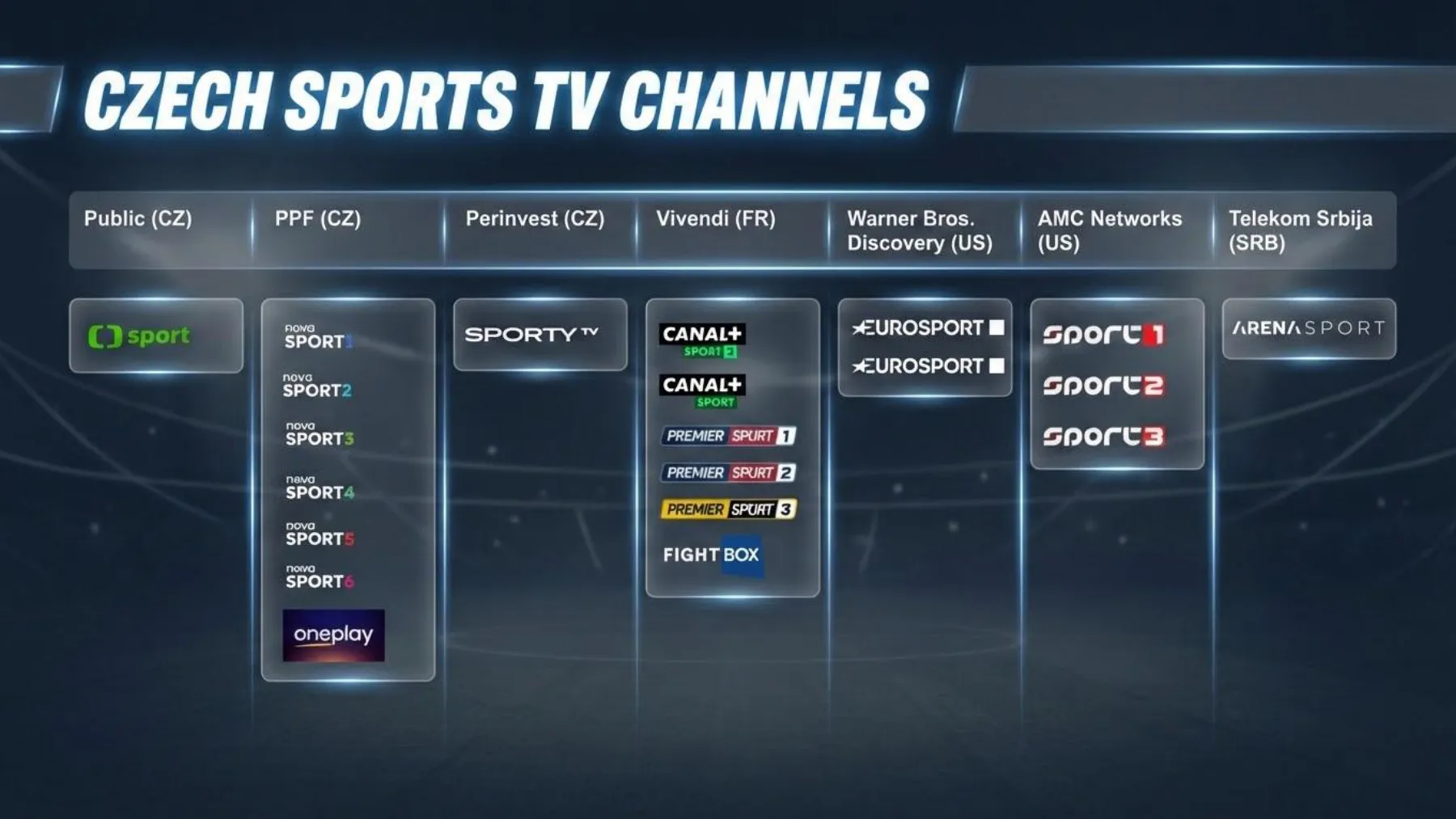
Why does it matter? The owner doesn’t write articles, but approves the budget, appoints the editor-in-chief, and sets the priorities. On top of that, the new government is proposing to replace the license fees for Czech Television and Czech Radio with money from the state budget from 2027, which would bring public service media closer to the government (Reuters DNR 2026). Before you send a press release, know whom you’re writing to and who’s above them. Sports rights are held mainly by ČT, PPF, and Canal+, which in August 2025 agreed with Nova to give each other access to their sports channels (Premier League and WTA on Oneplay, Nova Sport 6 on Skylink).
- -PPF (Renáta Kellnerová): TV Nova, Oneplay, Nova Sport 1–6, Oneplay Sport 1–4, Premier Sport 1–2, the operator O2.
- -Prima (Ivan Zach): Prima, Prima Cool, Prima Zoom, CNN Prima News, iPrima.
- -Mafra (Karel Pražák’s Kaprain and Pavel Tykač’s Tymeprax, 50/50 since April 2026): MF DNES, iDnes.cz, Lidovky.cz, Metro, Óčko, Rádio Impuls.
- -Czech News Center (Czech Media Invest: Daniel Křetínský, Patrik Tkáč): Blesk, Aha!, Sport, iSport.cz, Reflex, e15. CMI holds the radio stations Evropa 2 and Frekvence 1 outside CNC.
- -Economia (Zdeněk Bakala): Hospodářské noviny, Aktuálně.cz, Ekonom, Centrum.cz.
- -Seznam.cz (Ivo Lukačovič): Novinky.cz, Seznam Zprávy, Sport.cz, Právo (Borgis), Expres FM.
- -Public service: Czech Television, Czech Radio, the Czech News Agency (ČTK).
TV viewing share, viewers 15+, all day, 2025
unit: %
- Czech Television29.3%
- Nova group (PPF)27.8%
- Prima group26.8%
- Other16.2%
Three groups hold 84% of the time Czechs spend watching TV; ČT sport alone has 3.08%.
data table
| Czech Television | 29.3% | ČT1 16.04%, ČT2 4.23%, ČT sport 3.08% |
|---|---|---|
| Nova group (PPF) | 27.8% | Nova 18.04%, leads in prime time |
| Prima group | 26.8% | Prima 10.83% |
| Other | 16.2% | the remainder to 100% |
Rabbit holes
- MediaGuru: map of Czech media owners 2024 ↗ · Who owned what in mid-2024, including Prima, Mafra, and the sports channels (in Czech).
- ÚOHS allowed Tykač to buy half of Mafra (Seznam Zprávy, April 2026) ↗ · Kaprain remains the other half-owner; what Mafra publishes and how much Kaprain paid for it in 2023 (in Czech).
- NetMonitor now also shows data for Google and Meta (MediaGuru, March 2025) ↗ · Google, Seznam, and Meta have a similar number of real users; in time spent, the global platforms lead (in Czech).
- Canal+ and Nova opened up their sports channels to each other ↗ · How the two biggest players with sports rights agreed to swap content (in Czech).
4How media make money
0:00 / 3:31AI clone of Jan Ječmínek’s voice
Business models: who pays for content
- ·Advertising: free for the audience, the advertiser pays
- ·Subscription and paywall: 13% of Czechs pay for online news
- ·Public funding: ČT CZK 150, ČRo CZK 55 a month
- ·Hybrid, freemium, membership: Patreon, Forendors, Herohero
- ·Online advertising in Czechia 2025: CZK 70.7 bn, +10.6%
Ownership tells you who runs a medium; the business model tells you who pays for it. Public service media (BBC, Czech Television, Czech Radio) live on license fees, with a mandate to serve the public interest. Since May 1, 2025, a household pays CZK 150 a month for ČT and CZK 55 for ČRo (previously CZK 135 and CZK 45, the first increase since 2008 and 2005, respectively), and the fees are now indexed as soon as inflation since the last increase exceeds 6%. State media are run directly by the government (Czechia has none). Private media belong to the groups from the previous section and are meant to make money. Independent newsrooms (Deník N, Hlídací pes, Voxpot) matter for plurality and investigative journalism, but they are the most financially vulnerable.
There are basically four funding models, and most outlets combine them. The advertising model: content is free, the advertiser pays, and content adapts to whatever draws clicks. Subscription and paywall: the reader pays, and the newsroom has an incentive to go deep, but only 13% of people in Czechia pay for online news (Reuters Institute, Digital News Report 2025), and 10% of listeners have paid for a specific podcast (ČRo/Median 2025). Hybrid and freemium: some content is free, premium articles cost money (Seznam Zprávy, Aktuálně.cz). Membership and crowdfunding: Patreon, Forendors, Herohero; fans pay the creator directly, and the relationship is closer than with a subscription.
Meanwhile, advertising money is growing. A record CZK 70.7 billion went into internet advertising in Czechia in 2025, 10.6% more than the year before (SPIR, the Czech internet industry association, measured by Median; a combination of rate-card and net prices), of which display advertising was CZK 51.1 billion and search CZK 18.2 billion. For 2026, SPIR estimates CZK 76 billion. The catch is where that money goes: a large part ends up with the global platforms, not with newsrooms, and AI summaries in search are starting to take visits away from newsrooms too (see the box below). The advertising market as a whole and its metrics are covered in the Advertising chapter.
Television shows how the models mix inside one company. Linear broadcasting runs on a schedule, everyone sees the same thing at the same time, and it lives on ad breaks sold according to viewership measured by the Association of Television Organizations (ATO). The broadcasting act caps the amount of advertising: commercial channels may carry at most 20% advertising between 6 a.m. and 6 p.m. and between 6 p.m. and midnight, and Česká televize only on ČT2 and ČT sport, at most 0.5% of daily airtime and no more than 6 minutes an hour between 7 and 10 p.m. Video on demand (VOD) splits by who pays. A subscription without ads is called SVOD: Netflix, the Oneplay library or Prima+ Premium. Free with ads is AVOD: YouTube or basic Prima+. There is also a cheaper subscription with fewer ads, such as Prima+ Light. Between the two worlds sits catch-up viewing on IPTV services: a recording of the linear broadcast, ads included, which according to ATO made up 12.5% of all viewing in 2025. IPTV or cable is the main TV source for 54% of viewers aged 15 to 69. Since February 2026, ATO has also measured viewing outside the home and is piloting streaming data from Oneplay.
That’s why you see the same show once with ads and once without. Every episode of Survivor Česko & Slovensko 2026 was on Oneplay a day before Nova, Prima+ released the second season of Zrádci (The Traitors) a week before TV Prima, and Nova shows like SuperStar play without ads in the Oneplay library. A subscriber pays not to see ads; a TV viewer pays with attention. But linear advertising still brings in the main money: in 2024, Nova had revenue of CZK 9 billion, of which CZK 5 billion came from TV advertising and CZK 1.16 billion from internet advertising and subscriptions combined. Viewers like skipping ads in catch-up: for 32%, it’s a reason they pay for TV at all. So Prima has limited skipping since 2022, and from November 18, 2026, Nova does the same on its six free-to-air channels: of every break, you have to watch at least the first three minutes, on Oneplay and with other operators. The Oneplay library stays ad-free, and Oneplay is preparing a cheaper tier with ads. Sport works differently: the value is in the live broadcast; the Champions League runs on Oneplay on the Nova Sport channels and can be replayed for seven days.
- -Linear TV: a program on a broadcast schedule; everyone sees the same thing at the same time (Nova, ČT1).
- -Catch-up viewing (time-shifted viewing): a recording of the linear broadcast at the operator, seven days back on Oneplay, ads included.
- -SVOD: a library for a subscription, without ads (Netflix, the Oneplay library, Prima+ Premium).
- -AVOD: free, paid for by advertising (YouTube, basic Prima+).
- -Hybrid tier: a cheaper subscription with ads (Prima+ Light, the planned Oneplay tier).
- -BVOD: video on demand from a TV broadcaster (iVysílání, Prima+, Oneplay); together with ads on smart TVs (CTV), it is among what drives the growth of digital advertising today (IAB Europe).
- CZK 150
- a month for ČT since May 2025 (was CZK 135)
- CZK 70.7 bn
- online advertising in Czechia 2025, +10.6%
- 13%
- of Czechs pay for online news
- 5 of 9 bn
- CZK of Nova’s 2024 revenue came from TV advertising
TV and radio fees act, finance.cz
SPIR / Median
Reuters DNR 2025
Lupa.cz
Internet advertising spend in Czechia
unit: CZK bn
The market grows by 5 to 11% every year; most of the money goes to display and search, where the global platforms and Seznam dominate. The 2026 figure is a SPIR estimate.
data table
| 2023 | CZK 59.5 bn | almost CZK 60 bn, +5% |
|---|---|---|
| 2024 | CZK 64 bn | +7.5% |
| 2025 | CZK 70.7 bn | +10.6% |
| 2026 | CZK 76 bn | SPIR estimate, +7.4% |
Rabbit holes
- SPIR: online advertising rose to CZK 70.7 billion in 2025 ↗ · The breakdown into display, search, and catalog listings, and the outlook for 2026 (in Czech).
- Reuters Institute: Digital News Report 2026, Czech Republic ↗ · Trust, paying for news, the impact of AI Overviews on Czech websites, license fees, and the government.
- License fees for ČT and ČRo from May 2025 ↗ · How much, from when, who pays, and how indexation works (in Czech).
5Agenda-setting and whom people trust
0:00 / 2:41AI clone of Jan Ječmínek’s voice
Media don’t tell you what to think, but what to think about
- ·McCombs and Shaw 1972: the ranking of topics in media = the ranking in our heads
- ·31% of Czechs trust the news, world 37% (Reuters 2026)
- ·11th of 180 countries in press freedom (RSF 2026)
- ·Trust shifts to individuals: authenticity, niche focus, direct contact
- ·Bubbles and echo chambers: you only see what you already know
Agenda-setting is the most cited theory about what media do to the public. In 1972, Maxwell McCombs and Donald Shaw (Public Opinion Quarterly 36/2) showed that the ranking of topics by the space and placement media give them matches the ranking of topics people consider important. So media don’t dictate your opinion; they decide what you’ll have an opinion about. You can see it in elections, in activism (#MeToo, a viral protest video), and in sports: when judo gets written about mainly in connection with Krpálek, judo is Krpálek to the public. Closely tied to the agenda is framing: the same event described as a “crash” or as a “restart” triggers a different emotion.
The second big issue is trust. The Reuters Institute measures trust in news every year, and Czechia is among the low-trust countries: 30% in 2023 (a record low), 31% in 2024, 33% in 2025, and 31% in 2026, while the world average was 37%. The most trusted brands remain the public service ČT and ČRo. At the same time, according to Reporters Without Borders, Czechia jumped in press freedom from 40th place in 2021 to 10th place in 2025, and in 2026 it holds 11th place out of 180 countries. Free but distrusted media: a paradox you work with in Czechia. Only 22% of Czechs pass news on via social networks, chat, or email (DNR 2025); most read it and don’t spread it, so don’t count on your story spreading on its own.
Trust is shifting from institutions to individuals. Joe Rogan has a bigger audience than news channels, writers are leaving newsrooms for Substack, and in 2025 Czech YouTubers and podcasters founded two professional associations (ATOM and the Association of Digital Creators). Why do people trust an individual more? Perceived authenticity (they speak for themselves, not for a company), niche expertise (one sport, one topic, in depth), and direct contact (they reply in the comments). In sports, that means fan podcasts, ultras forums, and former players’ blogs: closer to the fans, more authentic, but without fact-checking and with the risk of rumors. The flip side is filter bubbles (content based on your previous clicks), echo chambers (you see only the views you already hold), sensationalism (clickbait: the algorithm amplifies emotion), and a fragmented public debate. More in the Psychology chapter.
- 31%
- of Czechs trust the news (2026), world 37%
- 11th
- Czechia’s rank in press freedom 2026 (2025: 10th)
- 22%
- share news via social networks, chat, or email
Reuters DNR 2026
Reporters Without Borders
Reuters DNR 2025
Trust in news in Czechia
unit: %
The share of people who trust the news most of the time. Since 2023 it has stayed around 30 to 33%, below the world average of 37%.
data table
| 2023 | 30% | record low |
|---|---|---|
| 2024 | 31% | |
| 2025 | 33% | |
| 2026 | 31% | world 37% |
For discussion
Whom do you trust more: ČT24 or a YouTuber you’ve been following for five years? And what happens when that YouTuber gets something wrong? Who corrects them?
Rabbit holes
- McCombs & Shaw: The Agenda-Setting Function of Mass Media (POQ, 1972) ↗ · The official citation: free abstract, full text behind a paywall.
- McCombs & Shaw 1972: free copy (PDF, UNC) ↗ · A scan of the original study, 12 pages; University of North Carolina course material, an unofficial copy.
- Digital News Report 2026: Czech Republic ↗ · Trust, paying for news, the impact of AI on traffic, public service media.
- RSF: Czech Republic, World Press Freedom Index ↗ · 2026: 11th of 180 (83.01 points), 2025: 10th (83.96 points); a profile of Czech media through the eyes of Reporters Without Borders.
6Podcasts: a medium without a gatekeeper
0:00 / 4:19AI clone of Jan Ječmínek’s voice
Podcasts: 63% of Czechs monthly, about 4.8 million people
- ·44% listen weekly, up from 36% in 2023
- ·Most listening happens on YouTube, Spotify is second
- ·1,176 active Czech podcasts (October 2025)
- ·What sets them apart: intimacy, long format, host-read ads, RSS
- ·The gear is cheap; the expensive part is time for prep and editing
A podcast is an audio series, and more and more often a video series, that listeners play whenever they want. Technically, it’s an RSS feed with audio files: you upload an episode to a hosting service, the host generates the RSS, and apps read it. Nobody gives you permission or promotes you. It’s a medium without a gatekeeper, where the hardest part is getting your first hundred listeners.
The numbers for Czechia are higher than most people expect. According to Median’s survey for Czech Radio (April 2025, 2,524 internet users aged 15 to 70), 63% listen to podcasts at least once a month, which works out to roughly 4.8 million Czechs in the 15 to 84 population. Weekly listeners grew from 36% (2023) to 44%, and the share of those who listen for more than two hours a week rose from 33% to 56%. The most used platform for both listening and discovery is YouTube, with Spotify second; people listen on their phones, in their free time (58%) and while doing chores (50%). According to the České podcasty platform, there were 1,176 active Czech podcasts as of October 1, 2025 (an episode in the last 90 days), and 57,445 episodes came out in the third quarter.
What sets podcasts apart: intimacy (a voice in your headphones, often during activities when you can’t read), long format (40 to 90 minutes, a relationship with the host), host-read ads, which work thanks to that trust, and weak measurement: you know the number of plays, not who listened or for how long. A podcast is good for depth and relationships, bad for quick reach. An interview with an employee lasts for months, a press release for a day. How to start:
- -Format and rhythm: interview, solo, or two hosts; 30 minutes every two weeks is more sustainable than an hour every week.
- -Gear: a USB mic and headphones; for more guests, a mixer (Rode Caster Pro) and lavalier mics; for video, at least two cameras.
- -Hosting and distribution: Spotify for Creators for free, Buzzsprout or Transistor paid; RSS to Apple Podcasts and Spotify, episodes on YouTube too.
- -Every episode: a title with the topic (not just the guest’s name), a description with links, a transcript, three clips for social media, a paragraph for the newsletter.
- -Measurement: plays after 7 and 30 days, completion rate on Spotify and YouTube, website visits from the podcast (UTM tags in the link, your own short link).
- 63%
- of Czechs aged 15–70 listen to podcasts monthly
- 4.8 million
- listeners, extrapolated to the population aged 15–84
- 1,176
- active Czech podcasts (October 2025)
- 72%
- of people aged 15–24 listen monthly
ČRo / Median, April 2025
ČRo / Median
České podcasty
ČRo / Median
Regular podcast listening in Czechia: 2023 vs. 2025
unit: %
The number of listeners grows slowly, but those who listen are listening much more.
data table
| Weekly 2023 | 36% | |
|---|---|---|
| Weekly 2025 | 44% | |
| 2 h+ a week 2023 | 33% | |
| 2 h+ a week 2025 | 56% |
Rabbit holes
- Up to five million Czechs listen to podcasts (ČRo / Median 2025) ↗ · Who listens, where, when, and what they pay for; the survey methodology (in Czech).
- Active podcasts in Czechia top one thousand (České podcasty) ↗ · How many podcasts are being made and how many episodes come out each month (in Czech).
7Types of content and formats
0:00 / 3:47AI clone of Jan Ječmínek’s voice
One event, ten outputs
- ·Genres: news story, reportage, interview, commentary, data analysis, documentary
- ·Digital formats: live stream, short video, podcast, newsletter, gallery
- ·Format by channel: 16:9 on YouTube, 9:16 in Reels, plain text in email
- ·Gen Z: YouTube 98%, Instagram 96%, TikTok 77% (AMI 2025)
- ·Life cycle: creation → distribution → repurposing → archive
Journalists think in genres, and it pays to know them. A news story answers who, what, when, where, why, and how, with the most important thing first. A reportage is news from the scene, with atmosphere. An interview is built on personality, commentary on opinion, analysis on data and context, a documentary on time and story. Then there are the digital formats: live streams, short video (Reels, Shorts, TikTok), podcasts, newsletters, photo galleries, data visualization. When you send material to a journalist, give it to them in the genre they work in: a result and a quote for a sports website, a story for a magazine, a table for a data journalist.
The second axis is the channel. The same content takes a different shape depending on where people see it: horizontal 16:9 on YouTube and TV, vertical 9:16 in Reels and Shorts, square or 4:5 in the feed, text with one image in an email, bare text in a press release. Generations also differ in where they are: according to AMI Digital Index 2025, Gen Z uses YouTube at 98%, Instagram at 96%, and TikTok at 77%, while millennials use Facebook and YouTube equally at 94% and Instagram at 75%. One format for everyone doesn’t work; one piece of content in five formats does. The technical specs are covered in the Production chapter.
The third axis is time: content has a life cycle. It gets created, distributed (web, social media, email, journalists), repurposed (three clips from an hour-long interview, a quote from a clip, a post from the quote), and archived so that it can be found. A short video lives for hours, an article for years. Hence the rule: one event, ten outputs. From one tournament: the result, a photo gallery with photographer credits, the athlete’s reaction on video, a quote for the press release, a clip for Reels, a story from the arena, an article for the website, a paragraph for the newsletter, a post for partners, an entry in the archive. None of it costs an extra day of shooting, just a plan made in advance.
- -Before the event: a list of outputs, who makes them, where they go, and when; without a name on every line, nothing gets done.
- -During the event: photos and reactions right away, not in the evening; the first post within an hour, results as they come in.
- -After the event: the article and gallery within 24 hours, clips and the podcast within a week, a summary for partners within a month.
- -Archive: files with the date and the event in the name, a credit on every photo, transcripts for videos.

Rabbit holes
- AMI Digital Index 2025: Czech generations on social networks (MediaGuru) ↗ · Gen Z: YouTube 98%, Instagram 96%, TikTok 77%; millennials: Facebook and YouTube 94%, Instagram 75% (in Czech).
8PESO and why to start with O
0:00 / 3:16AI clone of Jan Ječmínek’s voice
PESO: Paid, Earned, Shared, Owned, and in reverse
- ·Paid: ads, sponsored posts, paid partnerships
- ·Earned: coverage you earn; it can’t be bought
- ·Shared: social networks and communities; reach borrowed from the platform
- ·Owned: website, newsletter, podcast; the only thing nobody can switch off
- ·In practice, start with O: Owned → Shared → Earned → Paid
The PESO model was described by Gini Dietrich in her book Spin Sucks (2014), and it’s the simplest map of communication today. Paid media: you control the message and the timing, you pay for every contact, and trust is the lowest. Earned media: a mention you can’t buy, but earn with a good story; the highest trust, zero control over what comes out. Shared media: social networks and communities where people spread the content; the reach is borrowed from the platform, and the algorithm can cut it at any time. Owned media: website, newsletter, podcast, contact database; the only thing nobody can switch off for you.
The original order of the letters tempts you to start with advertising. In practice, the model flips to OSEP: first Owned, because without a place of your own you have nowhere to send people; then Shared, where we spread our own content; then Earned, where journalists build on it; and Paid only at the end, to amplify what already works. Brands that do it the other way around pay for reach to something that has nowhere to lead. Each channel has a different role: Owned is home, Shared is conversation, Earned is proof, Paid is the amplifier. The best results come from the overlaps: a creator (Shared) talks about your podcast (Owned), a website picks it up (Earned), and you boost that article with ads (Paid).
A practical test for every channel: what happens if it gets shut down tomorrow? If Instagram disappeared, how many people would find you? If Google changed its algorithm, how many visits would you lose? If a journalist left, who would write about you? The only answer that doesn’t hurt is an email list and a website on your own domain. That’s why the Internet chapter starts with the website as the only place you own; borrowed reach is covered in the Social Media chapter, paid reach in the Advertising chapter.
- -Paid: search and social ads, a sponsored article (native advertising), a paid partnership with a creator, a billboard, a TV spot.
- -Earned: a press release and the article that comes from it, an interview, an invitation to a press conference, a quote in someone else’s podcast, a review.
- -Shared: your own social media profiles, groups and communities, employee advocacy, user-generated content.
- -Owned: website, blog, newsletter, podcast, YouTube channel (halfway: someone else’s platform, your content), contact database, events.

For discussion
Take a brand you like. Which of its channels are Owned and which are only borrowed? What would it have left if Instagram disappeared tomorrow?
Rabbit holes
- Gini Dietrich: PESO Model (Spin Sucks) ↗ · The model’s author explains the four types of media and their overlaps.
9PR and the press release
0:00 / 3:34AI clone of Jan Ječmínek’s voice
The press release: still the most useful thing PR provides
- ·PR = managing communication between an organization and its publics
- ·72% of journalists: the press release is the most useful material (Cision 2025)
- ·86% immediately toss a pitch that isn’t about their beat
- ·Anatomy: headline, first paragraph, quote, facts, credited photos, contact
- ·Timing: within an hour of the event, not the next day
Public relations is managing communication between an organization and its publics: journalists, employees, partners, fans, authorities. PR people write press releases and speeches, arrange interviews, speak for the company, guard its reputation, and handle crises. Unlike advertising, PR is mainly about earned media: space you can’t buy. A good PR person therefore thinks like an editor: what’s news for that outlet’s readers, not for the boss.
Journalists are overloaded, and they say exactly what they want. According to the Cision State of the Media 2025 survey (over 3,000 journalists from 19 countries), 72% call the press release the most useful thing PR can give them, 86% immediately reject a pitch that isn’t relevant to their beat or audience, and 85% say a relationship is best started simply: with an introduction by email. Over half of journalists already use generative AI, and 72% worry about factual errors in AI-written PR copy. The takeaway: write briefly and precisely, to a specific person, and back up every number.
A press release has a fixed anatomy, because a journalist reads it for ten seconds. The headline is the news in one sentence, with the name and the result, no embellishment. The first paragraph answers who, what, when, where, and with what result; if it were the only thing left, it would still have to work. A quote from the athlete or the boss adds emotion and what the journalist can’t write themselves. Facts and context: numbers, history, what it means. Photos in print quality, as a link, not a 30 MB attachment. A contact for a person who picks up the phone. And timing: a story about a medal is worth something for an hour; the next day, it’s already been written up from the agency feed.
- -Email subject = headline. Not “Press release” but “Zachová takes bronze at the World Championships.”
- -One page, plain text in the body of the email, no Word attachment; a link to the article and to the photo folder.
- -Photos: horizontal and vertical, the photographer in the file name and in the email, permission to use them.
- -A specific person, not a generic newsroom address; better ten right recipients than a hundred wrong ones.
- -An embargo only when it makes sense (announcements, awards), always with an exact time and time zone.
- -After sending: track who picked it up, say thank you, fix any mistake right away.
- 72%
- of journalists: the press release is the most useful material
- 86%
- immediately reject a pitch outside their beat
- 85%
- want to start a relationship with an email intro
Cision 2025
Cision 2025
Cision 2025
Rabbit holes
- Cision: State of the Media 2025 ↗ · What journalists want from PR: the press release, relevance, email, and how they use AI.
10Case study: Czech Judo and the media
0:00 / 3:51AI clone of Jan Ječmínek’s voice
Czech Judo: a PR package within half an hour of a medal
- ·IJF API results → article → reaction → credited photos → email to journalists
- ·The list from the “Média kontakty” spreadsheet, BCC, a send log
- ·Goal: one email with everything within half an hour of a medal; a human sends it
- ·After a medal, my dashboard sends a push: “Prepare a PR package for the media?”
- ·Verbatim quotes, nothing made up, a credit on every photo
The Czech Judo Federation is a small federation with a big name: Lukáš Krpálek has two Olympic golds (Rio 2016 under 100 kg, Tokyo 2020 over 100 kg) and world titles from 2014 and 2019. For the media, judo is Krpálek, and when he isn’t fighting, attention drops. So the federation’s media work has to get the most out of every result while newsrooms still want it. Journalists who care about results sign up for the mailing list themselves through the form on the For Media page.
At the core is the PR package for journalists after a Czech judoka’s result. The process: 1) match results from the public interface (API) of the International Judo Federation (IJF), with no manual copying; 2) the article from czechjudo.org; 3) a transcript of the athlete’s reaction, made locally on your own computer (ffmpeg and Whisper), and verbatim quotes from it; 4) photos from the IJF gallery with the photographer and a link to the original, plus a portrait from the agency Tvůj Brand; 5) an email, as a BCC, to the media list from the “Média kontakty” spreadsheet; 6) an entry in the send log. Goal: within half an hour of a medal, newsrooms get one email with everything. A person sends it, not a script: they check the email before sending and send it themselves.
The package has three rules: verbatim quotes, nothing made up, a credit on every photo. The IJF writes names without diacritics, so the Czech names are kept in a table keyed by IJF ID. Around the package runs the judo dashboard: upcoming events, Czech judokas’ matches at IJF events as phone notifications (draw, morning, medal, summary), and after a medal or a tournament day, the push “Prepare a PR package for the media?” The czechjudo.org website is the package’s permanent link: it has articles, results, a calendar, a media section, and links to social networks.
- -Before a tournament: events in the plan have “photographer” and “production” tasks, and my dashboard watches whether any are missing.
- -On match days: my dashboard sends Czech judokas’ matches as push notifications to the phone (draw, morning, medal, summary).
- -After a medal or a tournament day: the push “Prepare a PR package for the media?” and the goal of one email with everything within half an hour.
- -After sending: an entry in the send log; new journalists sign up through the form at czechjudo.org/pro-media.
- 2×
- Olympic gold for Lukáš Krpálek (2016, 2020)
- 30 min
- goal from the medal to the email to newsrooms
- 6 steps
- from the IJF API to the send log
- 68
- emails in 26 days sent by the old media monitor
Olympics Rio 2016, Tokyo 2020
Czech Judo PR package
Czech Judo PR package
jecminek.co dashboard
Rabbit holes
- czechjudo.org ↗ · The federation’s website: news, results, calendar, a media section, and links to social networks (in Czech).
- IJF: International Judo Federation ↗ · Results, rankings, and photo galleries with photographer credits, from which the PR package is put together.
- IJF: Baku 2026 World Championships gallery ↗ · Photos by category for the exercise’s backup material (Krpálek over 100 kg, Zachová under 63 kg), each with its photographer.
11Crises, critical thinking, and the future
0:00 / 2:50AI clone of Jan Ječmínek’s voice
When things are on fire, and how not to get fooled
- ·Crisis: the first statement within 60 minutes
- ·Media literacy: who owns it and where that photo came from
- ·AI: summaries instead of clicks, deepfakes instead of evidence
- ·Protocols (RSS, email) outlive platforms
- ·Free speech vs. regulation: you answer for every post
A crisis in the media comes unannounced, and in sports it typically involves doping, injuries, disputes in the team, finances, or fan behavior. There are three rules. A rapid response: answer a rumor or a controversy quickly and accurately; the media will read silence as an admission, and someone else will fill the space. One message: PR, players, coaches, and management say the same thing, and one person speaks for everyone. Multiple channels: a press release, your own website, social media, answers to journalists, and internally, employees and members hear it before they read it in the papers. Have a template for the first statement ready in advance (“we’re aware of it, we’re verifying, we’ll get back to you within two hours”) and a lawyer’s contact: in a crisis you don’t improvise, you fill in the template.
The second skill is reading media critically: knowing who owns the outlet (see the section on owners), checking the origin of a photo with a reverse image search, not trusting a sensational headline that promises more than the text delivers, and recognizing satire or deliberate disinformation (checklist below). The difference between native advertising (paid content in the newsroom’s style), influencer marketing (an athlete subtly recommends a product), and propaganda (deliberately shaping an ideology) lies in who pays and whether the reader knows.
Where is this heading? AI and algorithms: automatically written news, deepfakes (faked video or voice), summaries instead of clicks; and, on the other hand, AI for fact-checking. Decentralization: protocols instead of platforms, a common language of systems: HTTP and DNS for the web, SMTP and IMAP for email, RSS for content (podcasts still run on it today), ActivityPub for networks like Mastodon. A protocol belongs to no one; a platform belongs to someone. That’s why newsletters and podcasts will outlive the end of any network (the Internet chapter). And freedom or chaos: anyone can publish, disinformation included; nobody will draw the line between regulation and free speech for you, and as communicators you answer for it with every post. What comes next is summed up in the Trends chapter.
- -Crisis template: the first statement within 60 minutes, who speaks, who approves, where to point people, when the next update comes.
- -Verifying an image: TinEye or Google Lens; the date it first appeared and the original context.
- -Verifying a source: who owns it, when the site was created (Wayback Machine), who the author is, whether it cites sources.
- -Your own hygiene: every number has a source; a human reads AI text; a photo has a photographer and permission.
For discussion
Which internet protocol did you use today without knowing it? And what would happen to your favorite podcast if Spotify shut down tomorrow?
Rabbit holes
- TinEye: reverse image search ↗ · Upload a photo and find out where and when it first appeared.
- Wayback Machine ↗ · What any website looked like in the past; check when something was created and what changed.
- RSF: World Press Freedom Index ↗ · The press freedom ranking of 180 countries, with Czechia in the top twelve.
For the exam
Terms
- -Gatekeeper: whoever decides what gets published: the editor in traditional media, the algorithm in new media, and the creator for independent creators.
- -Media owner: doesn’t write articles, but approves the budget, appoints the editor-in-chief, and sets the priorities, so know whom you’re writing to.
- -Agenda-setting: media don’t dictate what you think, but decide what you’ll think about (McCombs and Shaw, 1972).
- -PESO and OSEP: Paid, Earned, Shared, and Owned media (Gini Dietrich, 2014); in practice you start with Owned media, and Paid amplifies only at the end.
- -Linear broadcasting and video on demand: linear TV lives on ad breaks in the schedule, while video on demand lives on an ad-free subscription (SVOD) or is free with ads (AVOD); that’s why the same show is ad-free in the Oneplay library and has ads in catch-up viewing.
- -Press release: a headline with the name and the result, a first paragraph on who, what, when, and where, a quote, facts, photos as a link, and a contact; a medal story is worth something for an hour.
Numbers
- -31%: of Czechs trust the news most of the time (2026); the world average is 37% (Reuters DNR 2026)
- -84%: of TV time is held by three groups: ČT, Nova, and Prima (ATO-Nielsen 2025)
- -143 min: a day internet users spend on social networks (AMI Digital Index 2025)
The final exam is online in the last lesson, in English: 30 questions with three options each from the whole course, and you need 80% to pass. It asks about the terms in the For the exam boxes and how to apply them, much like the quizzes at the end of each lesson.
Final quiz
1A federation pitches a topic to a sports podcaster who publishes on YouTube. Who decides whether the topic makes it into the show?
- a)The YouTube algorithm, where the podcast is published
- b)An editor, just like at news media
- c)The creator, who decides on their own content
answer
c) The creator, who decides on their own contentFor independent creators, the gatekeeper is the creator; the algorithm is the gatekeeper of new media, and the editor of traditional media (section 2)2From November 18, 2026, Nova viewers can no longer skip the start of an ad break in catch-up viewing, not even Oneplay subscribers. Why does the broadcaster do this?
- a)Linear advertising brings in most of its revenue, and skipping takes viewers away from the ad breaks
- b)The broadcasting act has required it since 2026
- c)ATO doesn’t measure time-shifted viewing, so nobody pays for skipped ads
answer
a) Linear advertising brings in most of its revenue, and skipping takes viewers away from the ad breaksIn 2024, CZK 5 billion of Nova’s CZK 9 billion revenue came from TV advertising, which is why both Prima and Nova limit ad skipping in catch-up viewing; the Oneplay library stays ad-free (section 4)3The media write about judo almost only when Krpálek competes. According to agenda-setting theory, what follows?
- a)People will adopt journalists’ opinions about judo
- b)To the public, judo will mainly mean Krpálek
- c)Nothing; agenda-setting applies only to politics and elections
answer
b) To the public, judo will mainly mean KrpálekAccording to McCombs and Shaw, media don’t dictate your opinion but decide what you’ll have an opinion about, so judo is Krpálek to the public (section 5)4A new running race has no website and no email list, and wants to go straight to paid social ads. What do you recommend as the first step?
- a)Its own website and email signups; ads come later
- b)Ads right away, since Paid gives control of the message
- c)A press release, since Earned has the highest trust
answer
a) Its own website and email signups; ads come laterIn practice, PESO flips to OSEP: first Owned, because without a place of your own you have nowhere to send people, and Paid only at the end as the amplifier (section 8)5A Czech judoka wins bronze at the World Championships at noon. How and when should you send the press release?
- a)The next morning after a careful review, as a Word attachment
- b)Within an hour, subject with name and result, text in body
- c)In the evening, subject line “Press release,” photos attached
answer
b) Within an hour, subject with name and result, text in bodyA story about a medal is worth something for an hour, the email subject is the headline with the name and the result, and the text goes in the body of the email, not in an attachment (section 9)
For next time
Student presentation at the start of lesson 04 Advertising
Bring one ad that caught your attention this week. Say what its goal is, who it’s for, and how you would tell whether it works.
5 minutes, one student or a pair, three slides at most or a phone on the projector
Sources worth clicking
- 1Reuters Institute: Digital News Report 2026, Czech Republic ↗ · The annual profile of Czechia: trust at 31%, paying for news at 13%, the impact of AI Overviews on Czech websites, public service media, and the government.
- 2ATO-Nielsen: TV viewing in 2025 (MediaGuru) ↗ · Group and channel shares for all of 2025, prime time, the most watched program (in Czech).
- 3MediaGuru: updated map of Czech media owners 2024 ↗ · Who owns what: PPF, Prima, Mafra, CNC, Economia, Seznam, radio stations, sports channels (in Czech).
- 4SPIR: the online advertising market rose to CZK 70.7 billion in 2025 (Lupa.cz) ↗ · How much is spent on internet advertising in Czechia, the breakdown by format, and the estimate for 2026 (in Czech).
- 5Czech Radio / Median: podcasts in Czechia 2025 (MediaGuru) ↗ · 63% monthly listeners, 44% weekly; who listens, where, and what they pay for (in Czech).
- 6McCombs & Shaw: The Agenda-Setting Function of Mass Media (POQ, 1972) ↗ · The official citation: free abstract, full text behind a paywall (a free copy is in the links of the agenda-setting section). The foundation of everything taught about the influence of media on the public agenda.
- 7Gini Dietrich: PESO Model (Spin Sucks) ↗ · The model’s author explains Paid, Earned, Shared, Owned, and their overlaps.
- 8Cision: State of the Media 2025 ↗ · Over 3,000 journalists from 19 countries on what they want from PR and how they use AI.
- 9AMI Digital Index 2025: time on social networks (MediaGuru) ↗ · 143 minutes a day, Gen Z 220 minutes, and each network’s share of the population, YouTube 88% and Facebook 84% (in Czech).
- 10AMI Digital Index 2025: Czech generations on social networks (MediaGuru) ↗ · Where the generations differ: Gen Z YouTube 98%, Instagram 96%, TikTok 77%; millennials Facebook and YouTube 94%; Gen X YouTube 87% (in Czech).
Rabbit holes
- Tim Wu: The Attention Merchants (Knopf, 2016) ↗ · How human attention became a commodity that media have been selling to advertisers since the 19th century: from the penny press to Facebook.
- Herman & Chomsky: Manufacturing Consent (1988, 2002 edition) ↗ · The propaganda model: five filters (ownership, advertising, sources, flak, ideology) that a story passes through before you see it.
- Gini Dietrich: Spin Sucks (Que, 2014) ↗ · The book in which the PESO model was born; communication and reputation without tricks.
- ČTK Protext: how a press release gets into the news agency ↗ · The paid PR service of ČTK, the Czech News Agency: the release goes into Infobanka, into newsrooms’ email feeds, and onto news portals (in Czech).
- Czech YouTubers, influencers, and podcasters founded the ATOM association (Lupa.cz, June 2025) ↗ · Creators organize like publishers: the Association of Creators and Online Media, led by Jiří Burýšek, and why it was founded just now (in Czech).
- The Association of Digital Creators now has bylaws (Lupa.cz, 2025) ↗ · A second association, this time mainly of podcasters: copyright, licensing, and education for creators (in Czech).
- Oneplay: PPF’s sports channels since March 2025 ↗ · Which rights Oneplay Sport, Nova Sport, and Premier Sport hold, and why you won’t find them with other operators (in Czech).