Lesson 06 · 90 minutes · 12 parts
Internet
Your website as the one place you own: the history and state of the internet, platforms, online stores, APIs, databases, analytics, SEO, and the path from the address bar all the way to the server.
This lesson has no English narration yet. The Czech version is narrated.
What you will take away
- -Explain why your own website is the only channel you fully control, and how to drive traffic to it from all the others.
- -Choose a platform for a website or online store based on purpose, budget, and who will maintain it: from Carrd to Next.js on a VPS, from Shoptet to Shopify.
- -Describe the path of a request from the domain through DNS, hosting, and HTTPS to the browser, and know what each layer costs.
- -Plug in ready-made services through APIs (payments, email, forms, maps) instead of building from scratch.
- -Set up measurement (Umami, GA4, Search Console) and SEO basics in Czechia, where Seznam and AI answers live alongside Google.
- -Write emails, landing pages, and QR codes that lead to one action: KISS (keep it simple, stupid).
Lesson plan
- 5 minIntro and a question for the class · “How many hours a day are you online?” Students guess, then we show 6 h 38 min from DataReportal. We ask two more questions during the lesson: on websites (what’s left if Instagram disappears) and on analytics (three numbers for the camp); the questions in the other sections are homework.
- 5 minStudent presentation · Show the website of one club or event on a phone: what’s on the first screen, how many taps it takes to reach the sign-up or the ticket, and what you would change.
- 10 minHistory and state of the internet · From ARPANET to 6 billion users, Czechoslovakia in 1992, Czechia today with 88% of people online.
- 15 minThe website as your own place, and platforms · Owned vs. rented, the Target → Result strategy, choosing a platform from Carrd to Next.js.
- 15 minInfrastructure, online stores, APIs, and services · Domain, DNS, hosting, HTTPS; Shoptet vs. Shopify and marketplaces; payments, email, and forms through APIs.
- 5 minExercise: the stack of your own project · Everyone draws the layers of their own (possibly fictional) website on paper: domain, hosting, platform, payments, email, analytics. One student presents, the others compare it with their own.
- 15 minAnalytics, SEO, and AI search · Umami vs. GA4, Search Console, Google vs. Seznam, Core Web Vitals, AI summaries and clicks.
- 15 minEcosystem, emails, QR codes, and landing pages · Recycling content, rewriting a bad email together using KISS, generating a QR code live, a landing page with one goal. Designing a landing page for a club event is homework.
- 5 minSummary and quiz · Five questions, three options, vote by raising your hand.
Contents
- 1From ARPANET to six billion
- 2Czechia online in numbers
- 3The website: the one place you own
- 4What to build your website on
- 5Infrastructure: what happens when you type an address
- 6Online stores and marketplaces
- 7APIs, databases, and services to plug in
- 8Analytics: measure, but don’t snoop
- 9SEO in Czechia and AI search
- 10The digital ecosystem and recycling content
- 11How (not) to email
- 12QR codes, digital business cards, and landing pages
1From ARPANET to six billion
From ARPANET to six billion
- ·1969: ARPANET connects the first four computers
- ·1983: TCP/IP, the protocol the internet still runs on
- ·April 30, 1993: CERN makes the web free for everyone
- ·February 13, 1992: Czechoslovakia goes online from ČVUT
- ·2025: about 6 billion people online, three in four
The internet isn’t one thing; it’s a layer cake. In September 1969, ARPANET connected its first computer at UCLA, and by the end of the year there were four nodes (UCLA, SRI, UC Santa Barbara, and Utah). In March 1972, Ray Tomlinson wrote the first program for sending and reading email. On January 1, 1983, ARPANET switched to TCP/IP, the set of protocols the internet still runs on today (Internet Society).
On top of the network sits the web. In March 1989, Tim Berners-Lee at CERN wrote the proposal “Information Management: A Proposal,” in November 1990 the first server and the first page went live, and on April 30, 1993, CERN declared that anyone could use the web without fees (W3C). That one decision is why the open web took over the world. Then came Google (1998) and the iPhone (2007): each layer added another billion people.
Czechia got connected early. On February 13, 1992, at the Faculty of Electrical Engineering of the Czech Technical University (ČVUT) in Dejvice, Prague, academics announced that the internet was available in Czechoslovakia. The team was led by Jan Gruntorád, who later founded CESNET, the operator of the Czech academic network, and who is now a member of the Internet Hall of Fame (CzechCrunch). The leased data line to Linz, Austria, cost about CZK 170,000 a month (CNN Prima News), and only academia had access. Seznam.cz, the Czech search portal, has been around since 1996.
Today, according to the ITU, about 6 billion people use the internet, three quarters of the world; 2.2 billion people remain offline, 96% of them in low- and middle-income countries. In high-income countries, 94% of people are online; in low-income countries, 23% (ITU, Facts and Figures 2025).
- 6 billion
- people online in 2025, about 74% of the world
- 6 h 38 min
- average daily time online for an adult internet user
- CZK 170,000
- a month for ČVUT’s first data line to Linz in 1992
- 1 trillion
- pages archived in the Wayback Machine (October 2025)
ITU, Facts and Figures 2025
DataReportal, Digital 2025 (GWI)
CNN Prima News
Internet Archive
Share of the world’s population using the internet
unit: %
In twenty years, from one sixth of humanity to three quarters; the jump in 2020 is COVID.
data table
| 2005 | 15.6% | |
|---|---|---|
| 2008 | 22.8% | |
| 2010 | 28.4% | |
| 2013 | 35.3% | |
| 2015 | 39.9% | |
| 2017 | 46.3% | |
| 2019 | 53.9% | |
| 2020 | 60.1% | |
| 2022 | 67% | |
| 2023 | 69.2% | |
| 2024 | 71.2% | |
| 2025 | 73.6% |
For discussion
How many hours a day do you think you’re online? Guess a number, then we’ll compare it with the average of 6 h 38 min. And what would happen to your day if the internet went down for 24 hours: which of the things you do would still work without it?
Rabbit holes
- Internet Society: Brief History of the Internet ↗ · History from the people who were there: Cerf, Kahn, Leiner, and others.
- W3C: History of the Web ↗ · A timeline of the web from the 1989 proposal to the founding of W3C.
- Lupa.cz: Den, který všechno změnil ↗ · What February 13, 1992, looked like at ČVUT (in Czech).
- Internet Archive: one trillion pages ↗ · The Wayback Machine passed one trillion archived pages; every website, including yours, has a history there.
2Czechia online in numbers
Czechia online: 88% of people, 90% of households
- ·ČSÚ 2025: 88% of people over 16 use the internet, about 7.7 million
- ·90% of households connected, senior households only 60%
- ·68% of Czechs shop online, 86% own a smartphone
- ·63% of web page requests worldwide come from mobile: design for the phone first
According to the Czech Statistical Office, ČSÚ (data for 2025, published November 11, 2025), 90% of households are connected to the internet and 88% of people over 16 use it, about 7.7 million people. 86% of people have a smartphone, and 68% have shopped online (ČSÚ). Age makes the difference: almost all households with children are connected (99.6% in 2024), senior households 60%; you can’t reach an older audience with a website alone.
The second number that changes the craft: mobile. According to DataReportal, more than 63% of requests to websites worldwide came from mobile phones in December 2024 (Digital 2025). “Mobile first” isn’t a choice: open your website on a phone first. A form you can’t fill in with your thumb is a form nobody fills in.
Addresses: at the end of 2025, 1,515,860 .cz domains were registered, up 2% year on year, according to the .cz registry (CZ.NIC). That’s roughly one domain for every seven inhabitants. Since March 2025, the wholesale price has been CZK 160 a year excluding VAT; at a registrar you’ll typically pay CZK 200 to 300: the cheapest item in your stack and the only one you must never let expire.
- 88%
- of Czechs over 16 use the internet (about 7.7 million)
- 90%
- of Czech households are connected, senior households 60%
- 1,515,860
- .cz domains at the end of 2025
- 63%
- of website requests come from mobile (worldwide, December 2024)
ČSÚ, 2025
ČSÚ, 2025
CZ.NIC, Domain report 2025
DataReportal, Digital 2025
Rabbit holes
- ČSÚ: ICT v domácnostech a uživatelé ICT ↗ · Official numbers on Czechs online, every year in November (in Czech).
- CZ.NIC: Domain report 2025 ↗ · Statistics on .cz domains: how many there are, who holds them, how they grow.
- DataReportal: Digital 2025 ↗ · The most-cited global overview of the internet, mobile, and social media; free, hundreds of slides.
3The website: the one place you own
Your website is the one place you own
- ·Owned (website, domain, emails) vs. rented (Instagram, YouTube, Google profile)
- ·All traffic ends up on your website: PPC, social, SEO, email, QR, offline
- ·A website must work before it looks pretty
- ·Strategy: Target → Audience → Message → Channel → Form → Result
Split your channels into owned (website, domain, email list) and rented (social media profiles, YouTube, your business profile on Google); paid and earned we know from the PESO model. On rented land, the landlord can change your reach, algorithm, format, and price at any time. On your own land, the rules and the data stay yours. Everything in your digital strategy ultimately leads to your website: it’s the one place you fully control.
Traffic flows to your website from everywhere: paid ads (PPC), social media posts, search engines (SEO), email links, QR codes, even offline campaigns. That’s why a website must work first and only then look pretty: clear navigation, fast loading, works on a phone, no broken links. The test: can a stranger tell within ten seconds what you offer and what they should do?
Your digital communication strategy rests on six questions in a row: Target (what I want to achieve, measurably), Audience (who I’m talking to), Message (what I’m saying), Channel (how I deliver it), Form (what it looks like), and Result (did I meet the goal?). Example with Judo Heroes Camp: the goal is to fill all 65 places; the audience is parents of judokas aged roughly 9 to 15 from clubs all over Czechia; the message is “A week of judo you keep coming back to”; the channel could be Instagram, email to past participants, and QR codes in clubs; the form is a landing page with registration; the result is registrations against capacity.
KISS (keep it simple, stupid; the Trends chapter covers it as a trend) applies to architecture too: instead of one giant website, go for several small ones, each for one thing. A static page doesn’t break and costs pennies; add a database only where people register or pay.

For discussion
If your Instagram and TikTok accounts disappeared tomorrow, what would be left of your communication? Do you have the email addresses of your fans or members, or does only the platform have them?
4What to build your website on
Purpose, upkeep, and cost pick the platform, not fashion
- ·WordPress powers 40% of all websites (W3Techs)
- ·A one-page site in an hour: Carrd $19/year, Framer from $10/mo billed yearly
- ·Apps with login or payments: Next.js on Vercel or a VPS
- ·Choose by purpose, who will maintain it, and what it can cost
Platforms form a scale from clicking to code: builders (Carrd, Framer, Squarespace, Wix, Webflow) with templates and hosting included; content management systems (CMS) like WordPress, with the content in a database; and custom code (Next.js, Astro) on Vercel or your own server (VPS). The further right you go, the more freedom and the more responsibility.
According to W3Techs (October 14, 2026), WordPress runs on 40.0% of all websites, which is 58.5% of the CMS market. And 31.6% of websites have no CMS at all: they’re static pages or custom applications. WordPress isn’t “the right one,” just the most common: its strength is plugins, its weakness is maintenance.
What it costs: Carrd Pro Standard is $19 a year for 10 sites with a custom domain and forms (pricing); Framer Basic is $10 a month billed yearly (more without an annual commitment) with a custom domain, Pro $30 (pricing). WordPress is free; you pay for hosting and updates. Next.js is free; you pay for the server and a developer or AI. The real cost of a website isn’t the license but the hours of maintenance per year.
The first decision: static or dynamic. A static website is ready-made HTML files: there’s nothing to hack, nothing crashes, and a CDN distributes it for cents. A dynamic website assembles each page from a database: necessary when people register or pay, or when content is created daily. Most clubs and small brands need static pages plus one form.
- -Does the content change more than once a week? Then a CMS or a database. Otherwise, static is enough.
- -Do people register or log in? Then an application (Next.js, Rails, Django), not a builder.
- -Who will be fixing it a year from now? A marketing colleague can handle a builder; code needs a developer or an AI agent.
- -How much can it cost? Add up the license, hosting, and hours of maintenance per year.
Share of technologies across all websites (W3Techs, October 2026)
unit: %
The remaining 31.6% of websites use no content management system: static pages or custom code.
data table
| WordPress | 40% | |
|---|---|---|
| Shopify | 5.4% | |
| Wix | 4.2% | |
| Squarespace | 2.4% | |
| Joomla | 1.1% | |
| Webflow | 0.8% | |
| Drupal | 0.6% | |
| Framer | 0.2% |
Rabbit holes
- W3Techs: CMS market share ↗ · How many websites run on what; updated daily.
- Carrd: Pro plans ↗ · The cheapest route to a one-page website with a custom domain: $19 a year.
- Framer: pricing ↗ · A designer’s builder with animations; Basic from $10 a month billed yearly.
- WordPress.org ↗ · The open source CMS that powers 40% of the web; this is where the ecosystem of plugins and themes begins.
5Infrastructure: what happens when you type an address
What happens when you type an address
- ·Domain (CZ.NIC, registrar) → DNS translates the name into an IP
- ·Hosting: shared, VPS, cloud; a reverse proxy (Caddy) in front of the app
- ·90% of websites use HTTPS; Let’s Encrypt issues 10 million free certificates a day
- ·Email from your domain: SPF, DKIM, DMARC, or you end up in spam
When you type an address, say jecminek.co, up to six things happen. 1) The browser asks DNS (the domain name system) for the IP address: an A/AAAA record gives it, a CNAME points elsewhere, MX says where mail goes, TXT carries verification. 2) The request reaches the server on port 443. 3) A reverse proxy (Caddy, nginx) terminates HTTPS and passes the request to the application. 4) The application reads from the database. 5) The response travels back. 6) A CDN (content delivery network: Cloudflare, CloudFront) keeps a copy close to the user, so the server doesn’t even wake up.
Domain: the registrar (Wedos, Forpsi, Namecheap, Cloudflare) is only the intermediary; the holder is whoever is listed in the CZ.NIC registry. Three rules: the domain in the organization’s name, not the agency’s; access stored in a password manager; automatic renewal. Someone else will buy a club’s expired domain within an hour, and the website and emails are gone.
Hosting comes in three tiers: shared hosting (hundreds of crowns a month, one-click WordPress), a VPS (virtual private server, for example a Hetzner CAX21 with 4 cores and 8 GB of RAM for around €10 a month), and the cloud (Vercel, AWS), where you pay for usage. HTTPS is a given: according to W3Techs, 90.3% of websites use it as the default protocol, and Let’s Encrypt issues about 10 million certificates a day for free; Caddy or Cloudflare renew them on their own.
An underrated layer: email from your own domain. For mail from info@yourclub.cz not to end up in spam, you need three DNS records: SPF (who may send on behalf of the domain), DKIM (a signature on the message), and DMARC (what to do when they don’t match). Since February 1, 2024, Google has required all three from anyone who sends more than 5,000 messages a day to Gmail, plus one-click unsubscribe and spam complaints below 0.3% (sender guidelines); without SPF and DKIM, filters penalize small senders too.
- -Domain: register it in the organization’s name, store access in a password manager, turn on automatic renewal.
- -Hosting: static sites on S3 + CloudFront or Netlify, apps on a VPS behind Caddy; never without a backup.
- -Email: SPF, DKIM, DMARC, then a test message to Gmail and Seznam and a look in the spam folder.
- -Monitoring: something that wakes you up when the website is down (UptimeRobot or your own monitor), and contact details for whoever fixes it.
- 90.3%
- of all websites use HTTPS as the default protocol (October 2026)
- 10 million
- certificates a day issued by Let’s Encrypt, free and automatic
- CZK 160
- wholesale price of a .cz domain per year excluding VAT (since March 2025)
- 5,000
- emails a day: the threshold above which Gmail requires SPF, DKIM, and DMARC
W3Techs
Let’s Encrypt, 10 years (December 2025)
CZ.NIC
Google, sender guidelines
Rabbit holes
- Caddy ↗ · A web server and reverse proxy with automatic HTTPS; a five-line configuration.
- Let's Encrypt: 10 years ↗ · How HTTPS became free: 10 million certificates a day, about 80% of page loads worldwide encrypted.
- Google Admin Toolbox: Dig ↗ · Checks your domain’s A, MX, and TXT records as Google sees them; a must after every DNS change.
- Google: Email sender guidelines ↗ · The rules without which you end up in spam: SPF, DKIM, DMARC, unsubscribe.
6Online stores and marketplaces
An online store pays off from a hundred orders a month
- ·Czechs spent CZK 206 billion in online stores (2025), 15% of retail
- ·Shoptet, the Czech number one: 48,000+ stores, Basic CZK 440/mo
- ·Shopify: global apps and selling abroad, Basic CZK 670/mo
- ·Marketplaces (Alza, Heureka, Amazon): someone else’s traffic, rules, and data
- ·Integrations decide: payments, Zásilkovna, invoicing, inventory, email
- ·Rules: discounts from the 30-day low, verified reviews, accessibility
The Czech e-commerce market is mature and well measured. According to APEK, the Czech e-commerce association, and the price comparison site Heureka, Czechs spent CZK 206 billion in domestic online stores in 2025, up 6% year on year, with an average order of about CZK 1,900; online accounts for around 15% of all retail (MediaGuru). According to APEK, there are about 50,000 online stores (49,700 at the end of 2024, according to the Czech News Agency ČTK). COVID lifted the market by 26% in a single year, followed by two years of decline (down 12% in 2022, APEK), and since 2024 growth of about 5 to 6% a year.
Platforms: Shoptet is the Czech number one and lists more than 48,000 stores on its website; the Free plan costs nothing for up to 10 products, and Basic is CZK 440 a month excluding VAT for up to 100 products (pricing). Shopify charges CZK 670 a month for Basic in Czechia (CZK 499 billed yearly) and takes 1.9% + CZK 6.50 from an online card payment (pricing). WooCommerce is a WordPress plugin, free, but hosting, updates, and security are on you.
Marketplaces: Alza Marketplace, Heureka, Kaufland.cz, Allegro, Amazon (for Czechs via .de), with pressure from below by Temu and Shein. The upside: the customer is already there and trusts the marketplace. The downside: commissions, the marketplace sets the rules, the customer data isn’t yours, and the competition is one click away. The approach: marketplaces for volume, your own store for margin and the relationship; get customers from the marketplace onto your own newsletter.
What an online store needs to handle: payments (card, bank payment buttons, Apple Pay), shipping (Zásilkovna, PPL, parcel pickup points), invoices, inventory, order status emails, returns, comparison sites. Integrations or APIs handle all of it, not custom code. And a club that sells twenty hoodies a year doesn’t need an online store: a form and a QR payment are enough.
Whatever an online store runs on, the same rules apply to it, and the Czech Trade Inspection Authority (ČOI) enforces them. Since January 6, 2023, the Consumer Protection Act has required every discount notice to include the lowest price in the previous 30 days at which the store offered and sold the product; the only exception is goods that spoil quickly. So the discount is calculated from that price, not from a price someone raised a week before the sale. A store that publishes reviews must say whether and how it checks that they come from people who actually bought or used the product. Fake reviews, reviews ordered from someone else, and distorting reviews, for example by showing only the positive ones, are always a misleading practice. ČOI checks a lot: in 2025 it carried out 1,432 inspections of discounts, found violations in 734 of them, and 380 fines totaling CZK 38.7 million became final in connection with them. It also warns about labels that get around the rule, such as “SUPER price,” “app price,” or “manufacturer’s recommended price.” In reviews, it found violations in 46 of 49 targeted inspections, and most often the store didn’t say how it checks its reviews.
Since December 13, 2024, the EU’s General Product Safety Regulation (GPSR) has applied across the Union. A product offer on a website must clearly state the manufacturer with a postal and email address, for a manufacturer outside the EU also the responsible person in the EU, plus a picture, the type, and other product identifiers, and warnings in a language customers easily understand. A marketplace must let sellers fill in these details and must take down an offer of a dangerous product no later than two working days after an order from the authorities. Under the Digital Services Act (DSA), fully in force since February 17, 2024, a marketplace must know a seller before it lets them sell: name, address, phone, email, ID document, payment account, and business register entry. With each offer, it then shows customers who is selling, and with every ad, who placed it and why you’re seeing it. Marketplaces that are small or micro enterprises are exempt from these DSA duties. Czech law also requires a marketplace to say whether the seller is a business or a private person, to whom consumer rights don’t apply, and how it ranks offers. The European Commission oversees the largest platforms: Temu was fined €200 million in May 2026 because, according to the Commission, it didn’t properly assess how often people in the EU run into illegal products on it, such as chargers that failed basic safety tests.
Since June 28, 2025, the Czech Act on Accessibility Requirements for Certain Products and Services has applied, the Czech version of the European Accessibility Act. It also covers online stores that sell to consumers: under the act, the website and app must be perceivable, operable, understandable, and robust, including sign-in and payment, and the store must describe how it meets these requirements in its terms and conditions or a similar document. Micro enterprises are exempt, meaning companies with fewer than 10 employees and annual turnover or a balance sheet total of no more than €2 million. A harmonized European standard for the act is still missing, so in March 2026 the Ministry of Industry and Trade published guidance documents, and for online stores it recommends the international WCAG 2.2 guidelines at level AA. In practice, this means you can get through the whole purchase, from search to payment, with a keyboard alone, product photos have text descriptions, variants aren’t told apart by color only, and sign-in doesn’t ask you to copy text from an image. ČOI supervises, and the fine can reach CZK 10 million. Cookie consent and visitor measurement are covered in the analytics section.
- -Lowest price in 30 days: belongs with every discount, and the discount is calculated from it, not from a price raised before the sale.
- -Review verification: a store with reviews says whether and how it checks that customers wrote them; fake reviews are banned.
- -Responsible person in the EU: a company in the Union that answers for a product from a manufacturer outside the EU; its name and address belong in the offer.
- -Trader traceability: a marketplace knows who sells on it and shows it with the offer.
- -Accessibility: you can complete a purchase with a keyboard alone and with a screen reader; the yardstick is the WCAG guidelines, and micro enterprises are exempt.
- CZK 206 bn
- spent by Czechs in online stores in 2025, about CZK 19,000 per person
- about 50,000
- online stores in Czechia (APEK: 49,700 at the end of 2024)
- CZK 440
- a month for Shoptet Basic up to 100 products; Shopify Basic CZK 670
- 51%
- of ČOI’s discount inspections in 2025 found a violation (734 of 1,432)
APEK and Heureka, January 2026
APEK
Shoptet and Shopify pricing, October 2026
ČOI, March 2026
Czech online store revenue according to APEK and Heureka
unit: CZK bn
COVID lifted the market by 26% in a single year, followed by two years of decline; since 2024 it has grown about 5 to 6% a year.
data table
| 2018 | CZK 135 bn | |
|---|---|---|
| 2019 | CZK 155 bn | |
| 2020 | CZK 195 bn | |
| 2021 | CZK 223 bn | COVID peak |
| 2022 | CZK 197 bn | |
| 2023 | CZK 185 bn | |
| 2024 | CZK 194 bn | |
| 2025 | CZK 206 bn |
For discussion
Why should a sports club have an online store? List what it would sell (merch, camp, tickets, memberships) and how many orders a month that would realistically be. Is it worth paying CZK 440 a month, or are a form and a QR payment enough?
Rabbit holes
- APEK: Asociace pro elektronickou komerci ↗ · The source of the annual numbers on Czech e-commerce; press releases every January (in Czech).
- Shoptet: pricing ↗ · Plans from Free to Enterprise; what’s included and how many products (in Czech).
- ČOI: amendment to the Consumer Protection Act ↗ · Questions and answers on discounts, reviews, and online store buttons under the amendment in force since January 6, 2023 (in Czech).
- Ministry of Industry and Trade: accessibility guidance documents ↗ · How to meet the Accessibility Act; document D walks through an online store purchase from search to payment (in Czech).
7APIs, databases, and services to plug in
Don’t program what you can order
- ·API = a waiter between your app and someone else’s service; speaks JSON over HTTPS
- ·Payments: Stripe 1.5% + CZK 6.50, Comgate Easy 1% + CZK 0 for EU cards
- ·Email: Resend, 3,000 messages a month free, or Microsoft Graph
- ·Forms: Tally, free with unlimited responses
- ·Databases: SQLite for one server, PostgreSQL for growth and concurrency
An API (application programming interface) is an agreed way for two programs to exchange data. The waiter metaphor: you don’t tell the cook how to cook; you place an order and get your food. Most web APIs are REST: a request to an address over HTTPS, data in JSON format, and instead of a password a key (token) that can be revoked at any time. The opposite direction is a webhook: the service calls you when something happens (a payment went through, a form was submitted). Today even AI can read API documentation; you need to know what you want to connect.
A catalog of services you just plug in. Payments: Stripe charges 1.5% + CZK 6.50 per payment with a European card (pricing); on its Easy plan, the Czech provider Comgate charges 1% + CZK 0 for consumer cards issued in the EU (according to Comgate, typically 95% of card payment volume) and 2% for business and non-European cards, with no fixed part; the monthly fee of CZK 100 is waived above CZK 100,000 in payments a month (Easy pricing 2026). Email: Resend sends 3,000 messages a month for free (pricing); a company that lives in Microsoft 365 sends through Microsoft Graph from its own mailbox. Forms: Tally, free with unlimited responses (pricing). Maps: the Mapy.cz API or Google Maps. Login, calendar, SMS, AI: all through APIs with a free tier; you pay once you grow.
Databases: SQLite is a single file on disk, zero administration, ideal for one server. PostgreSQL is a database server for concurrent writes from multiple instances, with backups via pg_dump. Hosted options (Supabase, Neon, Turso) give you a database without a server. Start with SQLite and switch when you have to; most websites never have to. Never go without a daily backup off the server and a tested restore.
Risks: the service raises its prices or shuts down, the free tier limit surprises you at your first event, and GDPR: where the data is stored and whether you have a data processing agreement (DPA). Keys belong in a .env file outside the repository, never in the code or in a chat with AI.
- -Does it have an API and webhooks, not just a clickable interface? Without an API, you can’t automate.
- -Free tier and the price at ten times the volume: calculate what you’ll pay at a thousand orders a month.
- -Where is the data stored, and is a data processing agreement (DPA) under GDPR available? Prefer the EU.
- -Export: can I get everything out as CSV or JSON when I leave?
- 1.5%
- + CZK 6.50: Stripe’s fee for a European card payment; non-European 3.15%
- 1%
- Comgate Easy for consumer cards from the EU, no fixed part; business cards 2%
- 3,000
- free emails a month with Resend (100 a day); Pro $20 for 50,000
- €0
- Tally: unlimited forms and responses for free; Pro €20 a month
Stripe, Czech pricing
Comgate, Easy pricing 2026
Resend, pricing
Tally, pricing
Rabbit holes
- Stripe: documentation ↗ · A model of what API documentation should look like; payments in a few lines of code.
- Resend ↗ · Transactional emails through an API; 3,000 messages a month for free.
- Tally ↗ · Forms with webhooks for free; a Typeform replacement for small projects.
- Model Context Protocol ↗ · How AI agents get tools; the foundation of automation with models.
8Analytics: measure, but don’t snoop
Measure four numbers; you can do it without cookies
- ·Google Analytics runs on 47% of all websites; 43% of websites measure nothing
- ·Since January 1, 2022, cookie consent in Czechia is opt-in: no click, nothing
- ·Umami: no cookies, no banner, open source; free self-hosted, cloud $20/mo
- ·Search Console: what people searched for before they came; free
Measure four things: visits, sources (where people came from), pages (what they read), and conversions (sign-up, payment, email click). Everything else is vanity metrics. According to W3Techs (October 14, 2026), Google Analytics runs on 47.2% of all websites, Meta Pixel on 8.5%, Hotjar 1.7%, Matomo 1.4%, Plausible 0.2%, Umami under 0.1%. And 42.7% of websites have no measurement tool at all.
GA4 is free and powerful, but complex; and it identifies users through cookies. In Czechia, an opt-in regime has applied since January 1, 2022: an amendment to the Electronic Communications Act (Act No. 127/2005 Coll.) requires the visitor’s prior active consent, with an exception only for strictly necessary cookies (Právní prostor). If someone doesn’t click “I agree” on the banner, GA4 doesn’t see them as an individual. Since March 2024, Google has required Consent Mode v2 for remarketing and personalization in the EEA; in the advanced setup, the website sends anonymous signals even without consent, and GA4 fills in part of the behavior with a model (common, but legally disputed). The Czech data protection authority (ÚOOÚ) checks the banners.
Umami, Plausible, and Matomo take a different path: they don’t store cookies or personal data, so the consent banner goes away and you see every visit. Umami is open source: free on your own server; in the cloud, the Hobby plan gives you 100,000 events a month for free, and Pro costs $20 a month (pricing). The downside: fewer details and no connection to Google Ads; for performance campaigns, GA4 remains the standard, see Advertising.
Google Search Console is free and shows which queries your website appeared for, how many people clicked, at what position, what Google indexed, and where it reports errors. Umami plus Search Console cover most of a small website’s needs; add GA4 once you start buying ads.
- 47.2%
- of all websites use Google Analytics; 42.7% measure nothing
- Jan 1, 2022
- since then, cookie consent in Czechia has been opt-in
- 100,000
- free events a month in Umami Cloud; self-hosted with no limit
- 0 cookies
- Umami stores no cookies or personal data, so no consent banner
W3Techs, October 2026
amendment to Act No. 127/2005 Coll.
Umami, pricing
umami.is
For discussion
Which three numbers would you track for a summer camp website? One has to be a conversion (sign-up), not visits. And what would you do differently if you found out that 70% of visits come from Instagram and only 2% from Google?
Rabbit holes
- Umami ↗ · Open source analytics without cookies; the self-hosting guide takes five minutes.
- Google Search Console ↗ · Free: your website’s queries, positions, indexing, and errors in Google.
- W3Techs: Traffic analysis tools ↗ · Who measures with what; Google Analytics on 47% of websites.
- Právní prostor: cookies since January 1, 2022 ↗ · What the amendment to the Electronic Communications Act changed for cookie banners and analytics (in Czech).
9SEO in Czechia and AI search
Seznam has a seventh of searches in Czechia; AI takes the clicks
- ·Czechia: Google 79%, Seznam 15%, Bing 5% (StatCounter, September 2026)
- ·Core Web Vitals: LCP under 2.5 s, INP under 200 ms, CLS under 0.1
- ·An AI summary on Google cuts clicks on results from 15% to 8% of visits (Pew)
- ·Write for people, structure for machines: title, headings, schema, sitemap
A search engine does three things: it crawls the web, indexes pages, and ranks them for a query. SEO (search engine optimization) rests on three pillars: technical (speed, mobile, indexing, HTTPS, sitemap, robots.txt), content (the page answers the query and has a title, an H1, and structured data), and authority (links, mentions, brand). Czechia: according to StatCounter, in September 2026 Google had 78.7%, Seznam 15.1%, and Bing 4.7%. Seznam is stronger on desktop and among older people, exactly the parents and grandparents searching for “judo for kids Prague 6.”
Google measures the technical basics as Core Web Vitals, at the 75th percentile of visits: LCP (largest contentful paint) under 2.5 s, INP (interaction to next paint) under 200 ms, CLS (cumulative layout shift) under 0.1 (web.dev). You can measure them for free in PageSpeed Insights. The usual culprits: large images (convert them to WebP with Squoosh), third-party scripts, and fonts.
And then came AI. In March 2025, Pew Research tracked 900 American adults and 68,879 searches: an AI summary appeared for 18% of queries. With one, people clicked a traditional result in 8% of visits; without one, in 15%. They clicked a source inside the summary in 1% of visits, and 26% of visits ended without any click (16% without a summary). Google disputes the methodology; other studies confirm the direction. Traffic from generic queries is falling; traffic for a brand and a specific event holds.
The answer is GEO (generative engine optimization): be the source that AI cites. Models prefer clear facts, numbers, dates, authors, and structured data (schema.org). The llms.txt file is a new convention for telling models what matters; no guarantee, but free.
- -Every page has a unique title (up to 60 characters) and description (up to 160 characters) with the keyword at the start.
- -One H1, logical H2s, text that answers the question; no marketing fluff.
- -sitemap.xml and robots.txt, submitted to Search Console; HTTPS and one canonical address.
- -Structured data (schema.org: Event, Organization, Article), so Google and AI know what’s what.
- 8% vs. 15%
- share of visits with a click on a result: with an AI summary vs. without
- 2.5 s
- threshold for a good LCP; INP 200 ms, CLS 0.1 (75th percentile)
- 15.1%
- Seznam’s share of search in Czechia (September 2026)
Pew Research Center, July 2025
Google, web.dev
StatCounter
Search engine share in Czechia (StatCounter, September 2026)
unit: %
- Google78.7%
- Seznam15.1%
- Bing4.7%
- Other1.5%
Seznam holds a seventh of searches in Czechia; more on desktop and among older people.
data table
| 78.7% | ||
| Seznam | 15.1% | |
| Bing | 4.7% | |
| Other | 1.5% | Yandex, DuckDuckGo, Yahoo |
Rabbit holes
- Google Search Central ↗ · Google’s official SEO documentation; start with the “SEO Starter Guide.”
- web.dev: Web Vitals ↗ · What LCP, INP, and CLS mean and how to improve them.
- PageSpeed Insights ↗ · Measures the speed and Core Web Vitals of any page; free, no login.
- Pew Research: AI summaries and clicks ↗ · Data from 68,879 searches: what AI summaries do to website traffic.
10The digital ecosystem and recycling content
Ecosystem: one piece of content, five outputs
- ·Google Workspace + Trello + scripts: registration, planning, tasks without paper
- ·Content life cycle: brief → production → publishing → recycling → archive
- ·Webinar → transcript → summary → article → posts → newsletter
- ·Publishing rhythm = event calendar: a tournament is content
Digital marketing means using the tools you already have: registration goes from Google Forms into a spreadsheet and from there to a confirmation email, tasks live in Trello, texts in Docs, and the publishing calendar is tied to the tournament calendar.
Content has a life cycle: brief, production, publishing, recycling, archive. One interview with a coach becomes an article for the website, three quotes for social media, a podcast episode, a short video, a paragraph in the newsletter, and a year later a “one year ago” reminder. The second through fifth outputs cost a fraction of the first. More on formats in the Social Media and Streaming chapters.
Automation: a typical example is a media plan that someone keeps in a .docx file, and a script pours it into a database (see From practice below); webhooks and APIs are covered in the section on services. Zapier, Make, or n8n connect services without code (Trends), and an AI agent writes a script when a tool isn’t enough. Automate what you do the same way three times a week.
Fewer tools is more. For day-to-day work, an office suite (Google Workspace or Microsoft 365), Trello, and one AI agent are enough; use specialized tools (Photopea, QRCode Monkey) for a single task. Notes in Apple Notes or Google Keep open in a second and search finds everything, which is why you actually write them.
- -Registration: form → spreadsheet or database → automatic overview (capacity, payments) → confirmation email.
- -Content: recording → transcript (Whisper, Google Meet) → summary → article → three posts → a paragraph in the newsletter.
- -Tasks: Trello or Planner, one card = one output, with a deadline and a person responsible.

For discussion
What do you do by hand every week, even though it could be automated? Write down one process and break it into steps: where the data originates, where it goes, who reads it, and where it gets copied by hand.
11How (not) to email
Email: KISS, or into the trash
- ·First sentence answers “why did I get this?”; CTA in the body, not an attachment
- ·Minimal formatting, one font, short sentences readable on a phone
- ·Newsletters: out of 1,000 people, 21 click (MailerLite 2025)
- ·Bulk email only from your own domain and with one-click unsubscribe
Let’s start with a bad email. Subject: “Info.” Text: “Hi, not sure if we’ll make it, apparently Petr hasn’t sent anything yet. I’m on vacation next week. Let me know.” It has five mistakes: it doesn’t say how urgent the matter is; it mentions something unclear but asks for nothing; it announces a vacation but doesn’t say what should happen before then; it throws a colleague under the bus; and it ends vaguely, so nobody knows who will do what.
The rewrite: subject “Camp photos: choose by Friday 12:00”; text “Hi, here’s a link to 40 photos from the camp. I need you to choose ten for the website by Friday 12:00. I’m on vacation from Monday; after that, Petr will handle the selection.” Three sentences: why, what and by when, who next. The rules: minimal formatting (no colors, one font), short sentences readable on a phone, a clear call to action in the body of the email, not in an attachment. One question = one email; ask three questions and you’ll get an answer to one.
With newsletters, the numbers decide. MailerLite analyzed 3.6 million campaigns from 2025 and found an average open rate of 43.46%, a click rate of 2.09%, a click-to-open rate of 6.81%, and an unsubscribe rate of 0.22% (benchmarks). Opens are inflated by Apple Mail Privacy Protection, so look at clicks: out of a thousand people, twenty-one click. Even so, people from email are the most valuable visitors to a landing page; the numbers are in the next section. Tools: Beehiiv, MailerLite, Mailchimp, and the Czech Ecomail.
Deliverability is technique, not luck: SPF, DKIM, DMARC, and one-click unsubscribe (see the section on infrastructure). Send from your own domain, never from gmail.com for an organization, and before a send-out, test delivery to both Gmail and Seznam.
- -The subject says what’s inside and what I want: content and request in five words or fewer.
- -First sentence: why you’re reading this. Second: what I need and by when.
- -One call to action, in the body of the email, as a link, not an attachment.
- -No colors, one font, two-sentence paragraphs, readable on a phone.
- -Bulk sending: BCC or a tool with unsubscribe, and a delivery test to Gmail and Seznam.
- 2.09%
- average newsletter click rate in 2025: out of 1,000 people, 21 click
- 43%
- average open rate; inflated by Apple Mail Privacy Protection
- 0.22%
- unsubscribes per campaign
MailerLite, 3.6 million campaigns
MailerLite, 2025
MailerLite, 2025
For discussion
Take the last email you sent to a teacher or a coach. Does the first sentence answer “why did I get this?” Is it clear what the recipient should do and by when? Rewrite it in five lines.
Rabbit holes
- MailerLite: Email marketing benchmarks ↗ · Open rates, clicks, and unsubscribes by industry from 3.6 million campaigns.
- Beehiiv ↗ · A newsletter platform with unsubscribe, DKIM, and stats included.
12QR codes, digital business cards, and landing pages
QR, business card, landing page: from the street to the web
- ·QR code: 1994, Denso Wave; readable even when damaged or with a logo
- ·Digital business card: Linktree, bio.link, or your own domain with a redirect
- ·Landing page: one goal, no navigation; median conversion 6.6% (Unbounce)
- ·Test: two versions, one change; numbers decide, not taste
The QR code (quick response) was invented in 1994 by Masahiro Hara at the Japanese company Denso Wave for tracking parts; it holds roughly 7,000 digits and has error correction, so a camera can read it even when it’s damaged or has a logo in the middle (Denso Wave). Uses: poster → registration, business card → contact (vCard), invoice → QR payment. Rules: a short link on your own domain with a UTM parameter (a tag in the address, e.g. ?utm_source=poster, that tells analytics where a person came from) and a test on both iPhone and Android before printing. QRCode Monkey creates a code with a logo for free.
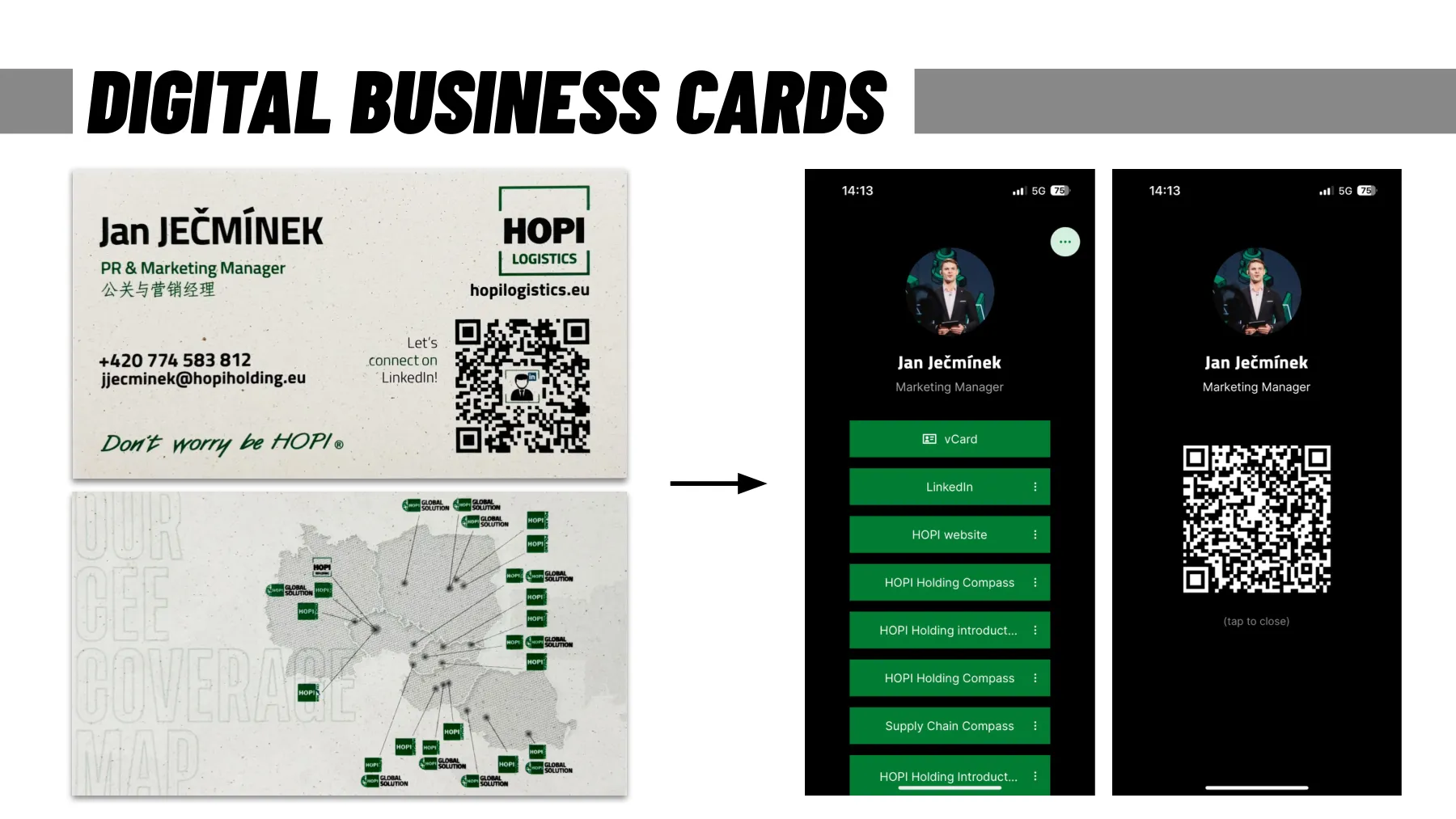
Digital business cards: Linktree or bio.link put all your links on one page; Blinq or Popl send your contact (vCard) straight over QR or NFC. Smarter is your own domain redirected to a service (say yourname.cz → bio.link/yourname): the address is yours, and you can swap the service without reprinting. Smartest is your own website.
A landing page is a page with one goal and no distractions: no navigation, one message, one form. That’s why it converts better than a regular website, is easy to measure, and works well as a destination for PPC and social media. Across 41,000 pages, 464 million unique visitors, and 57 million conversions, Unbounce measured a median conversion rate of 6.6% across industries; from email traffic it was 19.3%, the highest of all sources (Conversion Benchmark Report). Unbounce itself adds that 6.6% isn’t a target, just a baseline.
A/B test: two versions that differ in a single thing, and enough visits that the difference isn’t chance; a hundred tells you nothing, a thousand does. Carrd has ready-made templates in the Landing category; it costs $19 a year, and a Tally form costs nothing. You can put together a design for a club event in an hour.
- -One goal, one form, one button; the navigation goes.
- -Headline = promise + who it’s for + when: “Summer judo camp for kids aged 9 to 15, August 15–21, 2027, Kácov.”
- -Proof: photos from last year’s edition, numbers (edition, number of kids), one quote from a parent.
- -A form with up to five fields; payment right away, or a QR payment and confirmation by email.
- -Measurement: an Umami event on submit, UTM in every link, a QR code with its own parameter.
- 6.6%
- median landing page conversion rate across industries (41,000+ pages)
- 1994
- the QR code is born at Denso Wave; capacity up to 7,000 digits
- 19.3%
- landing page conversion rate from email traffic, the highest of all sources
Unbounce, Conversion Benchmark Report 2024
Denso Wave, qrcode.com
Unbounce, Conversion Benchmark Report 2024
For discussion
Design a landing page for your club’s event: what is the single goal, what is the one metric, and what will the headline be? What from a regular website has to go?
Rabbit holes
- QRCode Monkey ↗ · A QR code with a logo and colors for free, with SVG export.
- Unbounce: Conversion Benchmark Report ↗ · Landing page conversion rates by industry and traffic source.
- Carrd: templates ↗ · Ready-made templates in the Landing, Profile, and Form categories; a landing page without code in an hour.
- Denso Wave: history of the QR code ↗ · How the QR code came about and why its maker let everyone use it freely.
For the exam
Terms
- -Owned and rented channels: you control your website, domain, and email list, while the platform controls your social media profiles, so all traffic should lead to your website.
- -DNS: the system that translates a domain into the server’s IP address; the MX record says where mail goes, and TXT carries verification.
- -Lowest price in 30 days: with a discount, an online store must state the lowest price at which it offered and sold the product in the previous 30 days, and the discount is calculated from it; in force in Czechia since January 6, 2023, and enforced by ČOI.
- -API and webhook: an API is an agreed way for two programs to exchange data, and a webhook is the opposite direction, when the service calls you.
- -GEO: generative engine optimization, meaning being the source that AI cites, thanks to clear facts, numbers, and structured data.
- -Landing page: a page with one goal and no navigation, with one message and one form.
Numbers
- -15.1%: Seznam’s share of search in Czechia; Google has 78.7% (StatCounter, September 2026)
- -8% vs. 15%: share of visits with a click on a result, with and without an AI summary (Pew Research)
- -6.6%: median landing page conversion rate across industries (Unbounce)
The final exam is online in the last lesson, in English: 30 questions with three options each from the whole course, and you need 80% to pass. It asks about the terms in the For the exam boxes and how to apply them, much like the quizzes at the end of each lesson.
Final quiz
1A club has 8,000 followers on Instagram but no website and no email list. What should it do first?
- a)Pay for promotion so that all its followers see the posts
- b)Build a website on its own domain and send people there
- c)Start a TikTok account too, so it doesn’t rely on one network
answer
b) Build a website on its own domain and send people thereSocial networks are rented land where the platform sets the reach and the rules, and the only channel the club fully controls is its own website, where all traffic should lead (section 3).2A track and field club wants a website with contacts, a training schedule that changes twice a season, and one sign-up form. A volunteer from the board will maintain it. What do you recommend?
- a)WordPress, because it runs 40% of all websites
- b)A Next.js app with a database and member logins
- c)A builder or a static site with one form
answer
c) A builder or a static site with one formThe content doesn’t change more than once a week and nobody logs in, so a static site or a builder that a non-developer can handle is enough (section 4).3A club’s website and emails have stopped working. Years ago, an agency registered the domain in its own name, and nobody renewed it. What would have prevented this?
- a)The domain in the club’s name, with automatic renewal
- b)Moving the site from shared hosting to its own VPS
- c)Adding SPF, DKIM, and DMARC records to the DNS settings
answer
a) The domain in the club’s name, with automatic renewalThe domain holder is whoever is listed in the registry, and anyone can buy an expired domain, so it belongs in the organization’s name, with automatic renewal and access stored in a password manager (section 5).4A club’s website measures traffic in GA4, and its cookie consent banner is set up as the law requires. Why does GA4 show fewer visits than the club expected?
- a)GA4 counts only visits from computers and skips phones
- b)GA4 doesn’t see people who didn’t click “I agree”
- c)GA4 only sees people who arrived from a Google search
answer
b) GA4 doesn’t see people who didn’t click “I agree”In Czechia, an opt-in regime for cookies has applied since January 1, 2022, so GA4 doesn’t see anyone who doesn’t click “I agree” on the banner, while cookieless analytics like Umami see every visit (section 8).5A club’s newsletter went to 1,500 people; 650 opened it and 30 clicked the link. What is the click rate, and how does it compare with the average from the lesson?
- a)4.6%, about twice the average
- b)43%, about the average
- c)2%, about the average
answer
c) 2%, about the averageThe click rate is calculated from all recipients, and 30 out of 1,500 is 2%, in line with MailerLite’s average of 2.09%; 4.6% is the click-to-open rate and 43% is the open rate (section 11).
For next time
Student presentation at the start of lesson 07 Social Media
Pick one post by an athlete or a sports brand with a big reach and explain why you think it spread.
5 minutes, one student or a pair, three slides at most or a phone on the projector
Sources worth clicking
- 1DataReportal: Digital 2025 Global Overview Report ↗ · Hundreds of slides on the internet, mobile, and social media worldwide; free, with methodology. This is where most of the numbers people quote come from.
- 2ITU: Facts and Figures 2025 ↗ · The UN’s official estimate: 6 billion people online, who remains offline, and why.
- 3ČSÚ: ICT v domácnostech a uživatelé ICT ↗ · Czech numbers on connectivity, shopping, and phones by age; new every November (in Czech).
- 4W3Techs: Usage statistics of content management systems ↗ · The daily updated share of WordPress, Shopify, Wix, and others across all websites.
- 5StatCounter: Search engine market share, Czech Republic ↗ · Google vs. Seznam vs. Bing in Czechia by month and platform.
- 6Pew Research: Google users are less likely to click on links when an AI summary appears ↗ · The first big data on what AI summaries do to clicks: 8% vs. 15% of visits.
- 7web.dev: Web Vitals ↗ · Google explains LCP, INP, and CLS and their thresholds; the foundation of technical SEO.
- 8Google: Email sender guidelines ↗ · What anyone sending bulk email to Gmail must meet: SPF, DKIM, DMARC, unsubscribe, spam below 0.3%.
- 9Let's Encrypt: 10 years ↗ · How a nonprofit certificate authority made HTTPS free and a given; 10 million certificates a day.
- 10MediaGuru: Obrat e-commerce dosáhl loni 206 miliard korun ↗ · APEK and Heureka data for 2025: revenue, growth, average order (in Czech).
Rabbit holes
- Lupa.cz: Před čtvrt stoletím se náš stát připojil k Internetu ↗ · Jiří Peterka in detail on November 1991 and February 1992 (in Czech).
- info.cern.ch: the world’s first website ↗ · The restored first web page in the world; explore it in the line-mode browser simulator too.
- Wayback Machine ↗ · Enter your club’s address and see what its website looked like ten years ago.
- How DNS Works ↗ · A comic that shows step by step what happens between typing an address and the server’s response.
- Maciej Cegłowski: The Website Obesity Crisis ↗ · A funny talk on why websites keep getting fatter and why a slow website is expensive.
- Dan McKinley: Choose Boring Technology ↗ · Why proven boredom (SQLite, static pages, one server) beats trendy tools.
- Seznam: optimizing for search ↗ · How Czechia’s second search engine sees your website; Seznam’s help for website creators (in Czech).